Celebrating the Music of John Williams
John Williams, the “Maestro of the Movies,” has shaped the sound of modern cinema.
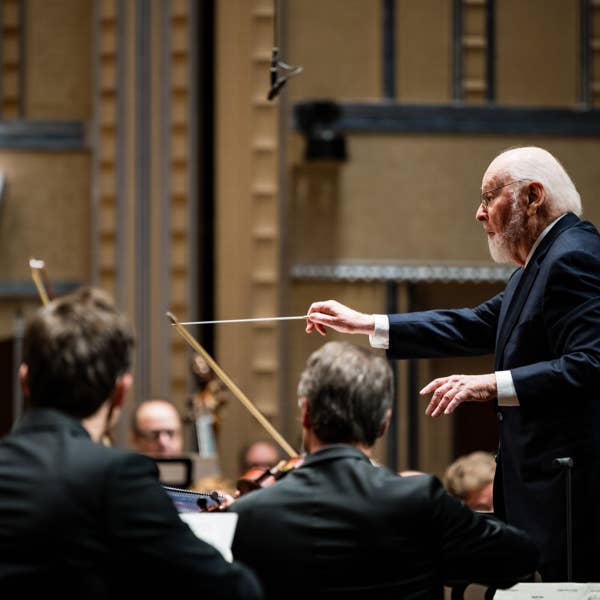
John Williams is the most influential composer alive.
A substantial claim, no doubt — but consider the facts: Williams has written the musical themes for some of the most iconic and memorable creations ever. If he had only written the music for the Star Wars universe, it would have been enough to enshrine him in the soundtrack heavens. But he has written scores in almost every genre of film imaginable, not to mention music for concert halls, television series, news programs, sports broadcasts, and the Olympics. His music emanates from amusement parks and children’s toys, appears in pop culture parodies (from Spaceballs to Family Guy), and has been incorporated into ceremonies and memorials around the world.
John Towner Williams — born in 1932 — had significant exposure to both music and film from an early age, both in his native Queens, New York, and eventually in Los Angeles, where he, his parents, and his three siblings moved in 1948. His father, Johnny Williams, was drummer for the radio- and record-famous Raymond Scott Quintette, whose songs featured in dozens of Bugs Bunny and other Warner Bros. cartoons in the 1940s. John apprenticed with, among other illustrious teachers, Mario Castelnuovo-Tedesco, the Italian émigré composer who, besides working in film music himself, was the teacher and mentor for a generation of film composers including Scott Bradley, Henry Mancini, and André Previn (one of Williams’s close friends).
Williams has been writing for film and television since 1954 — yes, since he was 22 years old. The major turning point in Williams’s career, however, occurred in the 1970s: within four years he scored Jaws (1975), Star Wars and Close Encounters of Third Kind (both 1977), and Superman (1978), four scores that still shape the way we hear and understand film music today.
Let’s start with Jaws: Can you think of another score where two notes tell us what’s going to happen? Besides launching the great shark panic of 1975, Jaws became Steven Spielberg’s first hit film, Spielberg and Williams’s first hit collaboration (they’d already worked on The Sugarland Express together), and is considered the first modern summer blockbuster. Williams’s ability to boil down the suspense, the impending danger, the mystery of the great unseen to just two notes remains one of the greatest compositional feats of modern times. Even people who have never seen the film, let alone seen a shark, know that those two notes — deep, uneven, and menacing — signify terror and potential peril.
Before the 1970s, the idea of a story stretching out over multiple films — let alone multiple generations — largely existed in lower-budget “B” movies or in serials (shorter films that told an endlessly unfolding story) like Buck Rogers, The Lone Ranger, or Flash Gordon; James Bond may be the biggest exception. As of this writing, however, the ongoing story of the many inhabitants of “a galaxy far, far away” has continued into its sixth decade, with no end in sight.
But we’re not only talking about Star Wars, of course: Williams would also write enduring themes for Superman, Indiana Jones, the dinosaurs of Jurassic Park, and Harry Potter. The key word here is “enduring”: all of the main themes, as well as many of the character themes, that Williams devised for these films live on in their sequels, even when other composers scored them. One example: Williams wrote the music for the first three Harry Potter films, but his melodies — particularly “Hedwig’s Theme” — continue to appear, even in the prequel Fantastic Beasts films.
While Williams has defined the musicscapes for many of our favorite film franchises, he has spent far more time writing scores for one-off stories which shape the emotional tenor of the film, help us get to know the characters, and remind us when to cheer and when to cry. He has scored tales of heroes and adventures, comedies and tragedies, epics and biographies. These include films like Hook (1991), an imaginative take on J.M. Barrie’s Peter Pan universe, and Far and Away (1992), an expansive tale about Irish immigrants and the Oklahoma Land Run of 1893.
Perhaps it’s the occasion of his 90th birthday in 2022, or the upcoming 50th anniversary of his score for the first Star Wars film next year, but there has been a recent outpouring of interest in Williams’s work. These include musicologist Frank Lehman’s online database documenting all the musical themes in Williams’s Star Wars scores, the 2024 documentary Music by John Williams, and the first major, authorized biography of the composer, written by journalist Tim Greiving and published in 2025.
Anniversaries aside, Williams’s legacy both inside and outside Hollywood speaks for itself. In addition to his now 30 collaborations with Spielberg, he has worked with dozens of directors including George Lucas, Ron Howard, Clint Eastwood, John Singleton, Chris Columbus, Brian de Palma, Alfred Hitchcock, and even scored Frank Sinatra’s sole directorial credit (None but the Brave, 1965). In the process, Willams has been recognized by practically every music, arts, and humanistic society on the planet, with honorary degrees, governmental orders and titles (including an honorary Knighthood from Queen Elizabeth II and a Chevalier of Arts and Letters from France). He has also been a mentor — official or otherwise — to the countless composers and musicians inhabiting the soundtrack world he has crafted for the past seven decades.
But his influence extends far beyond the industry. John Williams’s music has gone beyond being simply popular: his pervasive and perennial melodies have traversed the globe for generations and will continue to shape our musical world far into the future.
— Daniel Goldmark
Daniel Goldmark is professor of music and director of the Center for Popular Music Studies at Case Western Reserve University. He is an author and editor of books on animation, film, and music, including The Grove Music Guide to American Film Music.