Leonora: “I have Courage and Strength”
Beethoven’s Leonore Overture No. 3 (1806) to Fidelio
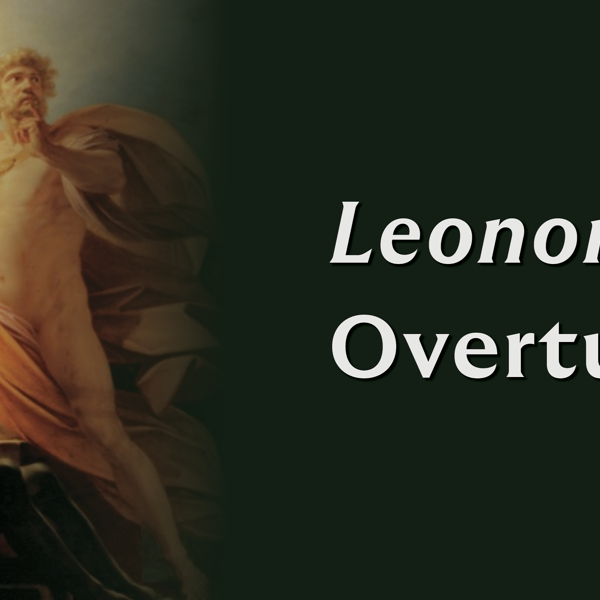
Fidelio (1805), Beethoven’s only opera, is a celebration of freedom. In the opera, Florestan has been imprisoned by the tyrant Don Pizarro. His wife, Leonora, embarks on a dangerous journey to free him: She disguises herself as a man named Fidelio and becomes employed at the political prison where Florestan is held. Eventually gaining access to his cell, she reveals her identity and prevents his execution by Don Pizarro. At the height of the action, the righteous government minister Don Fernando arrives, imprisons Don Pizarro, and declares Florestan and the other political prisoners pardoned. The opera ends with a choral celebration of Leonora’s devotion and heroism.

Leonore Overture No. 3 was Beethoven’s second of four attempts to write an overture to Fidelio (the unusual numbering and changes in name is a story in itself, and is explained in the footnotes). 1 Not unexpectedly, the opera gave Beethoven much difficulty, and underwent several revisions. Although most successful in its final form as Fidelio, the opera has had a complicated reception history. As historian Paul Robinson describes in his detailed study of the opera, most of the criticism of the opera, since its premiere, has focused on the opera’s “inconsistencies of dramatic tone and musical style . . . because the music tells us that it cannot simply be about a wife rescuing her husband.”2 Listen below as Music Director Franz Welser-Möst discusses a different way of interpreting Fidelio and Leonore No. 3 as more an idea than an opera, that helps in understanding the opera’s and the overture’s connection to promethean ideas of freedom.
Music Director Franz Welser-Möst discusses the role of freedom in Fidelio, Beethoven’s only opera, and one of its overtures, Leonore Overture No. 3.

Viewing Fidelio as freedom put into music is a paradigm shift that helps smooth over the rough dramaturgical edges. Indeed, as Robinson has argued, “At the ideological centre of Fidelio stands the abstract idea of Freedom.”3 In this way, Fidelio is the operatic precursor to the plotless synthesis of words, music, and philosophy in the “Ode to Joy” of Beethoven’s Ninth Symphony. The freedom that Fidelio and Leonore No. 3 express is both personal and communal, deeply connected to promethean ideals through its use of darkness-to-light imagery and celebration of the power of individuals to raise others.
As Franz Welser-Möst described, the opening of Leonore No. 3 depicts the imprisoned Florestan trapped in utter darkness and dreaming of freedom. Florestan and his fellow prisoners are symbolic of mankind before the gift of fire. Additionally, as John Clubbe argues, Florestan also resembles the punished Prometheus: chained, restrained, and “cut off from man and God.”4

Following this dream-like opening is joyous and heroic music depicting Leonora’s rescue mission. She undertakes a perilous journey to defy the powerful Don Pizarro and rescue her husband Florestan, and, like Prometheus, she symbolically lifts him from darkness into the light. Similarly, she derives her self-proclaimed “courage and strength” from the love she holds for Florestan (like that of Prometheus for humanity).
Finally, there is Don Fernando, the government minister. As a deus ex machina, his eleventh-hour intercession frees the other prisoners and banishes darkness from the prison. His “generous gesture” of granting Leonora the key to free Florestan is heavily symbolic of Prometheus as well.5 Don Fernando’s arrival at the end of the opera is marked by a far-off trumpet call; in Leonore No.3, Beethoven uses this same trumpet call to silence conflicted music reminiscent of the final confrontation between Don Pizarro and Leonora.

Leonore No. 3 celebrates the power of individuals to free themselves and others, and through its stirring music, inspires listeners to feel similarly: that they, too, whether in ways big or small, fight for freedom.
1To summarize the complex and often confusing history of the opera and overture, Fidelio was originally titled Leonore, or The Triumph of Married Love for its 1805 premiere, later simplified to Leonore; the premiere overture is Leonore Overture No. 2, whereas No. 3, the subject of this essay, was written for the 1806 revised production. In1808, Beethoven revised the Overture (No. 1) for a performance in Prague, that fell through. Finally, in 1814, Beethoven revised the opera a final time, renaming it as Fidelio, and writing a brand new overture (Overture to Fidelio), Lewis Lockwood, Beethoven: The Music and the Life (New York: W. W. Norton, 2005), 261. The reason for the confusing numbering appears to be that early biographies of Beethoven by Anton Schindler and Alexander Thayer mistakenly thought that Leonore No. 1 was the overture for the premiere.
2Paul Robinson, Ludwig Van Beethoven: Fidelio (New York: Cambridge University Press, 1996), 69; the difficulty in staging the opera is exemplified by the telling title to a review by The Spectator of the 2017 Longborough Festival Opera production: “That this Fidelio is merely frustrating counts as something of a success” (Richard Bratby, The Spectator, July 1, 2017).
3Robinson, Fidelio, 75.
4John Clubbe, “Beethoven, Byron, Napoleon, and the Ideals of the French Revolution,” In The Leslie A. Marchand Memorial Lectures, 2000-2015: A Legacy in Byron Studies, edited by Katherine Kernberger (Newark: University of Delaware Press, 2017), 112.
5Clubbe, “Beethoven, Byron, Napoleon, and the Ideals of the French Revolution,” 112-113.
— Dr. Alexis Lawler worked in The Cleveland Orchestra Archives and completed The Prometheus Project while a Historical Musicology PhD student at Case Western Reserve University.