The First Steps of a Symphonic Revolutionary
Beethoven's Symphony No. 1 in C Major (1800)
“There is something revolutionary in that music!”1
— Emperor Francis II on Beethoven’s music, c. late 1790s or early 1800s
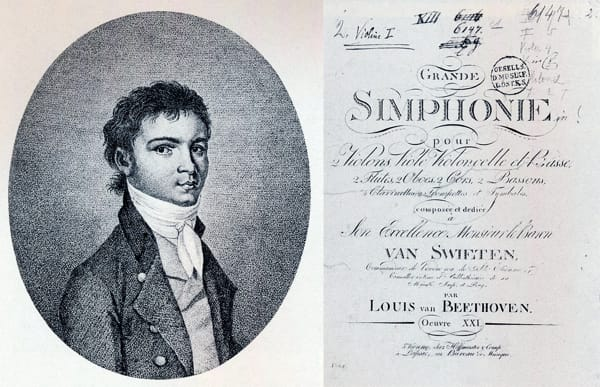
This alleged remark by the reactionary Francis II on Beethoven’s music seems strange, coming as it does before Beethoven’s “Heroic Period” of the Third Symphony and thereafter. In the mainstream history of Beethoven, his early works are more classical in style, hewing close to Mozart and (especially) Haydn. A work such as his first symphony, his first venture into writing sonata form with a full symphony displays caution and a more conservative mode. This is, in part, due to our ears knowing Beethoven’s later symphonies. As scholar Donald Tovey describes, “The caution which seems so obvious to us was not noticed by his contemporary critics.”2 Indeed, contemporary critics highlighted virtually every one of Beethoven’s deviations from classical norms – from beginning his symphony in the wrong key to his overuse of the wind section, which can be heard in the first audio excerpt. What these criticisms clued into was that in his First Symphony, Beethoven was already transgressing his era’s conventional symphonic rhetoric. These transgressions, while only the beginning for Beethoven, sought a new manner of expression and represent an introduction to the idea of Beethoven as a promethean figure. This symphony is a harbinger of who Beethoven was and where he intended to go with his music.

The third movement of Beethoven’s First Symphony offers one example of his incipient drive to push beyond the boundaries of convention. In the classical symphony before Beethoven, the third movement was often a minuet and trio. The minuet was a courtly, stately dance generally in a slower tempo with a typical triple meter. In the middle of the movement was the trio, a lighter and often airier section featuring a change in key and instrumentation. Haydn’s symphonies had minuets, Mozart’s symphonies had minuets, and none of Beethoven’s had them – save the first, but in name only. Beethoven’s minuet is fast — far too fast to dance a minuet to. The stately unfolding of a triple is replaced by a frenetic rush and the usual pattern of a strong first beat followed by two weaker ones is overcome by what feels like a torrent of only strong beats. The music’s mood is mercurial, with quicksilver changes in dynamics and texture.
The contrasting trio section’s attempt at a pastoral tone ultimately fails to subdue the movement’s immense forward momentum, and its gentle, repeated chords build to a triumphant finish. This movement is not a minuet, but something else altogether – a proto-scherzo. The term “scherzo” (Italian for “joke”) denoted a light-hearted piece of music with a quick tempo in triple meter. Although the scherzo predates Beethoven, it was Beethoven who seized the potential of including such a form in the symphony. Adaptable for comedy or terror, Beethoven’s scherzo would become integral parts of his later symphonies and would define the genre for the rest of the century.


However, it is the symphony’s fourth and final movement that most strongly foreshadows Beethoven’s later symphonies. Beethoven biographer Jan Swafford suggests that the fourth movement, which Beethoven composed last, “became the heaviest and most serious” and “pointed in the direction Beethoven was to pursue.”3 Music Director Franz Welser-Möst expands on this idea by highlighting how the movement grows from its unusual opening – a hesitant, slowly building upward scale in the violins. It is this “spark” from which the movement’s first theme emerges and infuses the entire movement.
The Cleveland Orchestra's Centennial Season ends with Music Director Franz Welser-Möst’s “Prometheus Project,” a special presentation of all nine of Beethoven's symphonies, examined through the metaphor of Prometheus, the daring Greek Titan.

3Jan Swafford, Beethoven: Anguish and Triumph: A Biography (New York: Houghton Mifflin Harcourt, 2014), 138.
2 Donald Francis Tovey, Symphonies and Other Orchestral Works: Selections from Essays in Musical Analysis (London: Oxford University Press, 1981), 36.
3Swafford, Beethoven: Anguish and Triumph, 244.
— Dr. Alexis Lawler worked in The Cleveland Orchestra Archives and completed The Prometheus Project while a Historical Musicology PhD student at Case Western Reserve University.