A Handful of Harpists at The Cleveland Orchestra
Only a few harpists have soloed with The Cleveland Orchestra. Here are some special moments from their time in the spotlight.
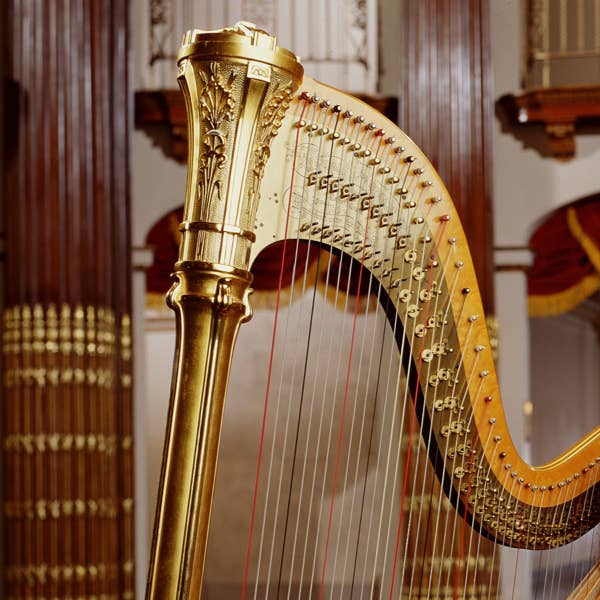
Of all the symphonic instruments, the harp is one of the most alluring. However, hearing the harp take center–stage is a rare experience. Here in Cleveland, only a handful of talented harpists have appeared in the spotlight.
The history of harp soloists at The Cleveland Orchestra begins in the ensemble’s third season. Sepp Morscher, a concert harpist with artistic connections in Munich and New York, briefly joined the Orchestra’s roster from 1920–22. His talents were greatly appreciated by the ensemble which had started to rapidly expand under Music Director Nikolai Sokoloff.
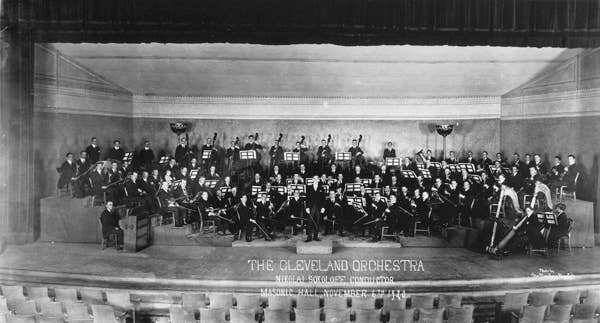
Although Morscher was not yet the Principal Harp at the time of his January 1921 solo appearances (an honor held by Carmella Cafarelli Chiostergi), his performances of Théodore Dubois’s Fantaisie for Harp (1903) took place at two Northeast Ohio concert venues: the newly constructed Masonic Auditorium near downtown Cleveland and the Rialto Theatre in Elyria.
In 1926, Laura Newell-Veissi performed Claude Debussy’s Danses sacrée et profane (1904) on tour in Erie, Troy, and Saratoga Springs. The Orchestra’s next Principal Harp, Florence Wightman, introduced this chamber work for harp and string orchestra to Cleveland three years later.
Influential performer, composer, and pedagogue; Carlos Salzedo was the first guest harpist featured with the Orchestra. For his April 1926 subscription concerts, he played a selection of his own solo transcriptions in addition to the Cleveland premiere of Maurice Ravel’s Introduction and Allegro (1905). Similar to his compatriot Debussy, Ravel also wrote this work for harp and string quartet, further adding flute and clarinet to his chamber instrumentation.
Both Debussy and Ravel’s works for harp struck a resounding chord with the Orchestra’s audiences, and they have been programmed a combined total of 46 times over the past century.
Listen to an excerpt of Ravel’s Introduction and Allegro performed by Alice Chalifoux, harp; Maurice Sharp, flute; and Robert Marcellus, clarinet. Conducted by Louis Lane on November 26, 1968.
Salzedo returned to Cleveland as a guest composer-conductor in March 1929. This time, his wife Lucile Lawrence appeared as the soloist for his composition The Enchanted Isle (1918). Salzedo’s symphonic poem was dedicated to Debussy, who had passed away shortly before its completion.
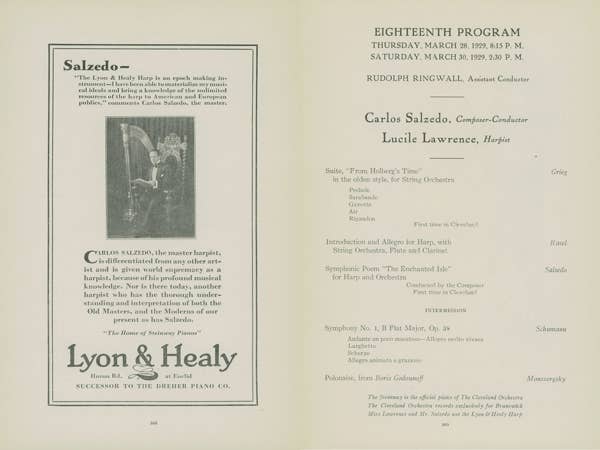
Inspired by the instrumental colors of early–20th century French orchestration, Salzedo wrote The Enchanted Isle for solo harp and a full orchestra. Despite its programmatic title, the composer insisted that it was named “mainly on account of the newness of the orchestral balance, which unveils to the hearer a new world of sounds. In this work, the harp is treated in an unexpected, unaccustomed fashion by taking advantage of the unlimited tone-colors of the instrument.” Some of the “unexpected” sonorities mentioned in Salzedo’s program notes include chromatic pedal slides, plucking close to the soundboard, and playing glissandos with the fingernails. The novelty of his musical language heralded a new era for the modern concert harp, eventually bringing about changes to pedagogy and performance that have flourished into the current age.
Starting in 1931, Alice Chalifoux held The Cleveland Orchestra’s Principal Harp position for an impressive 43–season tenure. A graduate of Salzedo’s harp studio at the Curtis Institute of Music, she was the ensemble’s only full-time female member for many years as well as a featured soloist on over 50 concerts. Initially hired by Sokoloff, Chalifoux’s long performance career coincided with several notable conductors, including Artur Rodziński, Louis Lane, Rudolph Ringwall, Ernest Ansermet, Robert Shaw, and George Szell.
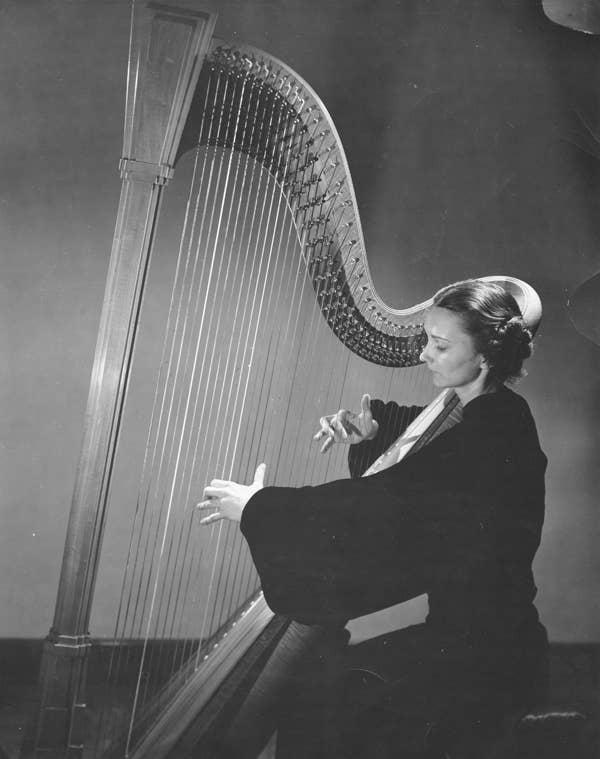
Chalifoux’s first solo appearance occurred on March 19, 1933, when she played Ravel’s Introduction and Allegro for one of Sokoloff’s final Cleveland conducting engagements. Over the years, her concert repertoire featured a steady rotation of the Debussy and Ravel works, which were typically programmed for run-out shows or “lighter” concert formats, such as the Twilight, Promenade, and Summer Pops series.
During her 12th season with the Orchestra, Chalifoux was granted the opportunity to solo on a Severance subscription program. Led by Rodziński, she gave the Cleveland premiere of From Childhood: Suite for Harp and Orchestra (1940) by American composer Harl McDonald. This new work was promoted at Severance, over radio broadcast, and on regional tour. Originally commissioned by Edna Philips (Principal Harp of The Philadelphia Orchestra), From Childhood juxtaposes the grandeur of the symphony orchestra with the tuneful simplicity of English nursery rhymes. The suite alternates between solo harp episodes and nostalgic orchestrations of familiar melodies, including “I Saw Three Ships,” “Lavender’s Blue,” “The Jolly Miller,” and “Three Blind Mice.”
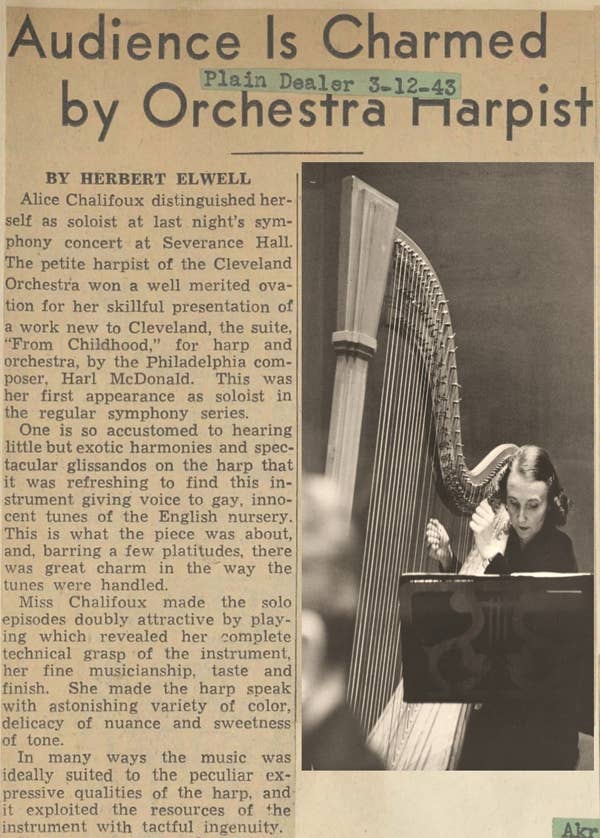
McDonald’s charming, yet unconventional composition positioned the harp squarely under the spotlight. As Herbert Elwell of The Plain Dealer observed, the suite required its harp soloist to play more than just harmonics or glissandos, and the extensive solo passages “revealed her [Chalifoux’s] complete technical grasp of the instrument.”
Chalifoux’s late 1967 performances of Debussy’s Danses sacrée et profane, directed by Principal Guest Conductor Pierre Boulez, were also met with great critical acclaim. The Cleveland Press called the piece “a veritable jewel” and praised the finesse “which exposed and developed all of the score’s subtleties without destroying the fine-grained qualities of the work as a whole.” The artistic nuance of Boulez and Chalifoux’s “no-nonsense” interpretation was ultimately preserved on the Orchestra’s 1969 Grammy Award–winning recording Boulez Conducts Debussy, Vol. 2: The Cleveland Orchestra.
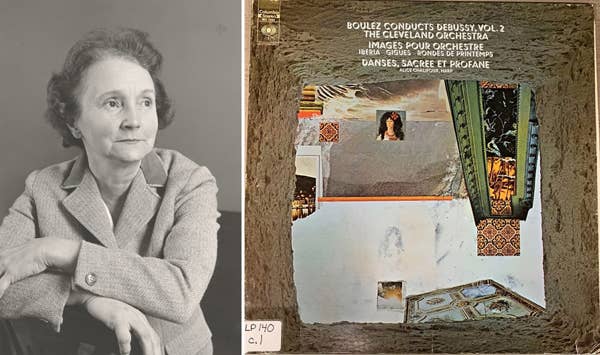
Hear Chalifoux play the cadenza and rousing finale from Debussy’s “Danses sacrée et profane.” Directed by Pierre Boulez on November 9, 1967.
The Orchestra’s March 1973 concerts with American harp virtuoso Heidi Lehwalder marked the Cleveland premiere of Alberto Ginastera’s groundbreaking Harp Concerto (1958), an evocative combination of technical virtuosity and Argentine folk elements. As one of the first harpists to play this concerto, Lehwalder worked tirelessly to promote it in classical venues across the country. Her appearances at Severance contributed to the composition’s rising popularity, and it became one of the most performed harp concertos by the end of the 20th century.
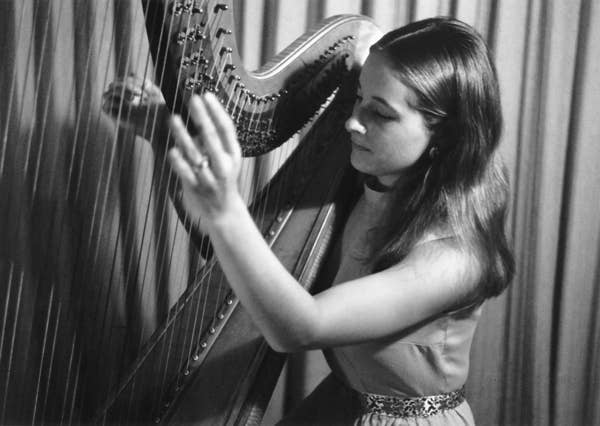
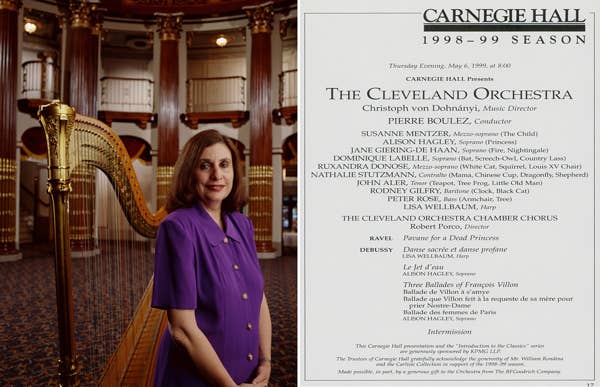
Upon Chalifoux’s retirement in 1974, her former student Lisa Wellbaum became her successor. Wellbaum joined the Orchestra during a period of increased interest in contemporary music , and she was often involved with “Music of Today” performances. In 1985, she appeared alongside Principal Flute Jeffrey Khaner for the US premiere of I sentimenti di Carl Philipp Emanuel Bach (1982), a modern transcription of the Baroque composer’s Fantaisie for harpsichord and violin (1787) arranged by guest composer-conductor Hans Werner Henze. Some of Wellbaum’s other soloistic ventures as Principal Harp included chamber recitals of works by Tōru Takemitsu and George Crumb performed with her Orchestra colleagues.
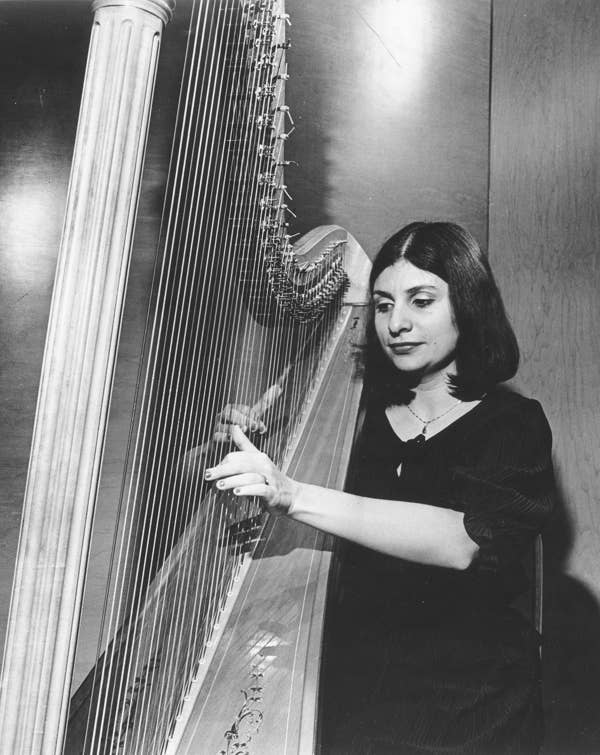
During her 33–year tenure, Wellbaum played Mozart’s delightful Concerto for Flute and Harp (1778) with two of the Orchestra’s principal players: once with Maurice Sharp and later with Joshua Smith. Her performance with the latter was commercially recorded under Music Director Christoph von Dohnányi and released by Decca in 1995. According to The Plain Dealer music critic Donald Rosenberg, both Wellbaum and Smith “gave the work a tasteful, caring reading that did much honor to Mozart’s exquisite inspiration.”
Take a listen to the first movement of Mozart’s Concerto for Flute and Harp, performed by Principal Flute Joshua Smith and Principal Harp Lisa Wellbaum.
Like Chalifoux before her, Wellbaum also partnered with Boulez on Debussy’s Danses sacrée et profane. This perennial favorite was featured on the guest-conductor’s all-French program at Severance and Carnegie Hall during the end of the 1998–99 season.
Harpist and recording artist Yolanda Kondonassis is another Chalifoux protégé and a recurring guest soloist with The Cleveland Orchestra. Following her 1994 Severance debut under former Resident Conductor Jahja Ling, she has since collaborated with other Orchestra members on artistic projects.
During the COVID-19 pandemic, Kondonassis and her husband, Principal Trumpet Michael Sachs, appeared in a special Adella broadcast filmed live at Mandel Concert Hall. Invoking the episode’s theme of “Celestial Serenades,” the duo performed a bespoke trumpet and harp arrangement of Elegy (for those we lost) (2020) by American composer Aaron Jay Kernis. The contemplative music served as a memorial to the recently departed and a tribute to the resilience of live performers.
Enjoy this excerpt from the April 2021 Adella broadcast featuring Principal Trumpet Michael Sachs and Yolanda Kondonassis, harp.
The Cleveland Orchestra’s current Principal Harp, Trina Struble, joined the ensemble as Assistant Principal in 1992 before being promoted to Principal (the Alice Chalifoux Chair) in 2007. As a former Chalifoux pupil, her appointment continued the distinct pedagogical legacy associated with this position.
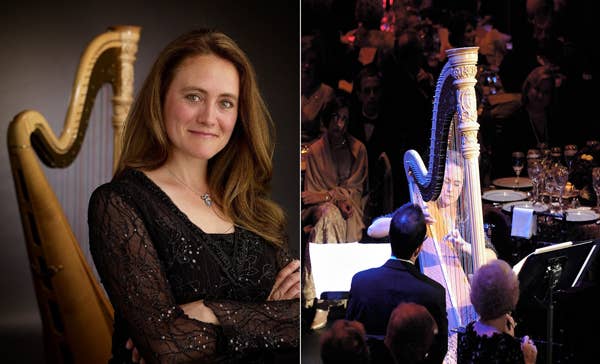
Now completing her 19th season as Principal, Struble’s long-awaited solo debut takes place on May 22, during the 2026 Mandel Opera & Humanities Festival. Under the direction of Music Director Franz Welser-Möst, The Cleveland Orchestra will present the world premiere of the Concerto for Violin, Harp, and Orchestra by Estonian composer Jüri Reinvere. This double concerto will pair Struble’s talents with those of violinist Leila Josefowicz.
Struble recently sat down with Archives Fellow Ina McCormack to share a few words about her upcoming performance:
Thank you so much for sitting down with me today and talking about your upcoming performance with The Cleveland Orchestra. Is this your first solo venture with the ensemble?
Yes, it's my first official solo after 34 years of being with the Orchestra. A few years ago, I was up front with Frank Cohen playing a piece at Blossom, and I’ve played a few cadenzas here and there. I also did the “Stargazers” solo from John Williams’s E.T., but nothing like this where I’m center stage. I’m looking forward to bringing my own energy and interpretation to it and also playing under the baton of Franz Welser-Möst, who is just the best. I’m so honored that he will be conducting this piece!
Could you talk a little bit about your preparation for this newly commissioned work?
It's basically the same way I go about preparing for most things that are new. I’ll start by listening to the MIDI since there’s not a recording yet. Then, I’ll compare my part with the violin’s to understand how everything fits together. I will also add my own markings — fingerings, pedals, and other necessary details — that harpists need to take care of.
Are there any special or unusual harp techniques that people will hear in this concerto?
Not really. There are a few glissandi but I’m not going to be grabbing a metal stick or clanging the wire strings together. Everything’s going to be played with my fingers.
How does playing as a soloist differ from your typical role as Principal Harp?
The harp plays an integral part in the Orchestra. It contributes to the general sound of the group, so when I’m playing, I try to blend with the ensemble. Sometimes it seems like I might be playing a solo because I’m the only harp on stage, but I’m not usually featured like I will be for the concerto.
You come from a special pedagogical lineage in the American harp community. How does it feel to be the next soloist in the hall that your teacher, Alice Chalifoux, once performed in?
It’s truly an honor for me to be sitting in her chair. Alice Chalifoux was an icon in the harp world and a role model. She was an extraordinary teacher, performer, and musician. I began studying with her when I was 11 years old, and her inspiration will be with me forever.
Many people might not know this, but you’re a former Grand Champion fiddler yourself! Does this double concerto have any moments that you’re looking forward to?
I’m definitely looking forward to playing with Leila Josefowicz, who is an extraordinary violinist. I love her interpretation of modern music, and I appreciate everything she will be bringing to this performance. Having played the violin, I understand the challenges she’ll navigate, and I think her artistry will make the piece.
Do you think this concerto blends the harp and violin together, or are you acting as individual instruments?
This concerto is a little bit against the norm, as it’s less about the solo spotlight and more about a musical conversation. Jüri Reinvere wrote this to explore the different sounds and qualities of both instruments, so overall, my role feels more collaborative than purely soloistic. There are a few times when we play off each other rhythmically and enhance each other’s part. The music is focused and expressive rather than overly lyrical — kind of like one giant gesture.
— Ina McCormack is the 2025–26 Archives Research Fellow. The fellowship is an opportunity for PhD music students from Case Western Reserve University to work in The Cleveland Orchestra Archives.