“A Martyr’s Crown”: Beethoven’s Struggles and Triumphs on the Operatic Stage
Fidelio is one of Beethoven’s crowning achievements, but it had a difficult gestation from its premiere to the version we know today.
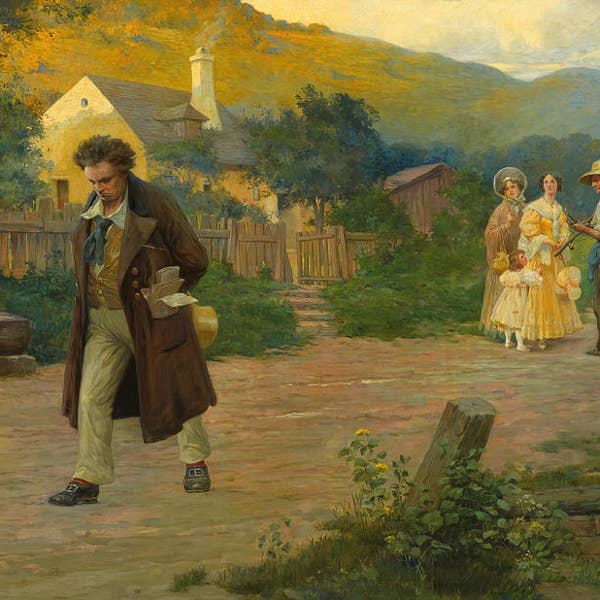
Jean-Nicolas Bouilly’s 1798 comic opera Léonore, ou L’amour conjugal (Leonore, or Marital Love) was conceived — like several other contemporary “rescue” dramas — in reaction to the Reign of Terror that gripped France in 1793–94. According to Bouilly’s 1836 memoirs, the story’s eponymous heroine was based on a real-life acquaintance, one who disguised herself as a male guard to free her husband from a Jacobin prison. Premiering in Paris with music by Pierre Gaveaux, Bouilly’s play went on to inspire three further operas over the next six years: Ferdinando Paer’s Leonora, ossia L’amore coniugale (Dresden, October 1804), Simon Mayr’s L’amor coniugale (Padua, July 1805), and Ludwig van Beethoven’s Fidelio, oder die eheliche Liebe (Vienna, November 1805) — the latter so named by the theater management to avoid confusion with Paer’s Leonora.
Beethoven came to Bouilly’s libretto in a roundabout way. His operatic journey began in early 1803 with an offer from Emanuel Schikaneder, librettist of Mozart’s The Magic Flute and founder of the Theater an der Wien. Schikaneder proposed that Beethoven write an opera for his company in exchange for an apartment in the theater complex and the use of his theater for concerts. This was an attractive deal: it allowed Beethoven to collaborate with a star in the theatrical firmament, provided a pathway into the lucrative world of opera, and enabled him to produce concerts for his own benefit.
Beethoven resided in the theater complex from April 1803 to May 1804. Not until November 1803 did he tackle Schikaneder’s libretto for Vestas Feuer (Vesta’s Fire), a ponderous affair about the Vestal virgins in Ancient Rome. Soon after composing the first scene, he soured on the project, writing to Johann Friedrich Rochlitz in January 1804: “I allowed myself to be deceived, because I was hoping that, given [Schikaneder’s] well-known ability to create stage effects, he would produce something more intelligent than usual. How wrong I was!” Beethoven further explained monarchical rule, hierarchical class structure, and the honor of the Habsburg dynasty.” One significant revision involved minimizing the state’s role in Florestan’s persecution. Rather than the state minister (Don Fernando) taking responsibility for the former’s unjust imprisonment, the blame is placed squarely on the prison’s governor (Don Pizarro), who acts according to a personal — rather than official — vendetta.
It is difficult to know precisely when certain changes were implemented, but the opera was still controversial enough to elicit a ban from the Viennese authorities two weeks before the premiere. In a desperate memorandum to State Councilor Philipp von Stahl, Sonnleithner stressed that the action was set in 16th-century Spain and therefore had no relation to current events, and that Pizarro was acting merely on a private impulse. In addition, the story was not only “moral in the highest degree” but also a favorite of Empress Maria Theresa, on whose name day (October 15) the premiere was scheduled to take place. These arguments — along with further tweaks to the libretto — persuaded the censors. The premiere proceeded a month later, on November 20, 1805.
The timing, unfortunately, could not have been worse. A week earlier, Napoleon had invaded the Austrian capital, parading his army through the streets and taking up residence in Schönbrunn Palace. Emperor Francis II fled the city, along with the rest of the imperial family and most of the nobility. While the five theaters remained open by governmental decree, Beethoven’s aristocratic supporters were gone, and the parterre was filled with foreigners who had little appreciation for German opera. More distressingly for Beethoven, critics found the work cumbersome and dramatically ineffective, citing among other concerns the “very extensive” third act, the overture with its “very long Adagio,” and the “endlessly repeated text.” The opera was a failure, withdrawn after just three performances.
Beethoven spent the winter revising his opera with the help of his friend Stephan von Breuning. The main changes entailed condensing the work from three acts into two and tightening the action. Beethoven also composed a new overture, known as Leonore No. 3. (Leonore No. 1, confusingly, was composed in 1807 for an aborted performance in Prague; Leonore No. 2 refers to the original 1805 overture). The second run of performances, in spring 1806, received a somewhat warmer response, but the financial returns were disappointing. Beethoven, inexperienced with the business of opera, believed the theater management had swindled him; the work was pulled after just two performances. In a June 1806 letter, Breuning confided to his sister and her husband that “probably nothing has caused Beethoven so much grief as this work, whose value will be fully appreciated only in the future.”
Fidelio lay dormant for eight years until 1814, when the success of Beethoven’s battle symphony Wellington’s Victory encouraged the directors of the court-run Kärntnertortheater to suggest reviving the opera. Beethoven now turned to the playwright Georg Friedrich Treitschke for assistance, and the two honed the work into what would become its definitive version.
Preserving Breuning’s two-act structure, Treitschke and Beethoven reversed the opening aria and duet, cut two numbers involving the warden Rocco’s daughter (Marzelline), expanded both act-ending ensembles, and moved the final scene from the subterranean dungeon to an outdoor courtyard, among many other edits. Beethoven also composed a fresh overture — known now as the Fidelio Overture — that, unlike the previous ones, makes no explicit reference to the ensuing drama. (However, Leonore Overture No. 3 is still sometimes played before the penultimate scene of Act II, as in The Cleveland Orchestra’s performances.) The sum of these changes was to sacrifice some of the original work’s characterizations and subtleties in favor of a celebration of universal themes: hope over despair, humanity over evil, light over darkness, feminine virtue, Christ-like resignation, divine providence, and moral courage.
Fidelio was, at long last, a hit, despite Beethoven’s sardonic remark to Treitschke that it would only win him “a martyr’s crown.” Indeed, the stars finally seemed to align, with the reworked opera’s premiere in May 1814 benefiting from the giddy atmosphere of Napoleon’s defeat by the Sixth Coalition. Over the next year, Fidelio was repeatedly performed for the monarchs and diplomats assembled at the Congress of Vienna as they decided how to carve up the European continent. The opera’s message of freedom from tyranny — facilitated, crucially, under the auspices of enlightened absolutism — set the tone for the Congress, commemorating Napoleon’s defeat while offering a vision of post-Napoleonic Europe that was at once ideologically progressive and politically conservative.
— Mark Ferraguto
Mark Ferraguto is a professor of musicology at The Pennsylvania State University. The author of Beethoven 1806, he has published widely on the music, culture, and politics of 18th- and early 19th-century Europe.