“An Adventure of the First Order”: John Adams and The Cleveland Orchestra
Nearly 40 years of collaboration between John Adams and The Cleveland Orchestra has left a notable impact on the ensemble’s musicians, artistic leadership, and audiences.
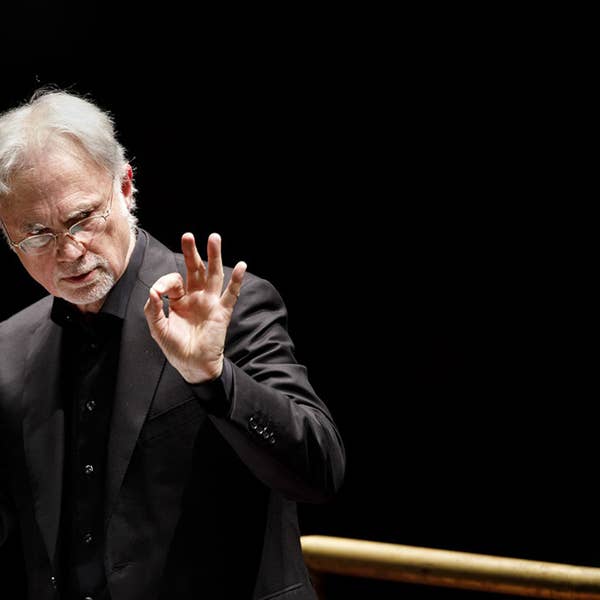
Beginning in 1987, The Cleveland Orchestra embarked on an artistic partnership with John Adams, an American composer and conductor widely renowned for his unique integration of classical and popular music traditions. Over the years, this harmonious collaboration has not only showcased the expansive breadth of Adams’s musical catalog but has also left a notable impact on the Orchestra’s musicians, artistic leadership, and audiences.
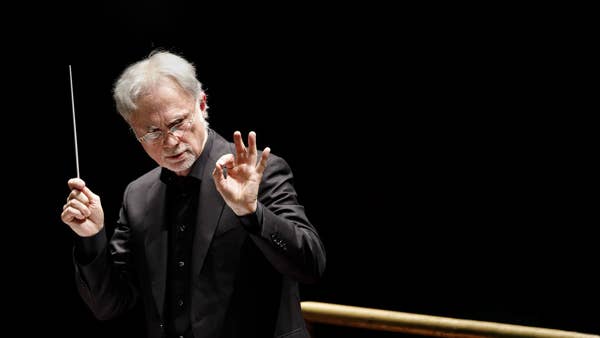
Born in Massachusetts in 1947, Adams was immersed in the rich performance culture of New England from an early age. The aspiring musician learned how to play the clarinet from his father and soon held positions with local marching bands and community orchestras. It was here that the catchy rhythms and potent lyricism of American popular music — jazz, blues, and swing — first became part of Adams’s own musical vocabulary. This East Coast upbringing also exposed him to classical symphonic traditions, a genre to which Adams displayed significant aptitude while still in his teens. He fondly remembers, “I grew up listening to both classical and popular music with little prejudice toward the one at the expense of the other.” Though this impartial music education, Adams has since cultivated a distinct compositional style, one that sounds at once cosmopolitan yet unmistakably American. He subsequently pursued a degree in composition at Harvard University, studying with an esteemed roster of mid-century American composers, including Leon Kirchner, Roger Sessions, and David Del Tredici. Upon graduation, Adams relocated to Northern California, where he quickly became a prominent fixture in American concert culture. (For more biographical information, the composer’s memoir, Hallelujah Junction, is an insightful resource.)
Adams’s partnership with The Cleveland Orchestra began just as the composer was breaking out into the international musical scene. His arrival was heralded with the gentle call of stereophonic trumpets at a 1987 Blossom Music Festival concert conducted by David Zinman. The selected composition, Tromba Lontana (1985), opened the late summer program and introduced Northeast Ohio audiences to Adams’s sonorous, quasi-minimalist style. Over the remainder of the decade, the Orchestra gave repeat performances of Tromba Lontana as well as The Chairman Dances (1985), an orchestral foxtrot inspired by Adams’s groundbreaking opera Nixon in China (1987).
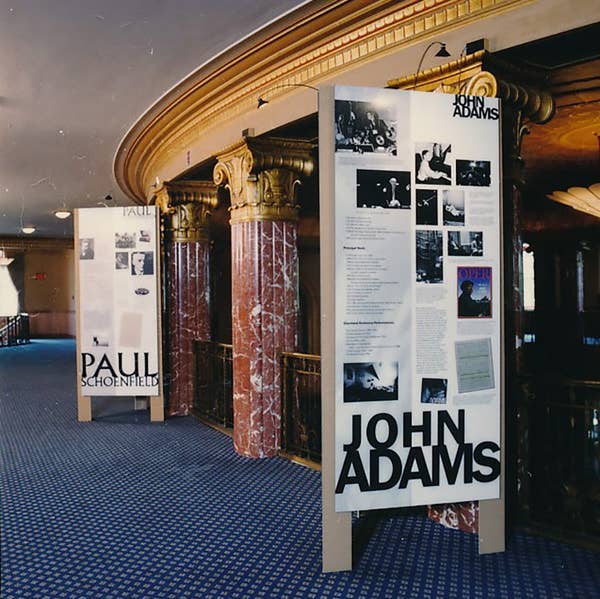
Throughout the late ’80s and ’90s, The Cleveland Orchestra continued to promote Adams’s career, a decision that coincided with a new era launched by the late Christoph von Dohnányi. Appointed as the Orchestra’s sixth Music Director in 1984, Dohnányi wished to maintain the artistic vision of his predecessor, Lorin Maazel, and expose Cleveland audiences to contemporary music. A 1989 article by Robert Finn of The Plain Dealer quotes the conductor: “I don’t blame people who say, ‘I don’t like it.’ But I would blame them if they said it was not good music — then they would have to prove it. We have to offer a certain quantity of new music. If we don’t play it, who will?” In October 1990, Dohnányi put this verbal commitment into practice by programming Adams’s latest composition, The Wound-Dresser (1989).
Based on an excerpt from “Drum-Taps,” an autobiographical set of verses by Walt Whitman, the stirring text of The Wound-Dresser conveys the poet’s experiences tending to wounded soldiers during the American Civil War. Baritone soloist Sanford Sylvan initially premiered the work with the Saint Paul Chamber Orchestra before bringing the piece to Cleveland. In this composition, Adams pairs the expressive baritone with elegiac passages for solo violin and trumpet, creating a tenderly orchestrated rendering of human suffering and sympathy. Under Dohnányi’s leadership, The Cleveland Orchestra performed The Wound Dresser at Severance before taking it on tour to Boston, Montclair, New York City, and Brookville.
Adams’s conducting debut with The Cleveland Orchestra took place on April 25, 1991, during a “Composers of our Time” subscription concert. His repertoire selections simultaneously spoke to his recent establishment as a preeminent American composer and paid homage to his compositional roots. Adams opened the evening with Aaron Copland’s Second Symphony (1933), a meaningful gesture that strengthened his associative ties with the Orchestra.
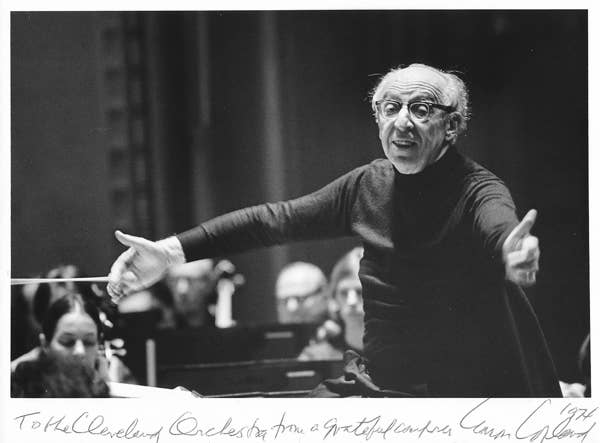
As one of the nation’s foremost cultural figures, Copland’s music has long defined what it means to sound quintessentially “American,” and his influence still looms large on the classical concertgoing experience. Between 1965 and 1974, Copland was invited to guest conduct The Cleveland Orchestra five times, during which he routinely programmed his own compositions alongside other past and present American works. Adams has similarly adopted this agenda in his frequent role as guest composer-conductor, thus continuing the legacy set by his historic predecessor.
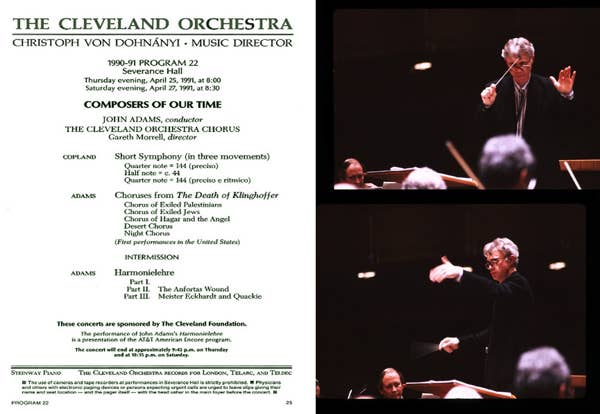
Adams’s innovative debut program also featured two recent works of his own: Harmonielehre (1985) and Choruses from The Death of Klinghoffer (1991). With Harmonielehre, Adams established his signature combination of the chugging rhythms of Minimalism, allusions to popular music, and lush orchestration. The sprawling, three-movement work borrowed structural elements from Modernism and minimalism but presented them in a lush orchestration reminiscent of late-Romanticism. As an American composer trying to navigate a post-Schoenberg world, Adams recalls how “rejecting Schoenberg was like siding with the Philistines, and freeing myself from the model he represented was an act of enormous will power.” Thus, upon completing Harmonielehre, the burgeoning composer firmly cemented his place within American music history.
Listen to The Cleveland Orchestra’s first performance of Harmonielehre conducted by the composer on April 25, 1991.
The Choruses from The Death of Klinghoffer were drawn from Adams’s second (and highly controversial) opera, produced in conjunction with Peter Sellars. Throughout the opera, the chorus functions as an external commentary on the unfolding events, critically aware yet far removed from the action itself. Their voices help contextualize a challenging plot already fraught with centuries of political, social, and spiritual tension. A month after the opera’s world premiere in Brussels, The Cleveland Orchestra and Chorus had the immense privilege of giving the US premiere of this music — under the composer’s own baton, no less. These performances highlighted Adams’s distinctive style and aesthetic heritage, marking the successful inauguration of an artistic partnership that has flourished for nearly four decades.
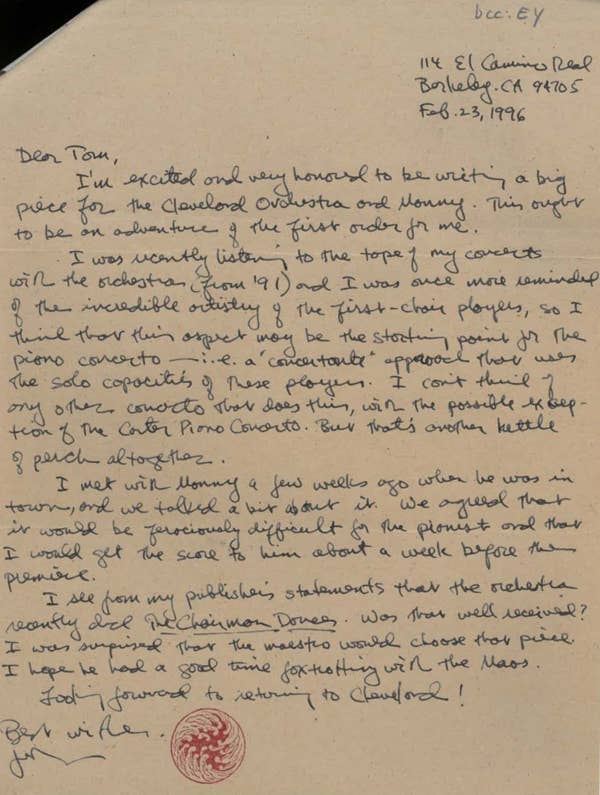
The next milestone for Adams and the Orchestra occurred on September 25, 1997, with the world premiere of Century Rolls (1997). Commissioned by the Orchestra, Adams wrote this piano concerto in collaboration with his close friend Emanuel Ax. In a letter dated February 1996, Adams revealed that he was still in the planning stages of the concerto, but that he and “Manny” had agreed that the piano part must be “ferociously difficult.” The composer further expressed his excitement at the opportunity to write for the musicians of The Cleveland Orchestra, calling the endeavor “an adventure of the first order.”
Enjoy the thrilling climax of Century Rolls with soloist Emanuel Ax in this world premiere recording from 1997.
While laying the groundwork for his concerto, Adams was inspired by the growing tension between artisanal craftsmanship and advancing technology that developed over the course of the 20th century. Program annotator Peter Laki documented a conversation between Adams and musicologist Matthew Daines in which the composer described his creative process:
One night I was listening to some Gershwin piano roll music and then I realized that it was a very different experience from hearing someone play on a regular piano or hearing a recording of someone play a regular piano and so I took that sensation of how music sounds when it’s played through the medium of the piano roll as a kind of sonic image.
Century Rolls bears several hallmarks of Adams’s compositional style, such as his incorporation of American popular music within a classical structure and his penchant for instrumental pyrotechnics. The two outer movements share a driving mechanistic intensity coupled with spontaneous dance music riffs, while the more pensive central movement revels in Ax’s expressive touch. The final product certainly blurs the distinction between human and machine by carefully balancing the technical and lyrical demands placed on its soloist.
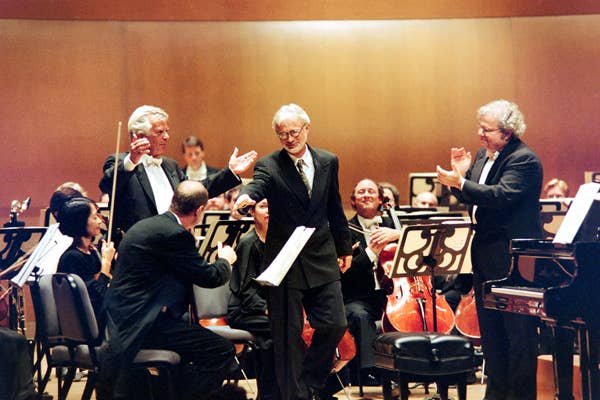
Since its 1997 world premiere, The Cleveland Orchestra has released a commercial recording of Century Rolls with soloist Emanuel Ax and Christoph von Dohnányi conducting. The ensemble has also programmed the concerto on four separate occasions, including on tour at Carnegie Hall, the Vienna Konzerthaus, and Cologne Philharmonie. Its most recent performance featured pianist Conrad Tao at Blossom Music Center in summer 2023.
In addition to the Century Rolls commission, Adams has collaborated with some of the Orchestra’s principal players. Adams has collaborated with some of the Orchestra’s own principal players. His February 1999 visit featured former Principal Clarinet Franklin Cohen in Gnarly Buttons (1996). This piece requires extensive virtuosic passages for Adams’s childhood instrument and serves as an ode to Carl Adams, the composer’s father and first music teacher. Accompanied by an unconventionally scored chamber orchestra (including banjo and two electronic keyboards), the solo clarinet meanders through several recognizable tropes from Protestant hymnody, Western hoedowns, and sentimental songwriting.
After nearly two decades away, Adams returned to Severance in late 2018 as part of the Orchestra’s Centennial celebrations. This time, he was joined on stage by violinist Leila Josefowicz — one of his long-time artistic collaborators — in performances of Scheherazade.2 (2015). This dramatic symphony for violin and orchestra reinterprets the titular legend for 21st-century audiences. Adams has described the motivation behind the work in a humanitarian vein, specifically commemorating the bravery exhibited daily by women around the globe. Regarding his decision to compose such a provocative part for Josefowicz, the composer stated, “I find Leila a perfect embodiment of the kind of empowered strength and energy, which a modern Scheherazade would possess.”
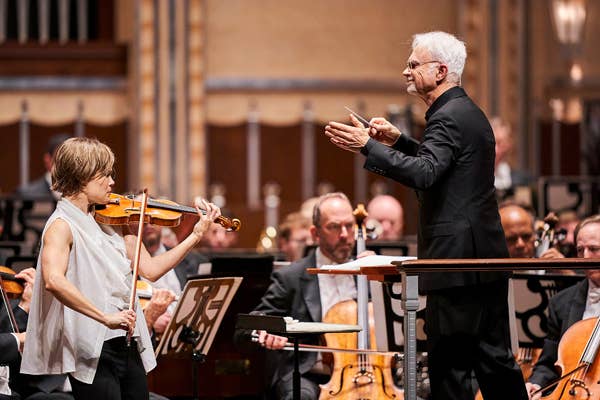
Violinist Leila Josefowicz takes the role of the titular protagonist in this clip from the third movement, titled, “Scheherazade and the Men with Beards.” This performance was conducted by John Adams at Severance on November 30, 2018.
In another juxtaposition of novel and nostalgic American repertoire, this same concert highlighted two Orchestra members, Solo English Horn Robert Walters and Principal Trumpet Michael Sachs, in an expressive rendition of Quiet City (1939), Copland’s nocturnal tribute to an unnamed American town. As the featured guest artist for Adams’s February 2022 concerts with The Cleveland Orchestra, American pianist Jeremy Denk performed the cheekily titled concerto Must the Devil Have All the Good Tunes? (2018). Its dynamic melodic and rhythmic contours are characteristic of Adams’s instrumental writing and explore the American soundscape through effervescent hints of honky-tonk, jazz, swing, gospel, and blues. Across its three consecutive movements, listeners can hear reiterations of Adams’s trademark rhythmic drive, inspired by the relentless pulse of minimalism.
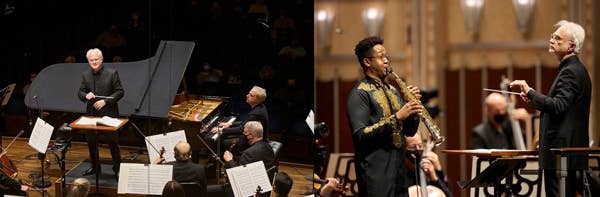
Pianist Jeremy Denk and The Cleveland Orchestra deliver a flashy performance of Must the Devil Have All the Good Tunes? under the composer’s own direction on February 6, 2022.
A performance of Façades from Philip Glass’s Glassworks (1981) further supplemented this concert’s retrospective tribute to one of Adams’s primary stylistic influences. Played by Cleveland-based saxophonist Steven Banks, this minimalist composition exhibits the subtle yet effective manipulation of tonal harmony, rhythmic subdivision, and pulse that consistently resurfaces throughout Must the Devil Have All the Good Tunes?
Adams’s strategic programming at The Cleveland Orchestra effectively champions his personal contributions to American concert music as well as the potential of those making music “from sea to shining sea.” As befitting his celebrated status within the classical music industry, Adams has proven to be a steadfast advocate for the younger generation of American composers. During recent conducting engagements with the Orchestra, he has promoted the works of emerging voices — such as Gabriella Smith and Carlos Simon — whose diverse techniques embody the creative scope of the modern national soundscape.
Among his numerous visits to Severance, Adams has not only conducted The Cleveland Orchestra but has had memorable interactions with its subsidiary ensembles. As preparations for a February 1999 concert were underway, Adams surprised The Cleveland Orchestra Youth Orchestra during their rehearsal of The Chairman Dances. The ensemble was working on his popular foxtrot for their spring concert when the visiting composer walked into their session.
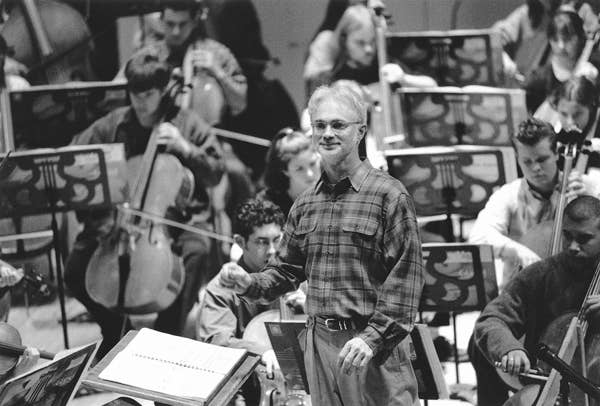
Adams graciously took time to direct the young musicians as they rehearsed, providing them a special opportunity to work alongside a living composer-conductor. Indeed, The Chairman Dances has since become a perennial favorite in Cleveland; to date, it has been programmed a total of 19 times between The Cleveland Orchestra and the Youth Orchestra.
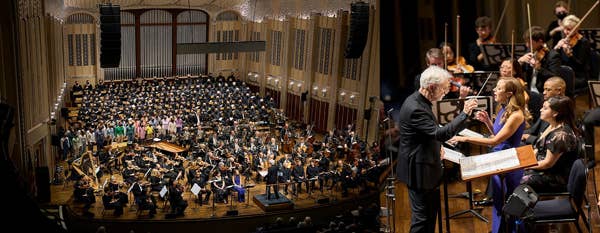
The Cleveland Orchestra Chorus first appeared under Adams’s direction for his 1991 conducting debut, and they eventually reunited three decades later for one of the highlights of the 2022–23 season. Weaving together ancient and modern sources, El Niño (1999) presents an intertextual and multicultural exploration of the Nativity story. Although this work for solo vocalists, choir, and orchestra was composed in 1999, this joint Adams-Sellars production was new to The Cleveland Orchestra’s audiences. Adams directed the combined talents of the Orchestra, The Cleveland Orchestra Chorus, and The Cleveland Orchestra Children’s Chorus in this momentous program. (For those who would like to experience this concert, the production A Postmodern Christmas, featuring El Niño is available to stream on Adella.live, the Orchestra’s digital home.)
Even when Adams is off the podium, he maintains a strong rapport with The Cleveland Orchestra’s leadership and has proven invaluable during joint programming endeavors. As part of the Orchestra’s residency at the 2011 Lincoln Center Festival, the Orchestra participated in the Bruckner (R)evolution series, a concert marathon offering fresh perspectives on the 19th century Austrian composer. For this event, Music Director Franz Welser-Möst paired three Adams compositions — Guide to Strange Places (2001), his Violin Concerto (1993), and Doctor Atomic Symphony (2007) — with four Bruckner symphonies.
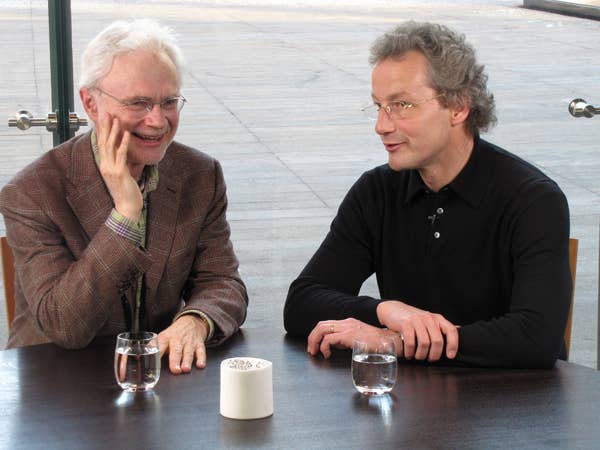
The audacious vision of Bruckner (R)evolution was fueled by a series of conversations between Adams and Welser-Möst. Early in the promotional process, the colleagues sat down together in New York City for an interview where they discussed elements linking the two composers. Despite the generational and geographical distances separating the two, Adams revealed aesthetic similarities to Bruckner, including a shared admiration for large formal structures. He elaborated, “I’ve long been a fan of Bruckner— probably one of the reasons is that I’m very much drawn to large-scale, formal architecture. ... Bruckner, from a very early age, spoke to me.” These insights gave credence to Welser-Möst’s assertion that “Bruckner is in many ways the grandfather of minimalism” and encouraged listeners to approach the concert series with open ears. In this regard, Adams fully endorsed the Orchestra’s programming efforts and even joined Welser-Möst and the Orchestra musicians for bows on the Lincoln Center stage.
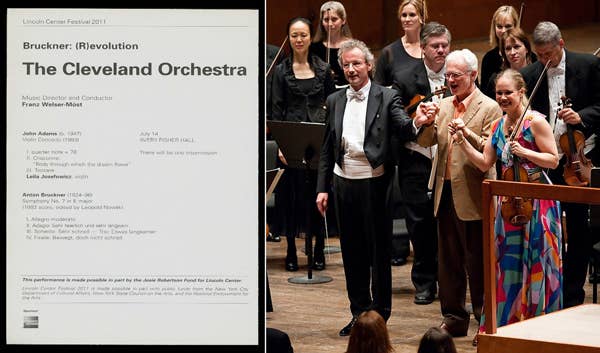
Although positioning European Romanticism as an apparent precursor to American minimalism proved to be a strenuous undertaking, critics responded well to Leila Josefowicz’s performances of Adams’s Violin Concerto and strove to identify traces of Bruckner within the dramatic scoring of Guide to Strange Places and Doctor Atomic Symphony. Zachary Lewis of The Plain Dealer summarily observed: “… one could more readily detect potential influence from Bruckner as the music [Guide to Strange Places] — brought to life in a dynamic performance — alternated between states of violent, rough-hewn agitation and sparkling calmness.” He continued, “The most soulful of Adams’ [sic] three pieces on the series ‘Doctor Atomic’ evinced both the frenetic energy and unsettled calm of Bruckner.”
It is significant to note that the source material of the Doctor Atomic Symphony came from Adams’s award-winning opera Doctor Atomic (2005), which stages a critical moment in the life of J. Robert Oppenheimer, the “father of the atomic bomb.” After the conclusion of Bruckner (R)evolution, the Orchestra presented Adams’s piece of American history before a global public, performing the work on tour in Madrid, Valencia, Paris, Cologne, and Vienna.
As The Cleveland Orchestra continues its 2025–26 season, Adams returns to the podium once again to direct his most recent orchestral work, Frenzy: a short symphony (2023). These February concerts will also spotlight the dance rhythms of Latin America, featuring the composer’s own arrangements of three tangos by Piazzolla. Rounding out the program are a fugue by Charles Ives (From Greenland’s Icy Mountains) and the piano concerto Made of Tunes by Timo Andres, two compositions that share Adams’s love of juxtaposing the old with the new. In light of this artistic partnership approaching 40 years, the Orchestra eagerly awaits the next chapter of this brilliant composer-conductor’s legacy.
— Ina McCormack is the 2025–26 Archives Research Fellow. The fellowship is an opportunity for PhD music students from Case Western Reserve University to work in The Cleveland Orchestra Archives.