Beethoven’s Piano Concertos and the Cleveland Orchestra
Cleveland has a rich and storied history with Beethoven’s piano concertos, and Music Director Franz Welser-Möst has had a notable hand in keeping this vital tradition alive.
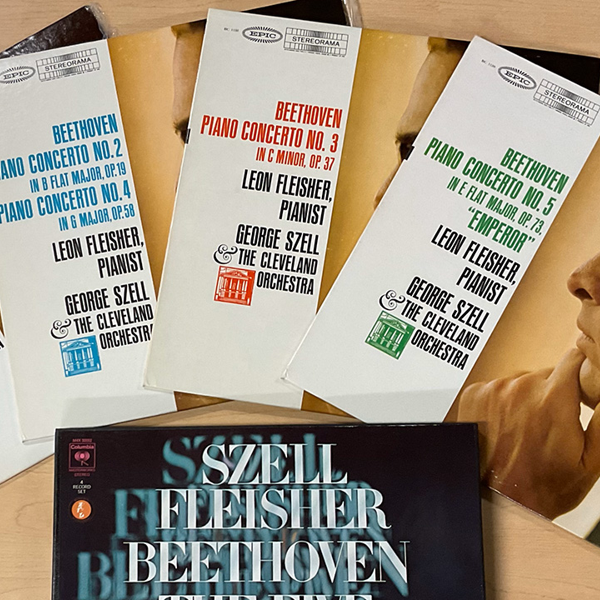
In the early decades of the Orchestra, Beethoven’s Fourth and Fifth piano concertos were programmed about once a season, with a few performances of the Third as well. It was not until the 1940s and ’50s, though, that the First and Second concertos were performed with the Orchestra, but none of the first three music directors programmed all five concertos during their tenure. With George Szell, however, these pieces became firmly ensconced in the Orchestra’s repertoire. Since Szell took the podium in 1946, The Cleveland Orchestra has released three recordings of the five Beethoven piano concertos and performed all five with six pianists. The Triple Concerto was first performed in 1928, but not again until 1951, and it is by far the least programmed of the works in this year’s cycle, perhaps because of the difficulty of coordinating three soloists. In fact, the November 2024 performances will only be the third time that the Triple Concerto has been presented in the context of the other five concertos by the Orchestra, and only the 12th program to feature this piece in the Orchestra’s history.
This post celebrates the performance history of Beethoven’s piano concertos with The Cleveland Orchestra, beginning with a snapshot of the first performances of each piece, remembering the few other times the whole set has been recorded and performed, and highlighting unique and special performances along the way.
The first performance of a Beethoven piano concerto by The Cleveland Orchestra happened over a century ago, in January 1922, with Joseph Hofmann at the piano and Music Director Nikolai Sokoloff on the podium. Hofmann had appeared in Cleveland before, but reception of his performance of Beethoven’s Fifth Piano Concerto was decidedly lukewarm. Wilson G. Smith wrote a disappointed review of the concert, acknowledging that his “own preference is for the C minor and G major concertos,” but ultimately putting the blame with Hofmann’s interpretation: “I could not rid myself of the impression that Hofmann felt some restraint in giving full rein to his interpretive and virtuoso moods.” James H. Rogers, on the other hand, found the fault solely in Beethoven’s writing: “for our own part, we are unable to feel that this E flat concerto is one of Beethoven’s most inspired works … Of one thing the hearers of last night may rest assured. They will never hear it so marvelously played again unless Mr. Hofmann is at the piano.” Yet another publication summed up “the gossip … that centers about Joseph Hofmann, the soloist,” illustrating that the opinion that the concerto selection was “uninteresting” extended beyond the critics and into public opinion. This reviewer concluded that Beethoven’s work was “broad and effective rather than deep or introspective,” but that Hofmann’s delivery was nevertheless “exhilarating in its alert vivacity.”
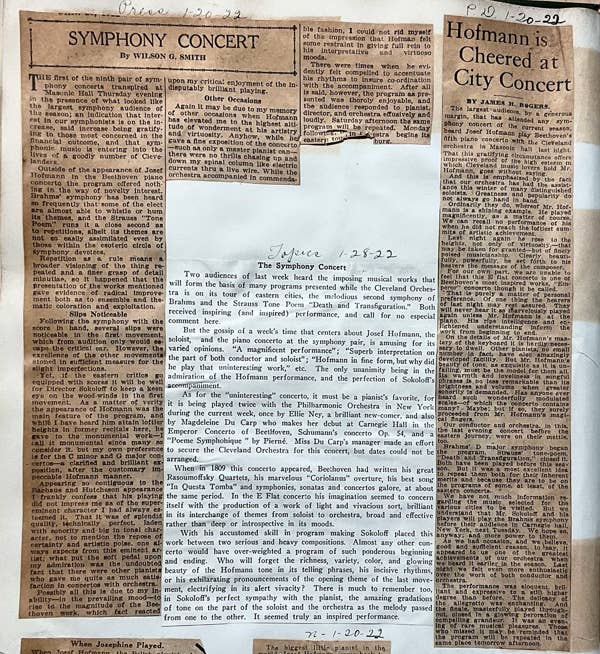
Perhaps the 1922 impressions of this work came down to the programming decision to place it between Johannes Brahms’s Second Symphony and Richard Strauss’s Death and Transfiguration, two rich Romantic works, to which the Orchestra had likely contributed more energy in their preparation for an upcoming East Coast tour. When the Fifth Concerto was next programmed two years later, the quality of the work was not questioned. In February 1924, Ernö (Ernst von) Dohnányi, grandfather of future Music Director Christoph von Dohnányi, performed the concerto on a program otherwise devoted to his own compositions. The reviews from this concert focused equally on Dohnányi’s skill as a soloist in the Beethoven as they did on his contributions as composer and conductor. In the century since the first performance, public opinion seems to have decisively shifted in favor of the “Emperor” Concerto. The Cleveland Orchestra has performed the Fifth Piano Concerto 144 times, second only to their 151 performances of the Fourth Concerto.
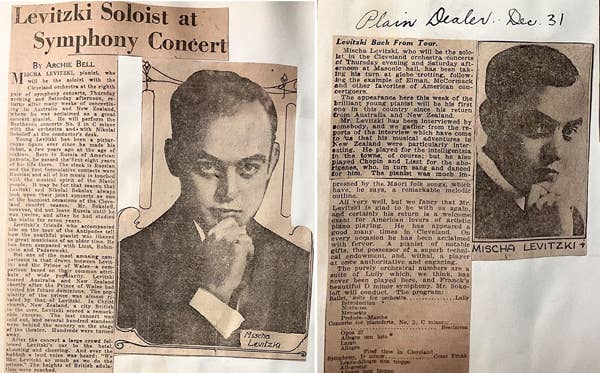
Almost exactly a year after Hofmann’s appearance in 1922, Beethoven’s Third Piano Concerto made its Cleveland Orchestra debut with soloist Mischa Levitzki under the baton of Nikolai Sokoloff at Masonic Hall. Newspaper announcements prominently featured brooding portraits of the handsome 24-year-old soloist. Levitzki was a long-time favorite of Cleveland audiences, but his performances on January 4 and 6, 1923 were significant in that they fell on the heels of a high-profile tour to Australia and New Zealand, where he gained popularity not only as a performer but also as a Prince of Wales look-alike (the future Edward VIII having also just made a Pacific tour). Despite the excitement preceding Levitzki’s return, the Musical Courier reported that attendance was low at the January 4 performance. Despite poor attendance, the music reached a wider audience when the performance was radio broadcast by Union Trust Co. A review praised Levitzki’s playing as displaying his “usual brilliant style, endowed as he is with full command of the keyboard technically and with full inspiration of an artist of first rank. His playing was authoritative and his manner devoid of idiosyncrasies.” No comments were made on the quality of the concerto itself, as in the press response to Hofmann’s performance a year earlier.
Following the tepid reviews of his rendition of the Fifth Concerto, Joseph Hofmann returned to Cleveland in November 1923 for two performances of Beethoven’s Fourth Piano Concerto. Eager concert goers nearly filled Masonic Hall, and reviewers were enamored with Hofmann’s “geniality and joyous exuberance.” These critics unanimously applauded his execution and interpretation alike, but one reviewer could not refrain from noting that “the fourth concerto of Beethoven is not one of the most popular works for this instrument. … In short, as commented by many hearers last evening, it takes a player of Hofmann’s genius to make it the genuinely appealing thing that it becomes beneath his hands.” But there is a difference between popular and familiar, and it may be that this reviewer mistook the former for the latter. Indeed, the week before the concerts, a preview in The Plain Dealer noted that Hofmann’s “coming will be signalized by the first performance here in a good many years, at any rate, of Beethoven’s fourth piano concerto. In fact we cannot remember that it has ever been played here.” The Cleveland Orchestra Archives offer no answers as to other local performances, but this was certainly the first time in the history of the Orchestra that the work was performed. The Fourth Concerto would not remain unfamiliar in Cleveland for long. It became the Beethoven concerto Sokoloff conducted most in his tenure as music director, including two return performances with Hofmann in 1927 and 1929 (on tour in Pittsburgh), and as previously noted, it has received the most performances of any Beethoven concerto by the Orchestra.
The final three Beethoven concertos remained in the Orchestra’s repertoire in the 1920s and 1930s, but it was not until 1941 that they programmed one of the earlier two works. In the meantime, the Triple Concerto for violin, cello, and piano was first programmed in 1928 as an apparent afterthought. British pianist Harold Samuel was in Cleveland primarily to display his chops as a Bach specialist (at a time when Bach was not a common name on concert programs). The Beethoven, then, served as first half filler before the Bach feature. Still, the program book drew attention to the Triple Concerto with an indication that this was its first performance by The Cleveland Orchestra. A review in The Cleveland News noted that this concerto was unique in being a commission, yet it mostly “reveals the customary melancholy of the master; still, there are times when it is lilting and gay in his lighter manner. It received a beautiful reading by the three soloists and the conductor contributed his measure to revealing it as a thing of beauty.” James H. Rogers of The Plain Dealer “all three being accomplished players, the performance was competent, though not without some semblance of perfunctoriness, due, no doubt, to the piece itself, which, taken as a whole, is interesting.” He made sure to laud Principal Cellist Victor de Gomez’s playing, though. Concertmaster Josef Fuchs was the third soloist. After this lackluster performance debut, it would be another two decades before the Triple Concerto was programmed again.
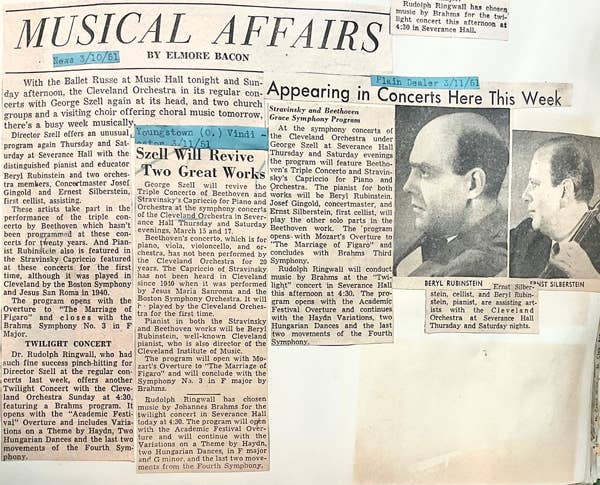
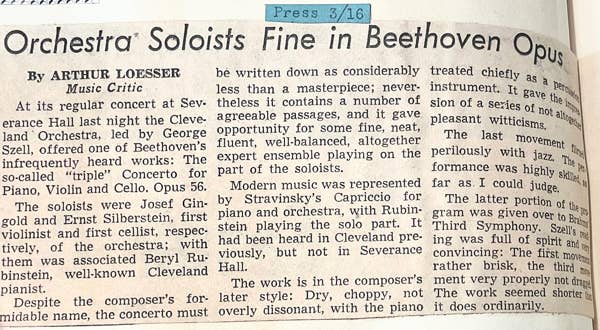
On March 10, 1951, Elmore Bacon of The Cleveland News noted in a concert preview that the Orchestra would be performing “the triple concerto of Beethoven which hasn’t been programmed at these concerts for twenty years.” A Youngstown paper titled their preview “Szell Will Revive Two Great Works,” referring specifically to the Triple Concerto and Stravinsky’s Capriccio for Piano. This much anticipated return of the Triple Concerto to Cleveland’s concert hall was performed by Cleveland-based pianist Beryl Rubinstein, Concertmaster Josef Gingold, and Principal Cellist Ernst Silberstein. In his subsequent review, Bacon said, “we are indebted to Szell for reviving it,” and went on to praise Szell’s “virtuosity in welding orchestra and soloists together,” making sure to note “Concertmaster Gingold’s suavity of tone and wealth of expression” and Silberstein’s “fluency and fine technical prowess,” while saving his praise of Rubinstein for his performance of the Stravinsky. Reminiscent of the 1928 reviews, Herbert Elwell of The Plain Dealer finds the work “less than Beethoven’s best,” but like Bacon he commends the “artful display passages which were rendered with great skill and beauty by all three soloists.” Pianist, scholar, and critic Arthur Loesser wholeheartedly concurred, writing in The Cleveland Press, “the concerto must be written down as considerably less than a masterpiece; nevertheless it contains a number of agreeable passages, and it gave opportunity for some fine, neat, fluent, well-balanced, altogether expert ensemble playing on the part of the soloists.”
Loesser also reviewed the first performance of Beethoven’s First Piano Concerto with The Cleveland Orchestra a decade earlier in 1941. It was not a subscription concert, but one of the special All-Star Concerts offered at Public Auditorium, designed to entice a wider audience with cheaper tickets in a larger space. This performance was especially exciting because the featured soloist was 67-year-old Sergei Rachmaninoff, by then a world-renowned composer and conductor. There was plenty of hype leading up to the concert surrounding this famous guest — the fact that the Beethoven would be a first performance was also touted in many previews — and the reviews after the fact were equally exuberant.
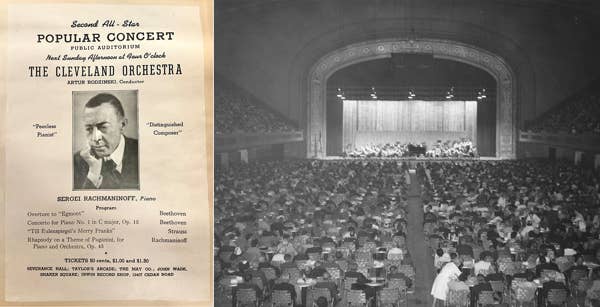
According to newspaper reports, the audience for this single performance on March 2 exceeded 6,000. Reviewers remarked that Rachmaninoff’s playing was sharpened, not muddled by his advanced years, and celebrated his performance of both the Beethoven concerto and his own Rhapsody on a Theme of Paganini. In by-now expected fashion, Arthur Loesser questioned the Beethoven as a repertoire choice in The Cleveland Press, but Rachmaninoff ultimately won him over:
For his first offering Mr. Rachmaninoff played the Beethoven Concerto No. 1 in C major. Offhand, this seemed a peculiar choice, since the work is hardly more than one of the composer’s adolescent efforts, much less a masterpiece. Furthermore, its mildly cheerful babblings would hardly seem compatible with the heavy, romantic melancholy that one imagines to be Rachmaninoff’s most characteristic vein. However, the performance swept away all prejudices. Phrases were contoured with a fine classic feeling of rhythm and line, runs were beautifully chiseled and tapered, shadings were exquisitely sensitive. The pianist seemed to glean 10 times as much from the concerto as there really is in it.
This performance must have left a deep impression on Loesser because the next time the Orchestra programmed Beethoven’s First Concerto — and the first time it appeared on a subscription concert — was with Loesser himself as soloist in 1948. Loesser even returned to perform this piece in 1961 and 1966.
The last of the Beethoven piano concertos to be performed by The Cleveland Orchestra was the Second. On April 1, 1954, pianist Leon Fleisher returned to Cleveland, eight years after his first appearance with the Orchestra, to play the Second Piano Concerto at Severance Hall under the baton of George Szell. This represented not only the first time The Cleveland Orchestra performed this work, but also the first performance in a year’s long collaboration between Fleisher and Szell on Beethoven’s piano works. Leon Fleisher was the first of a select group of only six pianists to play all five concertos with the Orchestra..
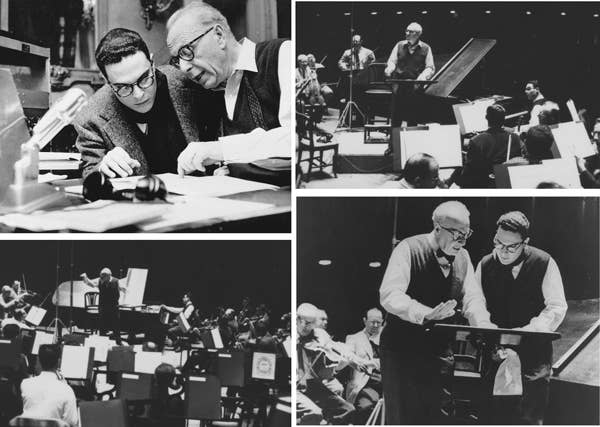
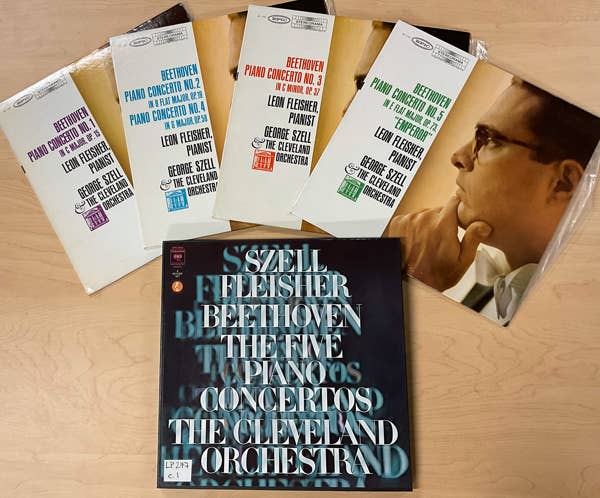
Over the next decade, Fleisher joined Szell and the Orchestra for no fewer than 14 projects involving the Beethoven concertos — including subscription concerts, national and international tours, and, perhaps most notably, a set of recordings of the complete concerto cycle released on the Epic recording label in 1961.
In the 2013–14 season, Leon Fleisher returned to The Cleveland Orchestra as an artist-in-residence, a collaboration acknowledging his long and intimate relationship with the ensemble. He made his Severance conducting debut with a set of three concerts December 5–7, 2013, leading Beethoven’s Second and Third concertos from the podium rather than the piano, with Jonathan Biss as soloist.
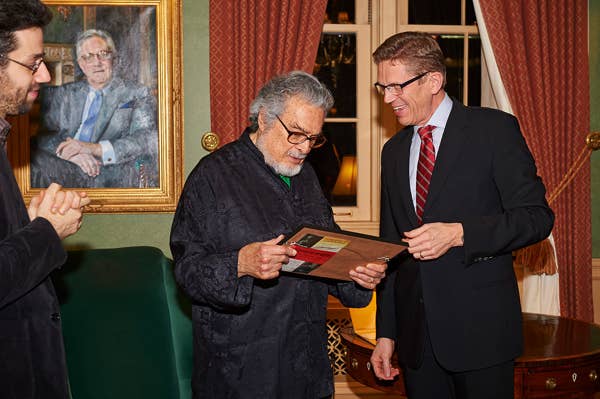
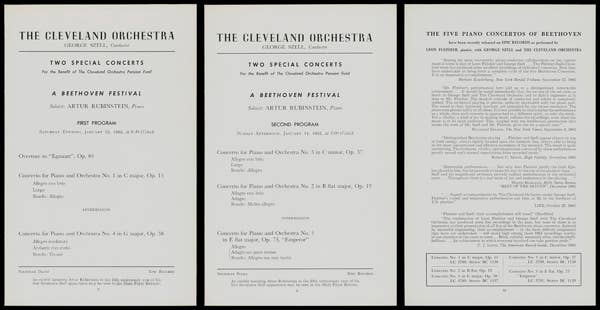
Fleisher may have been the first soloist to play all five concertos with the Orchestra, and the first to record them, but he would not be the last, nor did he ever perform all five in one season. Within the buzz about the Orchestra’s new recording with Fleisher, Arthur Rubinstein — a favorite collaborator of Szell’s for special events — played all five piano concertos at consecutive concerts on January 13 and 14, 1962, as a benefit for The Cleveland Orchestra Pension Fund. It would not be until 1977 that Cleveland Orchestra audiences would have the chance to hear all five of these incredible pieces in one subscription season again.
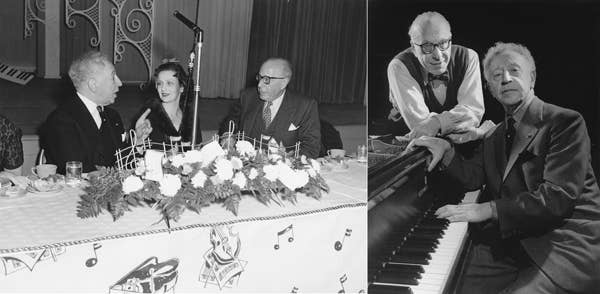
As illustrated by the link between Fleisher’s recordings and Rubinstein’s special performances, the history of the Beethoven concerto cycle is bound up with the history of recording. Before the 20th century, it was common for single movements of symphonies, song cycles, and concertos to be programmed alone; in fact, it was rare for audiences to be offered full pieces, let alone full sets of mammoth works. With the advent of recording, and the subsequent growth of record companies, music became an object to collect, rather than an experience to have, and record labels began to advertise complete works and box sets by composers or songwriters — think Ella Fitzgerald Sings the George and Ira Gershwin Songbook (1959). Sometimes these were compilations of recordings made at different times, but increasingly artists embarked on completist recording projects like this within a fixed period of time. Once the listening public became familiar with this completist approach to music consumption, it followed naturally for organizations and performers to consider programming whole cycles.
Some of these industry shifts are apparent in the history of these concertos at The Cleveland Orchestra. Szell and Fleisher recorded the Fourth Concerto in 1959, and it was released that same year by Epic. Two years later Fleisher returned and recorded the other four concertos with the Orchestra in one weekend in October. Epic then released these recordings as a complete set with the re-release of the earlier recording of the Fourth. Between and after these two recording sessions, Fleisher performed and toured with the Orchestra, which served to build the synergy between soloist and group and to drum up interest for future record sales — but there was no attempt to advertise the fact that audiences may have the opportunity to hear all five concertos in one season. When Rubinstein offered all five at the Pension benefit concert, it was also advertised in relation to the recording. In fact, there were no program notes for Rubinstein’s concerts, just a list of the pieces, and a full-page advertisement for the Fleisher-Szell recordings.
Clearly, this model of recording the full concertos was successful, because in 1968, Szell and the Orchestra recorded another complete set with Soviet pianist Emil Gilels. This project was for the record-buying public, however, not Cleveland concertgoers. It was nearly a decade later, in 1977, that Gilels came to Cleveland to perform all five concertos with Music Director Lorin Maazel, during a Beethoven festival honoring the 150th anniversary of the composer’s death. Over the course of three weeks in January, the orchestra performed not only all five piano concertos, but also the Triple Concerto (with Itzhak Perlman, Lynn Harrell, and Malcom Frager rather than Gilels at the pianist), all nine symphonies, a smattering of overtures, and two violin romances. The Orchestra took this festival to New York in early February, performing the overtures, piano concertos, and symphonies at Carnegie Hall and Avery Fisher Hall.
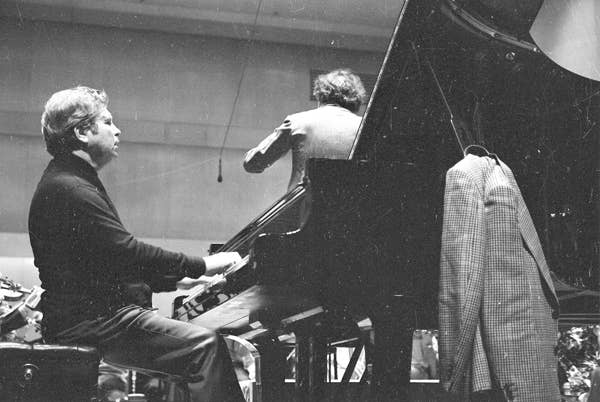
The third commercial recording of The Cleveland Orchestra playing the Beethoven piano concertos, featuring Vladimir Ashkenazy as both conductor and piano soloist, was released on the London label in 1990. The concertos were recorded throughout 1986 and 87, always around a live performance of the work, but not always for Cleveland audiences. The Third and Fifth concertos were performed at a runout concert in Oberlin on April 8, 1986, before being recorded on the 12th. The Second Concerto was performed on tour in Kentucky and North Carolina in March of the following year and recorded on March 16. The Fourth Concerto was performed twice at Playhouse Square the following month conducted by Andrew Davis, before Ashkenazy conducted it from the piano at Oberlin on April 21, and then recorded it with the Orchestra five days later. The First Piano Concerto was the only one performed at Severance Hall for a subscription concert on November 13, 1987, having already been recorded 10 days prior. Reviewers of this recording invariably compare it to Ashkenazy’s 1973 recording of the complete Beethoven concertos with the Chicago Symphony Orchestra and Sir Georg Solti. The consensus seems to be that The Cleveland Orchestra’s thinner and more sensitive sound allowed Ashkenazy further expressive possibilities than the power and bombast captured by the earlier recording.
Emanuel Ax was the only soloist to play the Triple Concerto in addition to all five piano concertos with the Orchestra. In 2001, Ax joined Music Director Christoph von Dohnányi and The Cleveland Orchestra for another Beethoven festival, performing all five of the piano concertos over nine days, as well as the Triple Concerto with Concertmaster William Preucil and Principal Cellist Stephen Geber. This festival was less far-reaching than the 1977 festival, simply pairing the concertos with overtures, without the symphonies. It also did not go on the road, as Gilels and Maazel had.
All five Beethoven piano concertos have been heard in a Cleveland Orchestra season was 20 seasons ago, in January 2005. In his third season with the Orchestra, Music Director Franz Welser-Möst and soloist Radu Lupu offered performances in Cleveland before taking the programs to Carnegie Hall, just as Gilels and Mazel had in 1977. In The Cleveland Orchestra’s history, Beethoven’s piano concertos have grown from works that felt unfamiliar to critics and audiences to moving favorites, performed year in and year out by world-renowned soloists, and memorialized in acclaimed commercial recordings and festivals. The opportunity to hear these works in such close proximity, let alone played by an orchestra of this caliber, was never available during Beethoven’s life, and is still a rare and precious way to appreciate this music.
— Ellen Sauer Tanyeri was the 2024–25 season archives research fellow. The fellowship is an opportunity for graduate music students from Case Western Reserve University to work with The Cleveland Orchestra Archives.