Collective Courage: Letting the Music Speak
Fidelio is about the value of human life and how freedom, both individual and collective, is only possible through love.
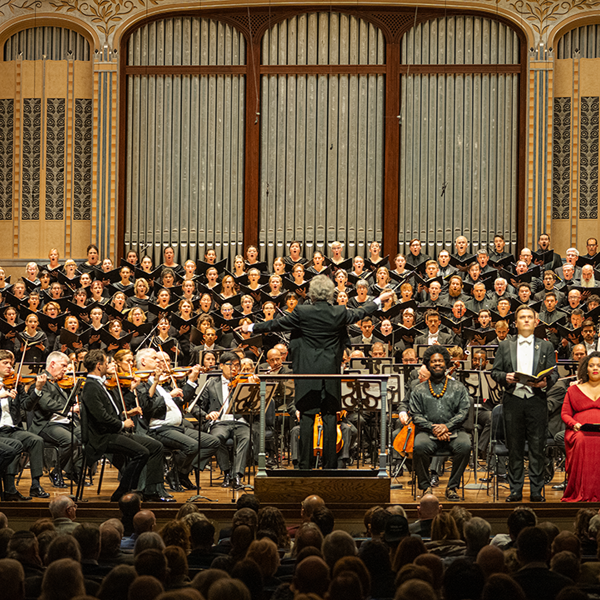
Fidelio is not only an opera; it’s a philosophical statement about courage, liberty, love, and the triumph of the human spirit. Every stage director I’ve met wrestles with the same question when putting on Fidelio: How do you make it relevant to the time we live in? Here, we present it in concert to bring attention to the extraordinary ways that Ludwig van Beethoven’s music is philosophy set to sound.
Any staging of Fidelio joins a long history of political performances. At a time when Europe was fighting one war after another, Beethoven — an extremely well-educated and politically engaged man — wrote this opera about a political prisoner ultimately freed by his wife’s courage. It is a very humanistic statement about the value of human life and the idea that freedom, both individual and collective, is only possible through love.
It is no accident that, in 1955, the first opera staged after the reopening of the bombed-out Vienna State Opera was Fidelio. After 10 years of being divided into four occupation zones, Austria was finally free to be its own country, and Fidelio captured that moment.
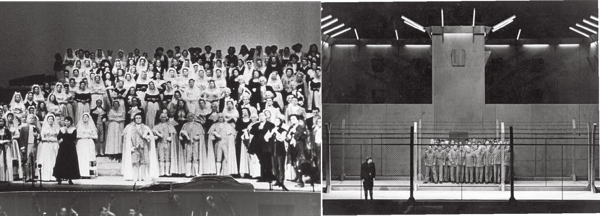
There was another famous production in 1989 by Christine Mielitz in Dresden, then the headquarters of the Secret Service of communist East Germany. The production premiered on October 7, almost exactly a month before the Berlin Wall fell. With dozens of secret agents in the audience, she staged it so that, as an audience member, you felt like you were inside the prison. It took tremendous courage of Mielitz to stage it that way, and from the Dresden Semperoper to present it.
Civic courage is not the strength of our time. People on both sides of the political spectrum tend to go with the flow without considering the consequences. But in the character of Leonore, Beethoven shows us that moving against the grain takes courage. She is the character who brings the light into a dark place. Before the opera starts, Leonore has the courage to dress up as a man and get a job in the prison. Don Pizarro harbors so much evil and maintains such a strong regime, but it is a woman who is willing to say, “No, that’s not what we stand for.”
In fact, Beethoven’s original title for the opera was Leonore, oder Der Triumph der ehelichen Liebe (Leonore, or The Triumph of Marital Love). He was always a proponent of sweeping philosophical messages. Before his First Symphony, he wrote the ballet The Creatures of Prometheus in 1801. Though it was a failure, it was his first earnest attempt to create music with a larger message. Even then, he already had plans to set Friedrich Schiller’s “An die Freude” (Ode to Joy), which he eventually did more than 20 years later in the Ninth Symphony.
But like Prometheus, Fidelio was not a huge success, because Beethoven’s ideals were bigger than the libretto could accommodate. There’s a saying in opera: “Only a second-rate libretto gives the chance to a first-rate opera.” There is some truth to that, but in the case of Fidelio, the text is not even second-rate. And that’s why staging it is so often a failure.
But the music is just extraordinary. It’s really Beethoven at his best. That is why I have decided to present this work unstaged, allowing the music itself to be the vessel for Beethoven’s powerful message. I’ve conducted over 70 different operas in my life, but every time I pick an opera for Cleveland, it’s because I specifically want to hear this Orchestra play it. Alongside the orchestra, of course, you also need strong soloists. Even at his best, Beethoven was never kind to singers. We have assembled a cast with great technique, especially Sara Jakubiak (Leonore) and David Butt Philip (Florestan), who can navigate the vocal challenges that Beethoven created. Don Pizarro is also an impossible role, but Tomasz Konieczny has a voice of such power that the hall may need another renovation!
Without a director influencing our interpretation, each of us is free to connect the opera with our own stories of love and courage, big and small. For me, it is a reminder of my father’s participation, at age 17, in an underground student movement against Hitler. For you, it will be something different. The scale does not need to be grand. Beethoven urges each of us to stand up for the people we love and the values we believe in.
—Franz Welser-Möst, Music Director