Fidelio’s Flights of Freedom
Beethoven’s clarion call for freedom and justice resounds as clear today as in its first performance in 1805.
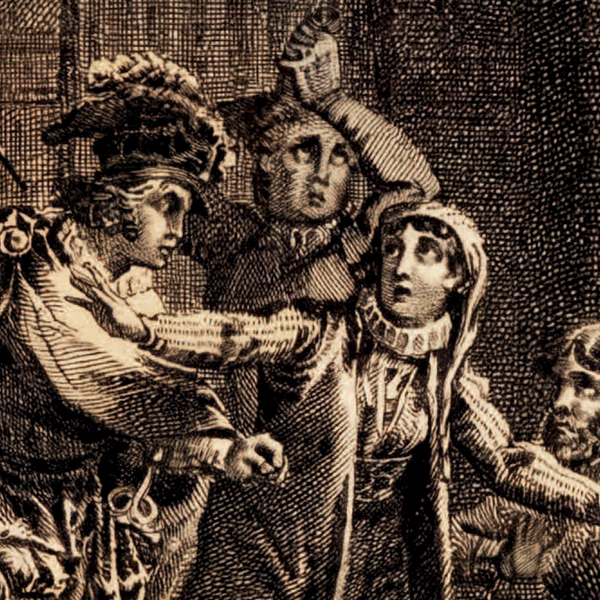
The first time we meet Don Pizarro, the governor who rules over the prison where Florestan is unjustly incarcerated, he makes no effort to hide his malicious machinations. In his Act I aria, Pizarro menacingly addresses the unseen prisoner: “I will satisfy my desire for revenge / Your fate awaits you!” Don Pizarro is villainous, intent on targeting those who speak out against him. His agenda is clear — Florestan must die.
Ludwig van Beethoven wrote Fidelio, his only opera, during a time in which the ideas of revolutionary fervor, prison reform, and freedom through enlightenment were in vogue. Based on a French libretto by Jean-Nicolas Bouilly, Fidelio follows the model of the “rescue opera” popular before, during, and after the French Revolution. Many such operas thematized the imprisonment and rescue of political prisoners from the control of unlawful, tyrannical governments. In Vienna, French rescue operas such as Luigi Cherubini’s Lodoïska (1791) and Le deux journées (1800) had already been produced to great success. Action-packed and appealing to a new working-class audience, rescue operas promoted the core Enlightenment values of self-determination and the triumph over oppressive forces.
Though structured as a Singspiel — a theatrical musical work in which the dialogue between musical numbers is spoken rather than sung in recitative — Fidelio clearly exemplifies the influences of its French predecessors. Set in a state prison, the opera follows the daring rescue efforts of Leonore, a desperate wife who disguises herself as a young prison guard named Fidelio to free her husband, Florestan. Maneuvering around Don Pizarro, Leonore ultimately succeeds in reuniting with Florestan and overthrowing Pizarro, and the opera concludes with a celebration of freedom. The version most often performed today was created in 1814 with the help of Georg Friedrich Treitschke, following 1806 revisions by Stephan von Breuning. Notably, in the final version, Treitschke altered the ending to grant amnesty to all the prisoners. It was premiered during the Congress of Vienna to celebrate the defeat of Napoleon.
Nowhere in the opera are the musical pleas for freedom more apparent than in the famous Act I “Prisoners’ Chorus.” Fidelio has just gotten permission from Rocco, the jailer, for the prisoners to walk in the courtyard, a small reprieve from their grim reality. While the moment is dramaturgically extraneous to the larger plot, in this chorus, we momentarily glimpse the meaning of freedom. We are not privy to these prisoners’ convictions or identities — we know only that they are state prisoners. The anonymous men begin singing cautiously, softly gathering strength from the open air: “Oh, what joy / to breathe in the open air again!” Registral shifts sonically illustrate the text, differentiating between the open-air courtyard and the dungeon, the locus of imprisonment. Musically arcing upwards, the prisoners’ phrases relish the feeling of freedom, and they reach the apexes of their phrases on the words “Luft” and “Frei” — air and freedom. Yet just as quickly as the chorus began, the closing stanza of the three-part form arrives. The opening returns, this time at a softer dynamic level, closing the brief window to the outside world. As the prisoners shuffle back into their cells, we are reminded of how fleeting true liberation can be.
Performing Fidelio has always been a political act. Government censors, working to protect the interests of the newly created Austrian Empire, banned the production just two weeks before the premiere at Vienna’s Theater an der Wien, citing political objections to the opera’s harshest scenes. Translator and librettist Joseph Sonnleithner then submitted a petition that appealed to Empress Marie Theresa’s admiration of the marital love theme and altered the setting to 18th-century Seville, which appeased government officials. The opera eventually opened to lukewarm reception and sparse attendance on November 20, 1805.
The exact nature of the tyrannical political power symbolized and embodied by Don Pizarro has been, and continues to be, mutable, taking on different guises in various performances at key historical junctures. During World War II, Arturo Toscanini conducted annual productions of Fidelio at the Salzburg Festival between 1935 and 1937 that have been understood as protests against the Axis powers. But in 1938, following the annexation of Austria into Nazi Germany, Fidelio was performed as a celebration of liberation by the National Socialists. In 1945, Fidelio yet again marked a sense of freedom at Berlin’s Deutsche Oper as the first opera performed in the city after World War II.
Fidelio has also acted as a symbol of liberation beyond Europe. A 1980 production of the opera in Buenos Aires notably flew under the radar of a regime that, like the malicious Don Pizarro, had similarly detained 30,000 political prisoners. And in South Africa, as musicologist Juliana M. Pistorius has shown, pivotal productions of the opera in 1994 and 2004 were associated with the nation’s democratic transition. More recently, director Francesca Zambello timed Washington National Opera’s 2024 production to coincide with Election Day in the US.
In our current moment, the cries of the imprisoned reverberate on a new frequency, prompting us to ask: Who are those nameless choristers kept behind bars? From those wrongly accused of crimes they did not commit, to those held in immigration detention centers and punished for seeking new lives, incarceration has yet again emerged as a pressing issue in contemporary discourse. Without a Leonore to rescue them, many are trapped within the United States’s current system of mass incarceration — one that imprisons at a higher rate than any other country. Yet the story of Fidelio is, at its core, one about humanity and the power of courage in the face of despair. To experience Fidelio, then, is to question the Don Pizarros who cling to tyranny, and to listen to those who remain imprisoned out of sight.
—Allison Chu
Allison Chu is an assistant professor of musicology at Vanderbilt University and a scholar of opera, American contemporary music, and race and identity