I, Prometheus
Beethoven's Symphony No. 2 (1802)
Beethoven first realized he was becoming deaf in the summer of 1798, at age twenty-seven. After an initial episode of total deafness, Beethoven found that his hearing had become filled with an unending “maddening chorus of squealing, buzzing, and humming.”1 Initially, Beethoven told no one; he feared what others would do and think if they had known of his condition, fearing for his career as a musician. It was not until 1801 that Beethoven revealed his deafness to anyone in his circle (having written to his close friend Franz Wegeler). During these years, even at his lowest, Beethoven did not seem to believe he would lose his hearing completely, and be left with that “maddening chorus.” However, in the summer of 1802, as he composed his Second Symphony while in Heiligenstadt, he finally came to realize his fears were coming to pass.2
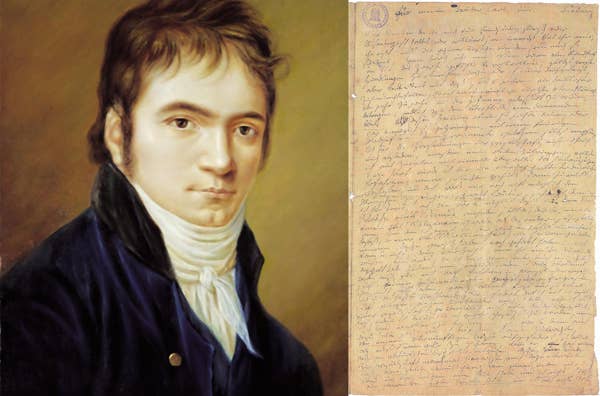
In Heiligenstadt, Beethoven may have first contemplated suicide. Here, in the countryside which Beethoven loved, he struggled mightily with the realization that he would become fully deaf, having spent years denying it to himself. In the Heiligenstadt Testament, written following his stay in the town, he described how experiences such as: “‘When someone standing next to me heard a flute in the distance and I heard nothing or someone heard a shepherd singing and again I heard nothing.’” It was these small experiences which brought him “‘close to despair’” and “‘at the point of ending [his] life.’” 3

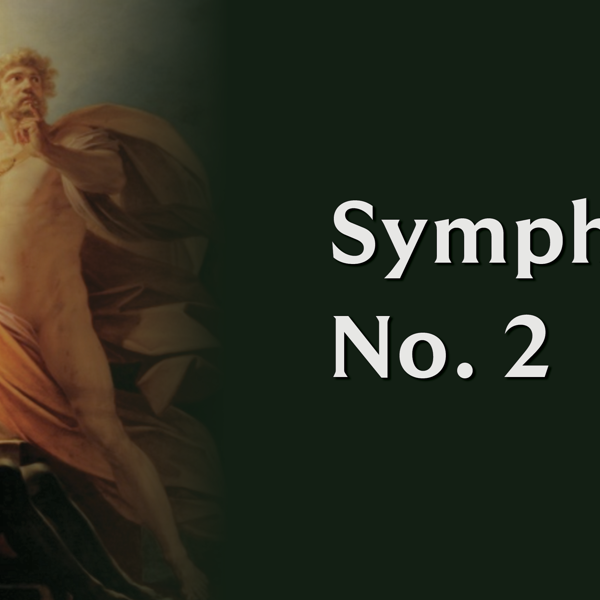
“‘The only thing that held me back was my art.’”4 It is here that Beethoven begins to self-consciously embrace the path of Prometheus as the only way forward. Beethoven describes how, with a “‘soul. . . filled with a love for humanity and a desire to do good’” he did not wish to die before he could write as much music as he could. He “vowed to live with suffering and for his art,” as Beethoven biographer Jan Swafford describes.
Typically, scholars and critics have connected the "Eroica," and not the Second Symphony, to the Heiligenstadt Testament; musicologist N. Straus traces this back to 1927.6 The Second Symphony has long been overshadowed because of ideas that Beethoven was “not supposed to be able to write vivacious and energetic works” during the same period that he was in “torment,” as noted by musicologist Lewis Lockwood.7 However, this symphony, with its “strongly mercurial emotional climate” and often upbeat spirit speaks to a powerful sense of hope and joy in the face of something threatening lurking in the background.8 Perhaps this symphony also embodies another facet of Beethoven’s response to his personal crisis: the hope and joy that Art can bring.

1Jan Swafford, Beethoven: Anguish and Triumph (Boston: Houghton Mifflin Harcourt, 2014), 224.
2Swafford, Beethoven: Anguish and Triumph, 225, 275-276, 300.
3Lewis Lockwood, Beethoven: The Music and the Life (New York: W.W. Norton, 2005), 119.
4Ibid.
5Ibid.
6Joseph N. Straus, Extraordinary Measures: Disability in Music (New York: Oxford University Press, 2011), 54; Straus himself offers a reading of the "Eroica" (among other works) in this vein (45-62).
7Lewis Lockwood, Beethoven’s Symphonies: An Artistic Vision (New York: W.W. Norton, 2017), 40-41.
8Lockwood, Beethoven’s Symphonies, 41.
— Dr. Alexis Lawler worked in The Cleveland Orchestra Archives and completed The Prometheus Project while a Historical Musicology PhD student at Case Western Reserve University.