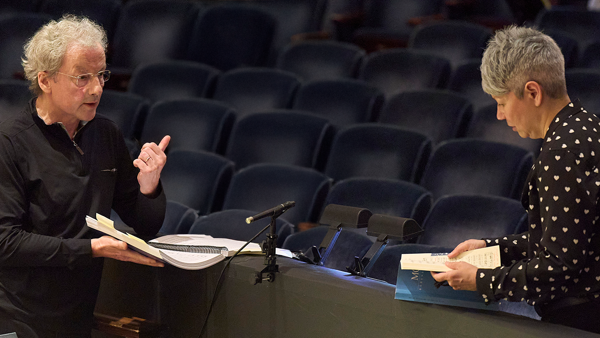
Inside The Cleveland Orchestra Chorus
We asked three members of The Cleveland Orchestra Chorus about preparation, touring, and the culture of ensemble.
This is a special year for The Cleveland Orchestra Chorus. The season opened with Bernd Richard Deutch’s Urworte, followed a few weeks later by Beethoven’s Ninth Symphony — both formidable works for orchestra with chorus. The usual Chorus-heavy Holiday Concerts were preceded by Handel’s Messiah, and this spring, the Chorus appears yet again in Verdi’s Requiem, Britten’s War Requiem, and Beethoven’s Fidelio. Not to mention that the Chorus is hitting the road with The Cleveland Orchestra to perform Verdi in New York City and — for the first time since the pandemic — Florida.
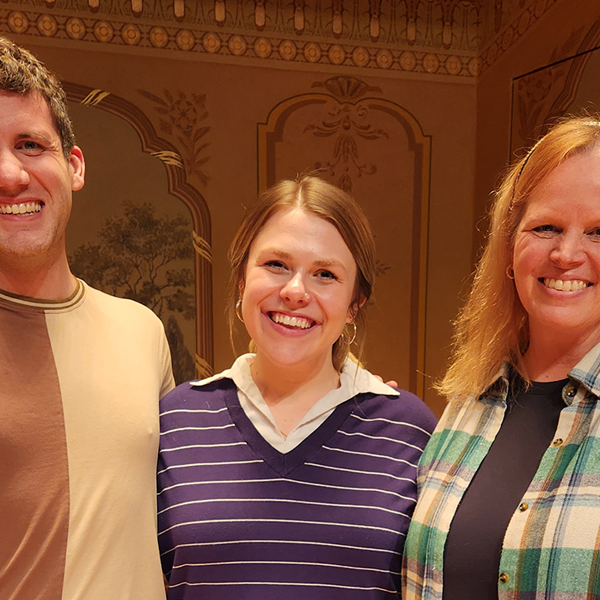
We got an inside scoop on preparation, touring, and the culture of the ensemble from three Chorus members:
- Jonathan Fuller, tenor (left): A music educator and collaborative piano graduate student at the Cleveland Institute of Music
- Elisha Evanko, second soprano (center): A music therapist and bereavement coordinator at a local hospice
- Emily Engle, first soprano (right): An elementary school music teacher
Let’s start at the beginning. When did each of you join The Cleveland Orchestra Chorus? Do you remember your first concert?
Emily: I joined the season that we went to Europe (2013–14). My first concert was Messiaen’s Trois petites liturgies de la Présence Divine, which is such a difficult piece. French is hard for me, and it was very abstract and modern, too. I had to work on it for hours, but it was amazing to start with a bang and then immediately go on tour. Even 13 years in, it still surprises me that we can do a concert for four nights in a row and sell out every night!
Elisha: I’m a newbie — I joined the Chorus about a year and a half ago. My first experience was performing with the Blossom Festival Chorus in Borodin’s Polovtsian Dances. I appreciated that it was from an opera; opera choruses are what made me fall in love with singing classically in the first place. Then, right after that, we did The Lord of the Rings: The Return of the King, which, I’m not going to lie, was another big reason I auditioned.
Jonathan: I also started in summer 2024 with the Blossom Festival Chorus. I remember the audition excerpt was from Deutsch’s Urworte, which didn’t have a reference recording. I thought, “Oh, I guess these folks are not messing around.” But it’s funny you mention that movie, Elisha. At one of the Return of the King concerts, it was hot and everyone was just a little tired, so my eyes were wandering a bit. And there was one particular moment I noticed some of the Orchestra members were watching the movie behind them, before I saw them whip around to make their entrance on time. No one would have noticed because they caught it — they’re pros — but it was so charming.
But when we got into last year’s Classical season, it was nothing to sneeze at. It was so cool to get to work with great conductors and do amazing, challenging new music like Saariaho’s Oltra Mar and America: A Prophecy by Thomas Adès. And the whole time, we were also rehearsing the Deutsch for this fall. It has also been great this season to work on music by more straightforwardly tonal — but no less challenging — composers like Beethoven and Verdi.
There is certainly a big difference between Deutsch and Verdi. How do you all feel about singing Verdi’s Requiem?
Jonathan: It’s very moving, timeless music. One of the funny things about this season is that, because there is so much music for the Chorus, we spent the first half of rehearsals in November doing holiday music, and then we would switch to the Verdi. It was such an amazing vibe shift going from simpler Christmas carols to this very different, intense music. But it also felt like that shift was seamless, and everyone was down to do it.
Emily: I’ve never performed Verdi’s Requiem, but I think it’s lovely, I really like it. As Jonathan said earlier, it’s very tonal music with a clear direction.
Elisha: For me, Verdi’s Requiem is that once-in-a-lifetime, bucket-list piece. When I was in college, I went to see Verdi’s La traviata and sobbed — that was my idea of a fun Saturday night. That kicked off a Verdi deep-dive for me. He just has this gorgeous way of making you feel something from the tips of your toes to the top of your head, and to be able to sing his music is amazing. As someone working in hospice and working with grief, there’s also something so profound about a Requiem Mass that hits on a deep level. Verdi’s in particular is so dramatic, and it almost sounds like an opera in some moments. It is so emotive and raw and human and spiritual.
It’s also funny that the Dies irae movement has become a viral TikTok sound. In that way, it’s been a great bridge for my family and the youth in my life, a way to pull them into my classical music world.
This piece is also special because you’ll be performing it in New York City and Florida. What are you most looking forward to about touring with the Chorus?
Emily: I’ve been to Carnegie Hall twice with the Chorus — this will be the third time coming up — and I’ve been to Florida twice as well. But we’ve never done New York City and Florida on the same trip in my time. As I mentioned, my first year in the Chorus was the European tour, which started with a kickoff concert at Lincoln Center in New York City. We flew in and out just for one day — I remember I had to go to work the next morning — before we left for Europe later that week. We’ll have more than a single day in New York City this time, and I’m extra excited for the free time. I’ve got tickets to see two Broadway shows with some friends — Oh, Mary! and Hadestown. It’s always nice to spend time with the chorus mates; it’s a group bonding experience.
We’re so lucky to get to take the show on the road for different audiences and see how The Cleveland Orchestra is respected around the world. You can become familiar with your sound in your particular setting, but when you put that exact same group somewhere else, it’s completely different, and it takes some time in rehearsal to get accustomed to it. In Miami, for example, we sing in a balcony choir loft, which is very different than being down on stage in Severance.
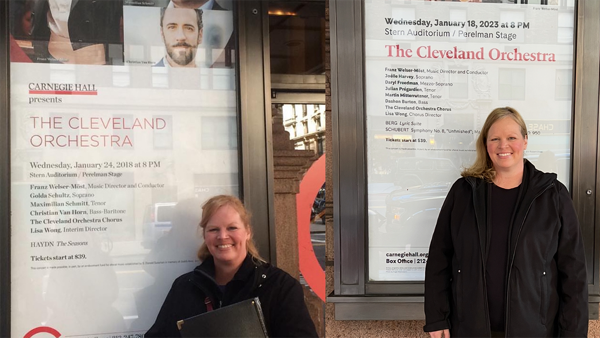
Jonathan: This will be my first tour with the Chorus, but I’ve performed at Carnegie before in a very different context when I taught in New York City. It’ll be amazing to hear this group of people in that hall. I also think that sometimes we take what we have here in Cleveland for granted, and to transplant all this into a different place and see the reaction from a different city’s audience is just mind-blowing. Obviously, there’s nowhere like Severance, but there’s also nowhere like Carnegie Hall.
I’ve chaperoned high school choir tours before, and what so often happens is that the ensemble becomes a unit. It’s not just the performance, it’s the wrangling of people, scheduling, and travel snafus. So, the performances that happen after those tours are so magical because everybody has learned much more about each other, which gels the ensemble in a whole new way. I am looking forward to sharing that experience with these people whom I see once a week. I’m really excited to see how it will deepen the bonds that we already have.
Elisha: Yes, there’s something so amazing about an ensemble tour. Being able to spend time with everybody on the flights or the bus and exploring new places together really brings you closer as a community, which, in turn, brings you closer together as an ensemble.
I toured throughout elementary and high school with The Singing Angels to France, England, and China, and I also went on international tours in college. But touring is something that I haven’t been able to access in the decade since I graduated, so this will be such a special experience as an adult.
Like Emily said, it will also be very cool to have access to different stages and different audiences that we don’t get at Severance. I used to live in Florida — in Boynton Beach and the West Palm Beach area — so a few of my hospice music therapy buddies who are still there will try to come hear us, which will be great. And unlike the two of you, I have not sung in Carnegie before, so I’m thrilled. I still cannot believe that’s happening!
You’ve all touched on this, but what is the community of the Chorus like in general?
Elisha: My whole life, I always had a musical community of people who approached life the way I did and shared my passions. But that evaporated after college. I love working in hospice, I love grief work, but I work with nurses and social workers and folks who aren’t classical musicians. So, being part of the Chorus has been a gorgeous reawakening of this part of myself that hasn’t had that community for a decade. I had no idea how much I missed being able to talk to my neighbor about rest placement, tone quality, or vowel shape without having to explain myself.
To be completely honest, when I auditioned, I thought I wouldn’t make it. I came home and told my husband, “There’s no way.” But then I did! After the first rehearsal, I just remember saying, “I feel like I am the least talented one in the room.” And that was such a good feeling; it really inspired me to be surrounded by incredible musicians. Truly, if anyone is questioning whether to audition, do it! It was the best decision I made in terms of expressing myself musically and having the opportunity to perform again and embrace my musical self. I know there’s sometimes hesitance when we age, but you can still do it! The amount of talent in the group is wild, especially considering that we’re not all professional performers. We have moms, dads, retired folks, people who just graduated from college. The woman who I sit next to is a math teacher. But everyone is completely committed.
Emily: It’s a great community. I’ve been part of a carpool group and we always joke about making t-shirts. I usually sit in the same place, so I get to know the people immediately around me. They are all from different backgrounds — there’s a lawyer, a doctor, someone who does finance, another music teacher like me. People are coming from such different day jobs, but we all have this in common: we love to sing. We love being a part of this community, and we love the challenge and privilege of singing excellent music at such a high level. Over my 13 seasons, I’ve made so many good friends.
Jonathan: It’s funny, I’m always a little worried about choirs. I’ve not been able to stick with one for a while, but Cleveland is so different. I actually joined the Chorus at the same time as one of my former students, but we didn’t know the other had auditioned. Having that bond made it easier to get to know more than just the people in my section or around my age. She was getting to know her people, and I was getting to know my people, but then we were able to cross-pollinate. From Lisa Wong on down, everybody is just so respectful of everybody else.
Speaking of Lisa Wong, are there differences between rehearsing with her and with Franz Welser-Möst?
Emily: They’re both phenomenal at what they do. They know exactly what they want, and Lisa has a really good idea of what Franz wants. For example, we sing with very minimal vibrato — a lot of the music we do is sung in a very controlled, pure manner. I think some of that comes from Franz’s upbringing, singing with boys’ choirs and so forth, but I love it. I’ve actually gotten so used to it that I tried to join another chorus recently, and ended up being unable to continue because of how heavy the vibrato was in their sound. So, I think they’re both very, very clear on the sound that they want, and they have very direct methods of bringing that out in us.
Jonathan: I completely agree. And I think this balance happens because Lisa is very detail-oriented; she gets all this into us so that Franz is able to look at the big picture. I don’t think there’s been a single rehearsal this year where Franz has had to nitpick, because Lisa has done such a thorough job of building a foundation. It’s like a handoff, so that by the time we rehearse with Franz, we feel secure that we can do what we’ve set out to do, and then Franz can shape the sound from there.
Elisha: Exactly! It really does feel like a seamless process where Lisa just builds and builds, passes the literal baton, then Franz builds and builds further. Lisa really encourages us to think about not only diction and intonation, but the cultural component, and Franz brings out the music history component. She asks, “What are you communicating? How are you communicating it?” And Franz helps show why we’re communicating it. When you combine those two, it is an immaculate recipe for success.
Like Emily was saying, they’re both wonderful conductors, too — you can pick up what they want you to do based on their body language. It’s sometimes funny how similar they are. I remember my first rehearsal with Lisa. We sang the first note of our warm-up, and she stopped us and said, “Yeah, not the best tone. Try it again.” And I thought, “Yes! This is who I want leading. I trust her.” It was a similar experience in my first rehearsal with Franz for Jenůfa last year. We sang the first chorus entrance, and he stopped us. I was so struck by their similarities. They won’t let us settle for mediocrity; they share this expectation of excellence.