Leonore: A Portrait of Courage
Though Leonore’s actions echo the 18th-century fight for women’s rights, her character represents much more.
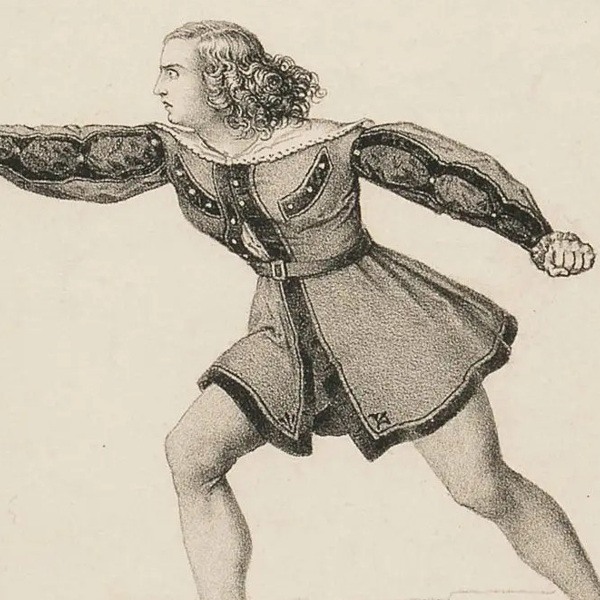
From a 21st-century vantage point, it is tempting to view Leonore’s courageous actions in Fidelio against the backdrop of 18th-century debates over women’s rights that produced foundational texts such as Judith Sargent Murray’s On the Equality of the Sexes (1790), Olympe de Gouges’s Declaration of the Rights of Woman (1791), and Mary Wollstonecraft’s A Vindication of the Rights of Woman (1792). Ludwig van Beethoven’s Leonore, however, does not engage in any such debates. She is a woman of action.
In the years preceding and during the Age of Revolution, many operas, especially in France, claimed to represent actual events and were thus billed as “fait historique.” Several centered on the actions of a heroine who rescues her beloved from imprisonment: Le déserteur (1769), an early and especially well-known example; Le comte d’Albert (1787) in which a wife saves her husband; The Prisoner (1792), an English pastiche (adapting music by Dalayrac and Mozart) in which two women pose as soldiers; and Léonore, ou L’amour conjugal (1798), on which Beethoven and his librettists based Fidelio.
Jean-Nicolas Bouilly, author of the libretto on which all subsequent Léonore operas relied, had trained in law and served as a judge in Tours during the Reign of Terror. He later said in his memoirs that he based his drama on “a sublime deed of heroism and devotion by [a lady] … whose noble efforts I had the happiness of assisting.”
Writing about the idealization of women in literature in A Room of One’s Own (1929), Virginia Woolf points to a curious paradox that aptly describes the duality of the Leonore/Fidelio figure: “[In] real life a respectable woman could hardly show her face alone in the street, and yet on the stage woman equals or surpasses man.” Leonore knows she cannot achieve her objective as a woman and has therefore disguised herself as a man. This simple fact is essential to understanding the opera’s action.
For most of Act I, we only glimpse Leonore through her disguise. It is not until her grand scena before the finale that we discover her full capacity for courage, love, and hope. Leonore has overheard Don Pizarro’s diabolical plan to murder her husband (Florestan), and when she enters, her inner turmoil can be heard in the orchestra. She tries to make sense of Pizarro’s rage as the music moves toward his key (D major). But then, suddenly, she imagines a rainbow shining above her, represented in the winds and in the unexpected key of C major, a key associated with love and triumph (especially in the Act II finale).
The aria type Beethoven employs here (a two-tempo rondo) was particularly associated with complex and emotionally fraught situations for noble heroines. It begins slowly in a bright E major, the key of the opera’s overture but otherwise unique to Leonore in this opera. Three horns, an audible manifestation of her innermost thoughts, engage in an exquisite dialogue with the voice. Coloratura aptly paints the image of how love will reach (“erreichen”) its goal. The tempo soon picks up as Leonore declares her resolve. Huge leaps, vocal runs, and an ascent to a high B emphasize the key word “Gattenliebe” (marital love).
In the Act II quartet, the opera’s climax, Leonore’s resolve is put to the test. Pizarro begins the ensemble in his key, but the music, characterized by frequent chromatic motion, drives continually onward, reflecting the action at every turn. As Leonore steps forward to shield Florestan from Pizarro’s dagger, she deflects the established harmony yet again. Unaccompanied and exposed, she dares Pizarro to kill her first, reaching up to a high B-flat. The battle of wills continues for more than 40 bars until the trumpet call is heard. This signal announcing the minister’s arrival changes everything: Leonore has achieved freedom for her beloved Florestan.
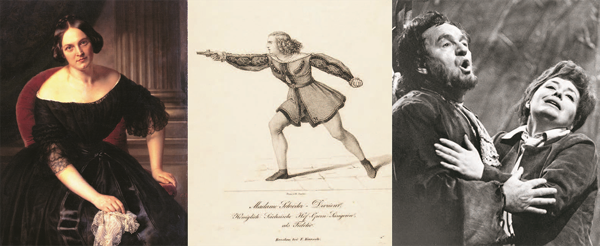
Two supreme moments of satisfaction now unfold for Leonore. First, the private reunion of husband and wife, in which extended a due passages (simultaneous singing in thirds) appropriately dramatize two hearts beating as one. The placement right before the finale is conventional, but this particular love duet, with its dynamic range, unexpected pauses, and heart-racing energy, conveys emotional exuberance as only Beethoven can.
The second such moment occurs in the Act II finale, when the minister (Don Fernando) invites Leonore to unlock Florestan’s chains. The music here makes an unexpected shift of tempo, texture, key, and mood. As Leonore gives thanks, the music captures the wonder of freedom. Its transformative stillness recalls the promise of Leonore’s rainbow in her scena and the quiet “shock tutti” passage in the dungeon after the trumpet signal is heard. The overwhelming emotion of the moment (“Augenblick”) appears to stop time and heighten the senses.
The opera’s final celebration in the next section focuses on Leonore as the chorus (comprising prisoners and townspeople, including women) sings together: “Whoever has won a lovely wife / Let him join in our jubilation” (a paraphrase of lines from Friedrich Schiller’s “An die Freude,” now familiar from Beethoven’s Ninth Symphony). The text setting is harmonious and euphoric. In the opera’s remaining bars, we hear this refrain sung repeatedly by the main characters and the chorus in turn.
Fidelio’s celebration of love, hope, and freedom may be summed up in one word: Leonore. She is the opera’s primary champion of compassion, justice, and courage. In Act I, it is she who insists that the prisoners be released into the open air. In Act II, upon first seeing the prisoner in the dungeon, she exclaims, “Whoever you are, I will save you.” And at the opera’s end, she attributes courage to love: “true love knows no fear.” Through her actions, Leonore demonstrates the essential message of Wollstonecraft’s Vindication, that freedom must “strengthen [woman’s] reason till she comprehend her duty, and see in what manner it is connected with her real good.”
— Jessica Waldoff
Jessica Waldoff is Carol and Park B. Smith Professor of Music at the College of the Holy Cross. She has published widely on the music of Mozart and his contemporaries. Her most recent book is The Cambridge Companion to The Magic Flute (2023).