Lisa Wong on the Chorus at 75
Since taking on the position of Director of Choruses in 2018, Lisa Wong has maintained The Cleveland Orchestra Chorus’s status as a formidable supporting ensemble for The Cleveland Orchestra. We recently sat down with her to reflect on the Chorus, its 75th-anniversary program, and its future.
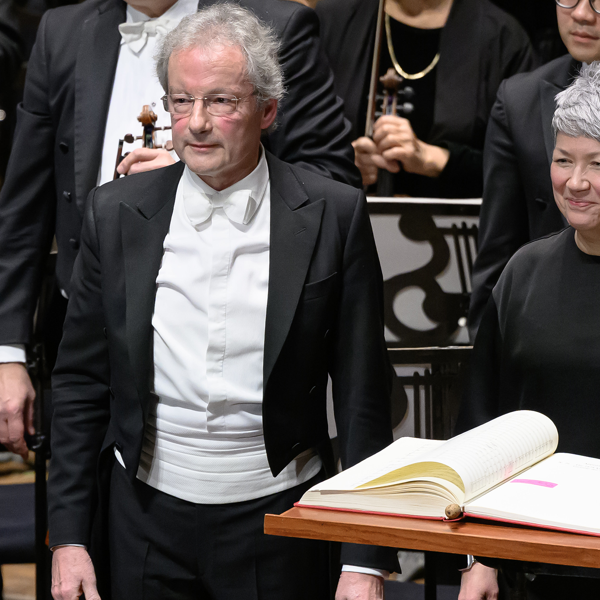
TCO: How has the Chorus evolved since its founding, and, more specifically, how have you seen it evolve in your time as Director?
LISA WONG: It’s probably easier, in fact, to talk about some things that haven’t changed. What remains the same is the unwavering commitment to excellence and singing at the very highest level. Our Chorus members are incredibly dedicated, and I think that has really remained the same in the ensemble’s 75 years.
In terms of what has changed, I think the role of the Chorus is expanding. I’ve been here in some capacity since 2009, and there are seemingly more guest conductors who come in wanting to do a major choral project with us, which is great. The Chorus is increasingly involved in the opera productions, now part of the Jack, Joseph & Morton Mandel Opera & Humanities Festival. We’re part of more recording projects — we just released a recording of Verdi’s Requiem, for instance, and we’re recording Eric Whitacre’s Eternity in an Hour for Adella. We’ve also been doing a lot of contemporary music in recent years. We were involved in a new work by Thomas Adès a few seasons ago, there was the major commission with Bernd Richard Deutsch last year, and Whitacre’s piece is a commission as well. So, there are lots of things that have remained the same, while lots of other things are expanding and going in new directions.
What is your favorite aspect of directing the Chorus?
It’s so hard to choose just one. I love the people — working with the incredible Chorus members, my colleagues, and our staff — it’s a terrific team. But I also love that I work in a place where the chorus is truly valued and appreciated. That’s not the norm in every place, but everyone here — from the Orchestra musicians to our Music Director Franz Welser-Möst — has a true appreciation for and greatly values our Chorus, the time that they put in, and their artistry.
What is one of your favorite memories of working with the Chorus or a favorite concert you’ve prepared them for?
My most distinct memory is the first time that I heard The Cleveland Orchestra in person. It was 2009 and I was singing in the Chorus. Before then, I had not heard the Orchestra or the Chorus in person — it was actually my first time being in Cleveland! We were performing two weekends in a row: Beethoven’s Ninth Symphony the first weekend followed by Brahms’s German Requiem the next. I distinctly remember being in that first rehearsal and experiencing the Orchestra for the first time. I’ll never forget how I could feel the sound through the floor. It’s such a special memory.
In terms of favorite concerts that we’ve done, there are so many, but I really loved doing Verdi’s Requiem last season, singing it here in Cleveland and then taking it on tour to New York and Florida with a dream team of soloists. One of my favorite pieces is Britten’s War Requiem, so it was very special to be able to prepare it for Klaus Mäkelä last season as well. And I must also mention John Adams’s El Niño. This piece was actually the topic of my doctoral dissertation, and never in my wildest dreams had I imagined that I would be preparing it for Adams to conduct [in 2022], so that was incredibly special.
What is something about the Chorus that most people would be surprised to know?
Many people are surprised to learn that this is an all-volunteer chorus. I think most assume they’re all professional singers, because they perform at such a high level. Now, we certainly have lots of professional musicians in the Chorus — people who are performers, music teachers, music therapists, or otherwise — but many of our members do something completely outside of music for their careers. The Chorus is completely volunteer based, and I think many people are still surprised to learn that.
What led you to curate this specific program for the Chorus’s 75th anniversary? What connects these two works?
We had the opportunity to work with Eric Whitacre three years ago when he was here to direct his piece, The Sacred Veil, as part of a week-long residency where he worked with high school students, college students, and our own Chorus. It was such a successful week in so many ways, and such a moving experience for our singers. In fact, some of our longest-serving Chorus members let me know that this was the most moving concert they had sung in their many years of being in the Chorus.
So, when Eric asked us shortly after if we would be interested in being part of his next large-scale work, Eternity in an Hour, we immediately said yes. At that time, we weren’t specifically intending it to be on the 75th-anniversary program. We just knew that we wanted to be a part of the commission and work with Eric again, but there was not an opening in our programming until fall 2026, which, of course, very happily coincides with the Chorus’s 75th season.
As we learned more about this new work, we discovered that Eric was setting a text by William Blake. It’s just four lines of text that he has fragmented and stretched to create a piece that lasts about an hour. The words are a reflection on time and beauty, so that seemed just perfect to mark the passing of time for the Chorus’s 75 years.
For the first part of the program, we’ve paired this with John Corigliano’s Fern Hill, which uses a text by Dylan Thomas that also considers the passing of time. It also just so happens that Corigliano was Eric’s composition teacher at Juilliard, so I think it’s a really nice pairing and a snapshot of American choral music from two very different composers.
What do you hope this program will share with the audience?
Eric has so brilliantly set up a space for reflection. The piece involves chorus, piano, cello, percussion, and, interestingly, electronics. Eric has this huge setup of synthesizers and electronically processes the music in real time, which creates this really fascinating sound. Both pieces in combination create an opportunity to slow down. We’re so busy today — our attention spans are shrinking and it’s hard to find time to just focus and reflect. I think, more than anything, this program allows us that time, so I hope the audience will allow themselves to enter this concert with that in mind.
Where do you envision the Chorus going in its next 75 years?
I’m dedicated to bringing more people into community singing. Whether it’s young children, high school kids, college students, adults — maybe people who haven’t sung for a while and want to come back — I want to find more entry points for everybody in our community to sing. And I think that’s up to us to continue to evolve and find new ways that attract people. Of course, we’ll also be bringing in a new Music Director in the coming seasons, so I’m very hopeful that it will be someone who loves choral music as much as we do and wants to program, record, and commission choral music that takes us into our next 75 years.
What is something you would tell a Chorus member 75 years from now?
I would want them to know what a special world they are about to enter. I feel so incredibly privileged every time I step in front of this group, every time I walk out onto this stage, and I often think about all the people who have come before me. That reminds me of a moment this summer: We were working on Stravinsky’s Symphony of Psalms and a Chorus member said to me, “I first performed this piece 61 years ago.” And I said, “Wow, that’s incredible. Do you remember who conducted?” And he said, “Yes, it was Stravinsky!” And that’s just one of many, many stories. So, I would say to future Chorus members: You’re joining an incredible legacy filled with really special people, and now you’re one of them.