Over a Century of Richard Strauss’s Tone Poems in Cleveland
The symphonic poems of Richard Strauss (1864–1949) have been ubiquitous in the world of the symphony orchestra since he composed Don Juan (after the legend of the same name) in 1888.
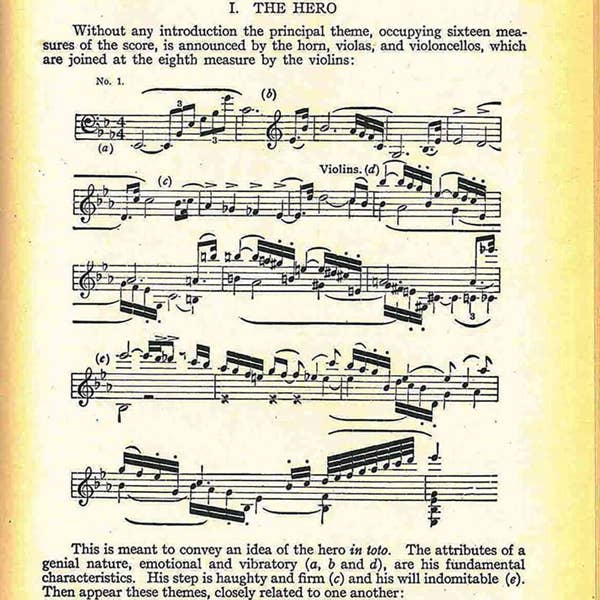
The symphonic poems of Richard Strauss (1864–1949) have been ubiquitous in the world of the symphony orchestra since he composed Don Juan (after the legend of the same name) in 1888. Whenever Strauss’s music was premiered somewhere, it created a huge sensation and made its home in the repertory of that city’s orchestra from then on.
Cleveland was no exception to this. Adella Prentiss Hughes, prior to founding The Cleveland Orchestra in 1918, was a musical impresario. Starting in 1901, she began the Symphony Orchestra Concerts Series, and brought to Cleveland many of the leading performers, conductors and composers of the day, including Strauss. Invited by Hughes, Strauss visited Cleveland with the Pittsburgh Orchestra during the third season of the Concerts Series, and conducted a sold-out concert on March 10, 1904. The program featured two of Strauss’s symphonic poems, as well as performances of six of his songs with his wife Pauline Strauss-de Ahna, an operatic soprano, as soloist with Strauss himself accompanying her.
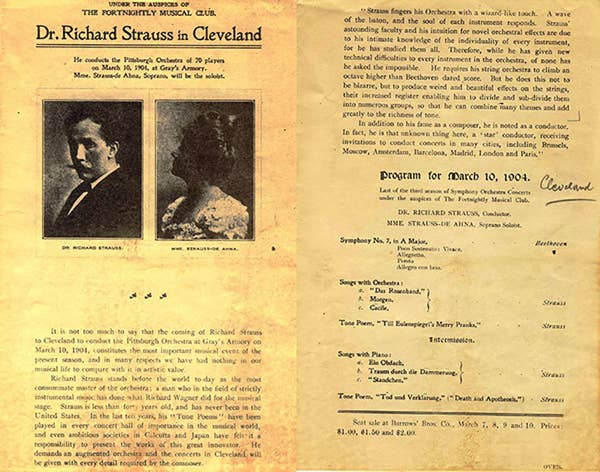
The enthusiasm for Strauss’s visit wasn’t expressed only through applause. After the concert, excited local German groups collected three hundred singers to perform for Mr. and Mrs. Strauss at dinner. Public reception was rapturous, and as Mrs. Hughes said later of the event, “Cleveland knew its Richard Strauss from then on.” Since then, The Cleveland Orchestra has performed at least one or two of Strauss’s symphonic poems almost every season.
However, this leaves one unanswered question: what exactly is a “symphonic poem?” A symphonic poem (also called a “tone poem”) is programmatic music — it has some sort of text or idea that the music represents. Sometimes these can be an evocation of a specific place and/or people, like Strauss’s Symphonia Domestica (1903), which depicts Strauss’s household. Other times, they can render elaborate stories into music that you can practically follow note for note, such as Strauss’s Till Eulenspiegel’s Merry Pranks (1895), which describes Till Eulenspiegel (a notorious prankster from German folklore) and his madcap high jinks. Ultimately, a great way to think of a symphonic poem is as “film music without the film”; Instead of having the images supplied for us, we the audience must use our imaginations to more freely recreate them.
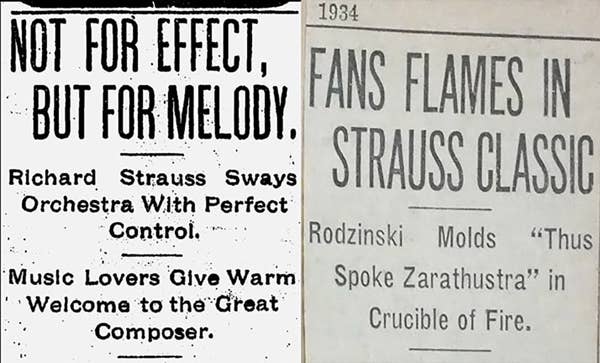
Oftentimes, to aid the listener, the program notes will provide additional details about the piece’s story and music. As we listen to some of The Cleveland Orchestra’s past performances of Strauss below, look at how differently over time the stories behind these symphonic poems are talked about.
— Alex Lawler was the 2015–16 season archives research fellow. The fellowship is an opportunity for graduate music students from Case Western Reserve University to work with The Cleveland Orchestra Archives.
All photographs and audio clips courtesy of The Cleveland Orchestra Archives.
Want to know more?
Biographies
- The Life of Richard Strauss, by Bryan Randolph Gilliam
- Richard Strauss: Man, Musician, Enigma, by Michael Kennedy
Website
Selected Recordings with The Cleveland Orchestra
- Vladimir Ashkenazy, London, 1989: An Alpine Symphony, Till Eulenspiegel’s Merry Pranks (Till Eulenspiegels lustige Streiche).
- George Szell, Sony, 1990: Don Quixote
- Vladimir Ashkenazy, London, 1990: Also Sprach Zarathustra, Death and Transfiguration (Tod und Verklärung)
- Vladimir Ashkenazy, London, 1991: Don Juan, Aus Italien
- Christoph von Dohnányi, London, 1993: Ein Heldenleben and Till Eulenspiegel’s Merry Pranks