Resurrecting the Second Symphony from Mahler’s Autograph Score
In 2022, The Cleveland Orchestra unveiled an extraordinary and utterly unique gift from European Trustee Dr. Herbert G. Kloiber: the autograph full score of Gustav Mahler’s Symphony No. 2. This remarkable artifact — 232 pages emblazoned with the composer’s bold musical script and handwritten instructions — provides unparalleled insight into the mind of a musical genius.
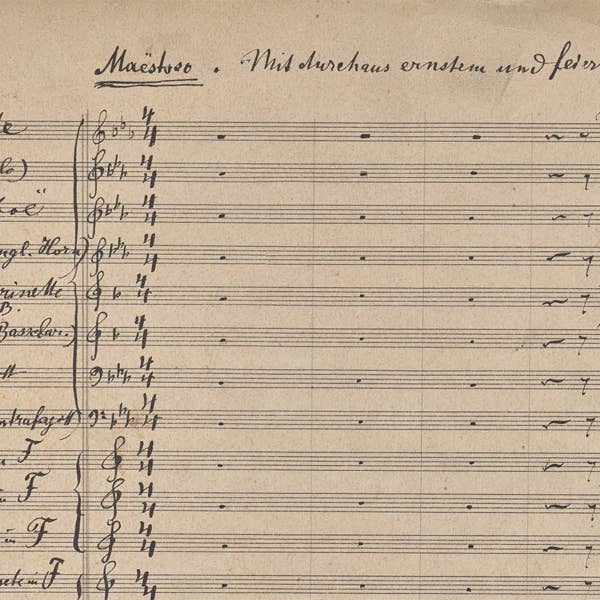
A few years ago, Music Director Franz Welser-Möst made plans to meet Kloiber at a café across from the Musikverein in central Vienna. His friend arrived carrying a black briefcase. Little did Welser-Möst know, it contained the autograph manuscript of Mahler’s “Resurrection” Symphony, No. 2, having been purchased at auction for a record amount of money. The score’s provenance is readily traceable: after the composer’s death in 1911, his wife, Alma, gifted the manuscript to conductor Willem Mengelberg, a great friend and champion of Mahler’s. It had remained in the Mengelberg archives at the Netherlands Music Institute until it was purchased in 1984 by the American businessman and financial publisher Gilbert Kaplan, who spent much of his later years conducting the “Resurrection” Symphony around the world. Mr. Kaplan died in 2016, at which point the autograph score was acquired by Kloiber.
Upon looking at the pages, two things immediately struck Welser-Möst. The first was the clarity of Mahler’s handwriting — one might think that someone who wrote such highly emotional music would reflect that excessiveness in his penmanship, but the Cleveland Orchestra conductor found this not to be the case. The writing instead demonstrates Mahler’s attention to detail, each musical decision carefully thought out. Welser-Möst was also surprised at how many layers of corrections the composer made. Examining his changes, it became evident that Mahler was very pragmatic. As one of the most famous conductors of his time, he clearly knew for whom he wrote and for what purpose.
This autograph full score represents a late, but not yet final, stage in the symphony’s gestation: while there would be no further structural changes to the music, Mahler would retouch the work’s orchestration and performance indications for each of the 13 (!) times he conducted it. In this sense his scores were never definitively complete. He is said to have told his disciples, “If, after my death, something doesn’t sound right, then change it. You have not only the right, but you are obliged to change something if it serves the idea of the music.” We can learn how to best serve this enigmatic “idea” by understanding the circumstances surrounding the work’s creation.
Resurrecting Origins
Mahler’s Second Symphony was written during a period of duress. The composition process began in 1888 amid his affair with Marion von Weber, wife of the grandson of composer Carl Maria von Weber. Before even finishing his First Symphony, Mahler penned the grim C-minor funeral march that would become the cornerstone of the Second. Weber’s relationship with the composer was soon discovered and forcibly terminated by her husband, sending Mahler into a period of depression. This disaster, combined with the death of both his parents and the flop of his First Symphony, blocked Mahler’s creativity (and the completion of Symphony No. 2) for four years. He resumed composing in January 1892, with a group of orchestral songs based on poems from Des Knaben Wunderhorn (From the youth’s magic horn), an early 19th–century collection of folk poetry he first encountered through Weber.
It was not until the summer of 1893 that Mahler revisited his Second Symphony. During the month of July, he completed the Andante and Scherzo movements, as well as the Wunderhorn song “Urlicht” (Primal light), which he would later incorporate as the prelude to the finale.
The finale itself proved to be a major stumbling block. On March 29, 1894, at the funeral ceremony for renowned conductor Hans von Bülow, a “lightning bolt” of inspiration struck Mahler: the sound of the boys’ choir singing Friedrich Gottlieb Klopstock’s hymn “Auferstehen” (Resurrection) in the loft of Hamburg’s St. Michael’s Church ignited his creativity, and he moved quickly on the final movement. Adopting two stanzas of the Klopstock text, he wrote six more of his own, determining that “Urlicht” would serve marvelously as the introduction to his emerging vision. By June 29, 1894, three weeks into his summer holiday, he had drafted the Second Symphony’s powerful culmination, based on an idiosyncratic interpretation of divine judgment and resurrection, and scored for a large orchestra, plus chorus and soloists.
During the remaining months of the year, Mahler carefully copied out the full score, inscribing it at the end “Beendigt am Dienstag, den 18. Dezember 1894 zu Hamburg” (Completed on Tuesday, the 18th of December 1894 at Hamburg).

The Idea of the Music
Having taken into consideration the Second Symphony’s historical context, we are now ready to approach the score in the present day and understand its complexities. The most crucial of these arises in the first movement, originally conceived as a separate symphonic poem called Totenfeier (“The Celebration of the Dead”). Mahler marked this movement Allegro maestoso, or lively, but it’s often interpreted as a funeral march. Ultimately, conductors have a decision to make: Is the music illustrating our angst and fear of death? Or is it about observing the reality of death? According to Welser-Möst, “These questions provide a foundation for the entire work. A symphony is like an architectural structure that is held together in a fine balance. The first movement provides the base for the structure — without this solid footing, there is nowhere to go.”
Then there are passages that are otherworldly in their magnificence, culminating in the fifth and final movement when Mahler draws upon the text of Klopstock’s poem, which says in essence, “Yes, I believe in resurrection, and God is going to grant that to me.” It’s accompanied by the most powerful musical language depicting an ascent toward heaven, the glory of God, and a world illuminated by love.

Mahler had an unwavering belief in art’s ability to draw out the divine from within us. One of the reasons that Mahler’s music still resonates is his continual search for the essence of what makes us human as individuals and collectively. While this glorious Symphony speaks to each of us personally, it cannot be realized without the collaboration of nearly 200 musicians all working together toward a common purpose. Mahler’s pursuit of these lofty goals is apparent in the handwritten markings using different colored inks, continually refining his musical ideas to make them clearer, more potent, more profound.
— Adapted from an article by Amanda Angel from the Fall 2022 edition of Spotlight magazine.
More to Discover
• Allen, David. “Mahler’s ‘Resurrection’ Manuscript Settles in Cleveland.” 27 September, 2022. https://www.nytimes.com/2022/09/27/arts/music/mahler-resurrection-symphony-manuscript-cleveland-orchestra.html?eafs_enabled=false
• Barone, Joshua. “Musical Manuscripts Are Intimate and Transporting. See Why.” 11 August, 2026. https://www.nytimes.com/2026/08/11/arts/music/mahler-manuscript-cleveland.html?eafs_enabled=false
• From the Source: https://www.adella.live/videos/from-the-source