Rewind: 100 Years of Cleveland Orchestra Recordings
Since making its first recording in 1924, the Orchestra has released hundreds of recordings, introducing the iconic “Cleveland Sound” to millions of listeners worldwide.
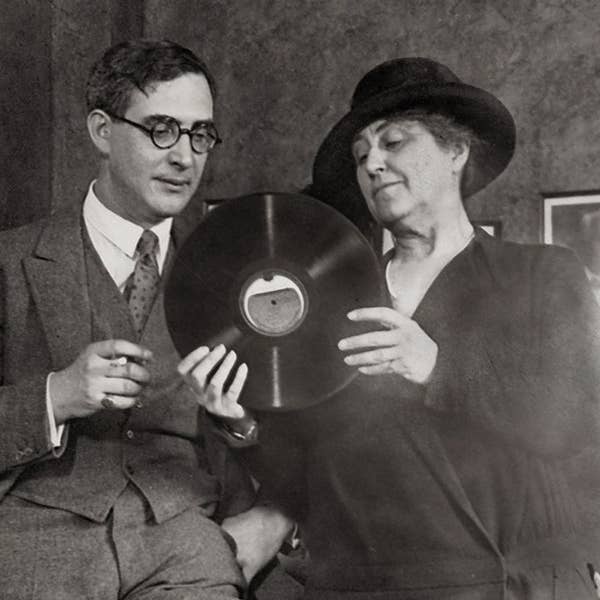
On January 23, 1924, several dozen Cleveland Orchestra musicians and Music Director Nikolai Sokoloff arrived at the Brunswick Records recording studio in Midtown Manhattan. The night before, the Orchestra had performed a program at Carnegie Hall and were now preparing to inscribe a shortened, 4-minute-15-second-long version of Tchaikovsky’s 1812 Overture onto wax. Sokoloff gives the following account in his unpublished memoir:
The [recording] horn was set up and the musicians were grouped behind it on tables, risers, packing boxes, books, even two stepladders, in addition to tall stools. After immense effort, we got the sound balanced — more or less — and started to record. Three hours of struggle, corrections, errors and retakes later, we finally had a good “take” going for slightly over four minutes and victory was in sight. With ten seconds to go (that was six bars from the end of the piece), a large packing case suddenly collapsed, felling our first trumpeter (unhurt, thank heaven) with a thunderous crash. Thus ended the first recording session of the Cleveland Orchestra!!
The cartoonish scenario of the first recording session did not deter Sokoloff and the young Orchestra from continuing to explore this new aural medium both in New York and back at Cleveland’s Masonic Auditorium. One of the biggest opportunities came in 1928 when Cleveland became the first orchestra to record Rachmaninoff’s Second Symphony. The composer trimmed the symphony especially for the recording project, but it was an arduous task. As Sokoloff admitted, “Even with the cuts, it took us four hours of almost every morning of a week in New York to record it!” Though this would be the final recording of the Sokoloff era, his tenure also brought about the construction of Severance Hall in 1931, which came with a radio broadcast studio that could accommodate up to 125 musicians.
In 1933, Music Director Artur Rodziński arrived in Cleveland in the wake of the Great Depression, which took its toll on the recording industry, but by 1935, interest began to stir again. Several years later, in 1938, the Orchestra signed a contract with Columbia Records and would go on to record a total of 28 works under Rodziński’s baton, a wide-ranging collection that includes music by Beethoven, Mendelssohn, Weinberg, and Jerome Kern. Notable also is the first recording of Berg’s Violin Concerto with soloist Louis Krasner, who performed the work’s world premiere in 1936.
Rodziński’s recorded legacy in Cleveland stopped short in 1942 when James C. Petrillo, president of the American Federation of Musicians, banned all musicians from participating in recording activities as part of his campaign against “canned” music. The ban would last more than two years.
Erich Leinsdorf was over a year into his tenure as Music Director when Petrillo lifted his recording ban. However, Leinsdorf recorded relatively little in his three years with the Orchestra — military service and a contractual disagreement with Columbia being the main factors — but he still managed to capture works by Dvořák, Rimsky-Korsakov, Robert Schumann, and others.
George Szell’s arrival in Cleveland in 1946 opportunely coincided with a golden age for classical recordings. Even when considering another recording stoppage by Petrillo from 1947–48, Szell’s first decade was surprisingly underrepresented on LP; only 14 works were recorded in his first nine seasons at Severance.
This changed in 1954 when the Orchestra signed a contract with Columbia subsidiary, Epic Records. Over the remaining 16 years of Szell’s tenure, the Orchestra would produce definitive recordings of works by Beethoven, Brahms, Mozart, Haydn, and many others. (Szell and the Orchestra were also the first to record Walton’s Second Symphony and Hindemith’s Symphonic Metamorphosis of Themes by Carl Maria von Weber.) Overall, the Szell era produced more than 100 recordings, many of which would serve as a calling card for the Orchestra and win fans across the world.
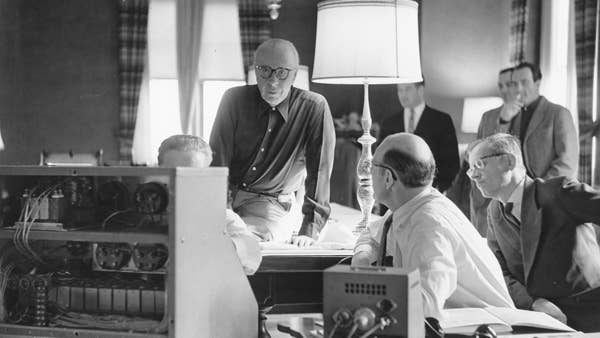
Following the unexpected death of Szell in the summer of 1970, the appointment of Lorin Maazel as Music Director ushered in a new opportunity with London-based Decca Records. After recording the complete ballet score of Prokofiev’s Romeo and Juliet, the Orchestra signed a three-year, 13-record contract with Decca, which would include the first in-stereo release of Gershwin’s opera Porgy and Bess. The recording won the 1976 Grammy for Best Opera Recording.
At the same time, Cleveland-based Advent Records, which would evolve into Telarc, was pioneering a new “direct-to-disc” technology that produced enhanced, high-fidelity recordings. Cleveland embraced this new technology, and its LP of Maazel conducting works by Berlioz, Bizet, Falla, and Tchaikovsky was the first classical direct-to-disc LP when it was released in 1977.
Eight years earlier, in 1969, the French composer and conductor Pierre Boulez was appointed principal guest conductor and would soon begin releasing his own recordings with the Orchestra. The first was a compilation of works by Debussy, which received the Orchestra’s first Grammy Award for Best Classical Performance, followed by Stravinsky’s The Rite of Spring, which received the same award the following year. In all, Boulez won five Grammy Awards with the Orchestra. (Other guest conductors, including Vladimir Ashkenazy and Oliver Knussen, also made notable recordings with the Orchestra.)
Like Maazel, Christoph von Dohnányi also had an established relationship with Decca when he arrived in Cleveland, and by his second season as Music Director, the Orchestra had deals with three companies: the European recording company Teldec, Decca/London, and Telarc. In the early 1990s, Dohnányi embarked on one of the Orchestra’s most ambitious recording projects yet: all four operas of Wagner’s Ring cycle. Due to the project’s complexity and external pressures on the recording industry, only the first two installments, Das Rheingold and Die Walküre, were released.
Dohnányi would record 109 works with the Orchestra, including the complete Beethoven symphonies and music by Mahler, Schoenberg, Lutosławski, and John Adams. One of the final recordings of his tenure, featuring works by Ives and Ruggles, won the Orchestra’s eighth Grammy, this one for Best Orchestral Performance.
Franz Welser-Möst stepped into the role of Cleveland Orchestra Music Director at an inauspicious time for the recording industry. Turning this challenge into an opportunity, the Orchestra not only pursued audio recordings but also ventured into video recordings. Five of Bruckner’s symphonies were released on video, including two recorded in Austria’s St. Florian Monastery, where the composer was a choirboy and organist, and is now buried.
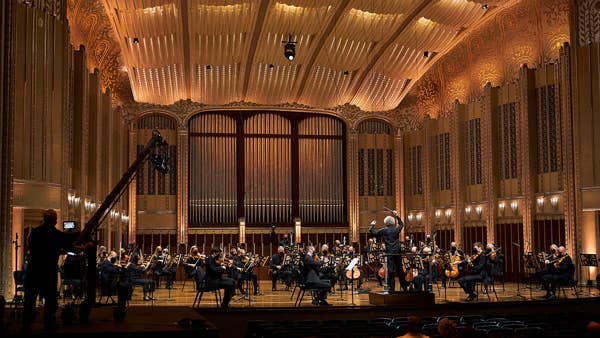
In 2020, the Orchestra launched its own recording label with the box set A New Century, featuring Welser-Möst conducting six works spanning three centuries, from Beethoven to commissions from two of the Orchestra’s Daniel R. Lewis Young Composer Fellows: Johannes Maria Staud and Bernd Richard Deutsch. Since then, the Orchestra has issued 13 recordings of 27 works, including its first digital-only releases.
At the same time, the streaming platform Adella.live, also launched in 2020, has offered a fascinating window into the Orchestra through behind-the-scenes features, pre-filmed interviews, and video broadcasts of live performances.
Since 1924, The Cleveland Orchestra has released 833 commercial recordings. With its recent leap into the world of digital and streaming, one can only imagine what the Orchestra’s recordings will look like 100 years from now. But if its track record is any indication, The Cleveland Orchestra will venture into new territory with an innovative mindset and continue to capture musical excellence for future listeners, no matter the medium.
— Written by Amanda Angel and Kevin McBrien, with research by Cleveland Orchestra Archivist Andria Hoy.