A Conversation with Marc Damoulakis
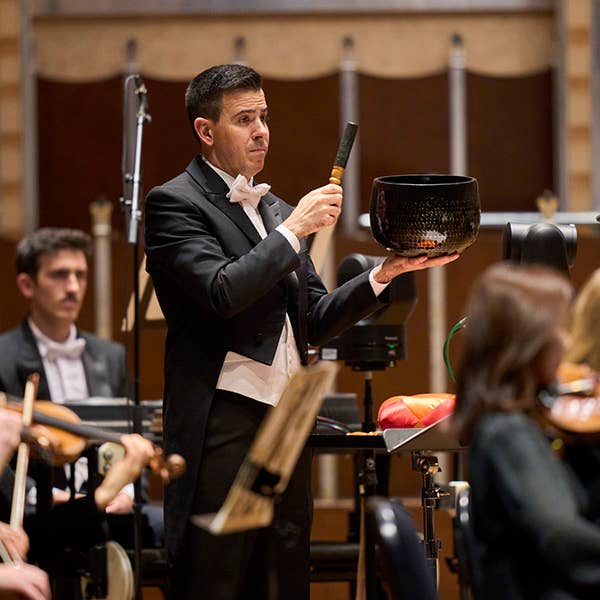
The Cleveland Orchestra performs Tan Dun’s 1998 Water Concerto, conducted by the Academy Award–winning composer-conductor, on October 31 and November 2. We recently sat down with Principal Percussionist Marc Damoulakis to learn about performing this unique work and the preparations involved.
Will this be your first solo venture with the Orchestra?
I performed John Corigliano’s Conjurer concerto during Covid, which was my first solo appearance with the Orchestra. We were distanced, since it’s for strings and percussion only, and it was recorded for Adella.
How did you come across Tan Dun’s Water Concerto? Have you known about it for a long time, or was this a recent discovery?
It was written for my teacher, Christopher Lamb, and commissioned by the New York Philharmonic. I heard him play it in Boston in 2001 while I was in the New World Symphony and was absolutely taken by it. As percussion concertos go, it’s a fascinating one and I thought it would be great to give it a shot someday.
Was this also your first exposure to Tan Dun’s music?
He wrote a concerto for cello and percussion quartet that I played as a student, so I was familiar with him and his music. I didn’t realize he did film scores until Crouching Tiger, Hidden Dragon was released, which is probably the opposite for most people. I knew him first as a concert composer!
This is an incredibly unique piece in terms of the setup and instruments required. Describe a bit about what that entails. What does your preparation look like?
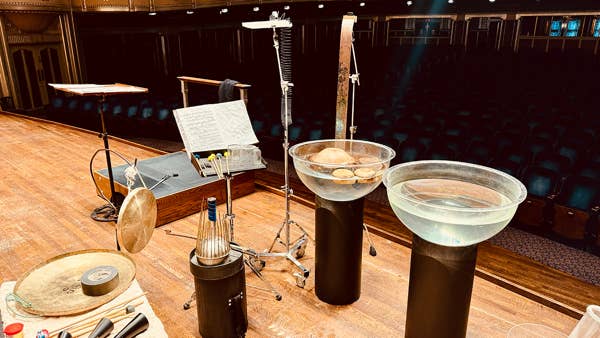
Finding and sourcing this stuff has taken tons and tons of hours. The soloist has two large acrylic hemispheres that are filled with water, miked, and placed on stands that are lit from beneath. Each member of the percussion section also has one of these bowls. As far as sounds go, there’s water dripping, plucking, splashing, bubbling. There are wooden bowls that are flipped upside down, float on the surface, and act as drums, alongside other cylinders, cups, and tubes that manipulate the water. Tan Dun calls for an instrument called the waterphone — this steel resonator that’s filled with water that can be bowed or drummed — which looks and sounds amazing. There are also some traditional instruments like gongs, bells, and vibraphone. So, it’s been really challenging to explore all these sounds. It’s like learning a completely different language.
Looking through the score, it seems like there’s some flexibility to put your own spin on the work. Do you feel that when you’ve been preparing it?
Yes, I do! There’s room for creativity and improvisation as well. The piece also has a theatrical element, but it comes honestly. It embodies the element of water. Tan Dun has taken something that’s so familiar to everybody and isolated it, putting it under a microscope. It’s an entirely original way to say something.
How would you tell someone who’s not familiar with the piece or Tan Dun’s music what to listen for? How would you recommend they go into this experience?
I would say just enjoy the experience. It’s a unique piece and utterly different than anything else. On one level, it stays true to a lot of what we percussionists do, engineering sounds and playing grooves, yet here, these are displaced on instruments that are completely one-of-a-kind.
Should people in the front row bring a poncho? I’m sure you’ll be wearing something that can get splashed!
Oh gosh … Hopefully not! There are many interpretations of this piece, and some span the spectrum of how crazy they get. Tan Dun dedicated the concerto to Tōru Takemitsu, so in my mind, that evokes more of a quiet garden rather than wild splashing. But we’ll see what happens!
Marc Damoulakis is Principal Percussionist of The Cleveland Orchestra. He holds the Margaret Allen Ireland Chair.