A Conversation with Mark Kosower
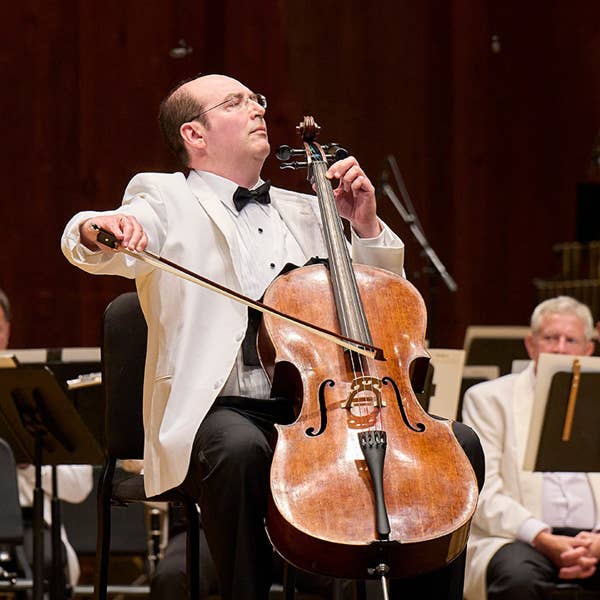
On February 7–9, Principal Cellist Mark Kosower tackles Dutilleux’s Tout un monde lointain… for cello and orchestra. Kosower discusses this fascinating piece, his role as a principal string player, and his fleeting impressions of Pierre Boulez.
Talk a bit about the Dutilleux work. Have you performed it before? What made you choose it?
It’s funny because the guest conductor for those concerts, Thomas Guggeis, actually requested it! I’ve never played it, but it just so happened to be one of those works I’ve always wanted to learn and perform. It’s definitely different than your standard Romantic-era concerto. One of the most striking things is the role of the soloist. You’re sort of this voice of the cosmos instead of the “hero” that overcomes a struggle. The language is “atonal,” but it often doesn’t sound that way. The orchestration and colors are very much an outgrowth of the French tradition: Debussy, Ravel, Messiaen, and Boulez. It’s absolutely captivating. The first time I heard it, I thought, “Wow, I want to hear that again!” It just draws you in.
Plus, it fits nicely in that program with Ravel’s La valse and Richard Strauss’s Also sprach Zarathustra, which famously has the 2001: A Space Odyssey connection.
Absolutely! The perfect type of program for early February.
What is your preparation like for a work you’ve heard a lot but have never performed before?
It’s a very complex work, so it requires a lot of score study. I’ve also been listening to different recordings to gain some points of reference. And in addition to working on it by myself, I’m practicing with a pianist because, harmonically, it’s very sophisticated. A piece like this needs a lot of playing to make it feel “normal.” I try to work on things from many different angles; it gives you a fuller, complete kind of approach. But I’m so fortunate to get to sit in front of this amazing orchestra and play this piece.
For those who may not know, what does your role typically look like as a principal string player?
There are several things. As principal cello, you’re the leader of the bassline in most musical compositions. You need to have a strong understanding of how the harmony works and develops in each piece. There are melodic places where the cello section is leading, but there are also places where you provide support. So, it’s all about interpreting your role in the music and setting the tone for the group. Also, before the first rehearsal, I coordinate bowings with the other string sections. We do bowings before anything starts so they align with the other sections and our own musical style. Some educated guessing is often required — since we don’t always know what the conductor’s interpretation will be — so we might tweak some things later during rehearsal to make it work better.
You mentioned Boulez earlier. Since 2025 marks the centennial of his birth, do you have a favorite memory or impression of working with him when he conducted the Orchestra?
Sadly, the first time I got to play for him in 2012, he conducted half a rehearsal and then had to pull out due to health concerns. So, I didn’t really experience him, but he was such a gentleman and still stuck around to observe the rehearsals. This was the last we saw of him; he passed away a few years after that.
He was one of the greatest musical minds and had one of the greatest sets of ears. He could pick out anything, anywhere. One touching thing was in the Mahler 10 video recording he made with the Orchestra the year before I arrived in Cleveland: It was his birthday, and Franz [Welser–Möst] came on stage with a cake. And you can see in Franz’s eyes the admiration he had for that man. Boulez loved the Orchestra, and it seems like the Orchestra really loved him too.
It certainly does. One last question: Outside of your Dutilleux performance, what other concerts are you excited about in the remainder of the season?
I’m really looking forward to working with Elim Chan again [January 16–18]. And the piece she’s bringing — Lutosławski’s Concerto for Orchestra — is outstanding. I first played it with Franz in 2012 and was so taken with it. It’s an amazing piece in the same vein as Bartók’s own Concerto for Orchestra. Outside of that, I always enjoy returning to Carnegie Hall [March 18 & 19]. Other than Severance, it’s one of my absolute favorite halls in the world. And I’m also excited for Janáček’s Jenůfa [May 17, 22 & 25]. When we did The Cunning Little Vixen several years back, it was so memorable. That composer has such a specific, individual voice, and I can’t wait to return to his music.
Mark Kosower is Principal Cellist of The Cleveland Orchestra. He holds the Louis D. Beaumont Chair.