Aurora Rising
Completed in 2019, Oded Zehavi’s concerto for piccolo finally gets a world premiere performance, featuring Principal Piccolo Mary Kay Fink.
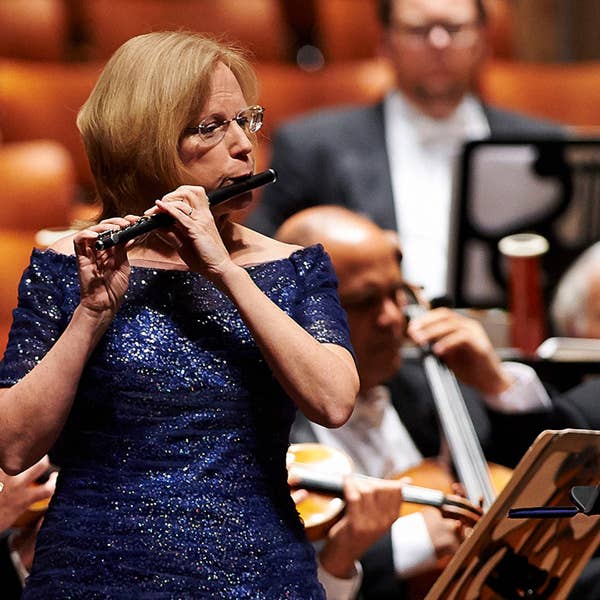
The music of Oded Zehavi is often singled out for its stylistic diversity and mélange of Western and Middle Eastern musical heritages. But ask him about his inspiration and he will say, “I’m a person’s person, a composer of human experiences. The origin of a piece is the person.” When he heard Principal Piccolo Mary Kay Fink perform in Cleveland in 2015 there was a spark — the kind that moved Johannes Brahms to compose masterpieces for the violin virtuoso Joseph Joachim. Zehavi knew he had found the one for whom he wanted to write a piccolo concerto, an idea he’d sprung long before as a graduate student studying with George Crumb.
Meeting Fink was a key moment in what turned out to be an extended journey. So much has transpired since the completion of Aurora in 2019 and its full orchestral premiere in March 2024 (delayed nearly four years), it’s difficult to talk about the piece purely in terms of the composer and performer’s original intentions. There was a global pandemic, emergence into a world that is still trying to find its feet, then heartbreaking loss and international warfare in the run-up to the March performances at Severance Music Center. If Zehavi’s music reflects human experiences, it seems impossible not to consider these as part of the tapestry. As it is, the sonic landscape of Aurora is deep and spacious enough to accommodate much nuance — a broad palette of mystery and color rooted in clear, lyrical melodies and occasional bells that toll from afar.
The tubular bells have a poignant presence in the Israeli composer’s music, which draws from Jewish and Arabic music traditions, European art song, and contemporary sensibilities. Their sound reflects one of his strongest war memories as a tank commander in the Lebanon War of 1982. At one point his unit was stationed in a churchyard. “While we were there it was completely surreal,” says Zehavi, a resident of Tel Aviv and professor at Haifa University. “Every hour you would hear the bells, so I think in every piece of mine you will find these chimes. It is a recurring sound I carry with me from this war.”
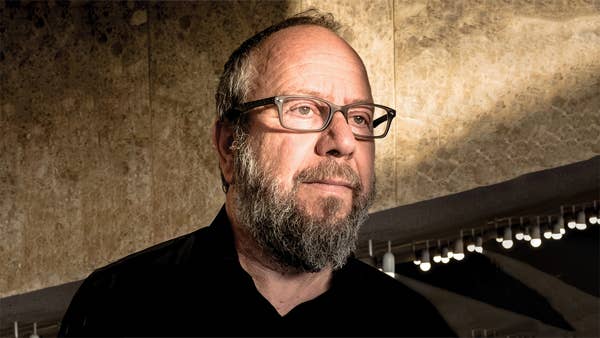
His mandatory service as a soldier had other profound effects: He committed to composing because he survived the battlefield and felt obliged to share what he experienced there. It freed him creatively (“After you see what life and death are,” he says, “you don’t care much about what your peers will say about your stylistic coherence. It changes your proportions.”). It even impacted his willingness to have children. After his composition Elmale was premiered in Aqaba, Jordan, by Valery Gergiev and the Kirov Orchestra (now the Mariinsky) in 1996, he told his wife they could go ahead. The commission was part of an international festival that took place in both Israel and Jordan as a gesture of peace.
War, however, continued to mark their lives. The 2023 eruption between Israel and Hamas had the composer devastated and questioning his purpose — again — in the midst of such tragedy. “I am writing this while getting in and out of our bomb shelter in the heart of Tel Aviv,” Zehavi wrote a few weeks into the cataclysmic turmoil following the Hamas attacks of October 7. “Lately I do ask myself why am I doing all this. What is the point of writing music in these times. I used to say that writing through my perspective of things is important, but I am not so sure of it anymore.”
What must hold true is something he said, before the latest outbreak of war in the region, about his creative process for Aurora. “As a composer here I’m wandering, I’m picking up impressions. I capture them, I cherish them.”
His pivot to people as the primary inspiration for his music came well into his career, after his multifaceted body of work had been widely played, including vocal, chamber, and orchestral works along with film soundtracks and pop/rock arrangements. It was during his artist residency at the Cleveland Institute of Music that Zehavi saw Fink in concert and was immediately taken with her potent musicality.
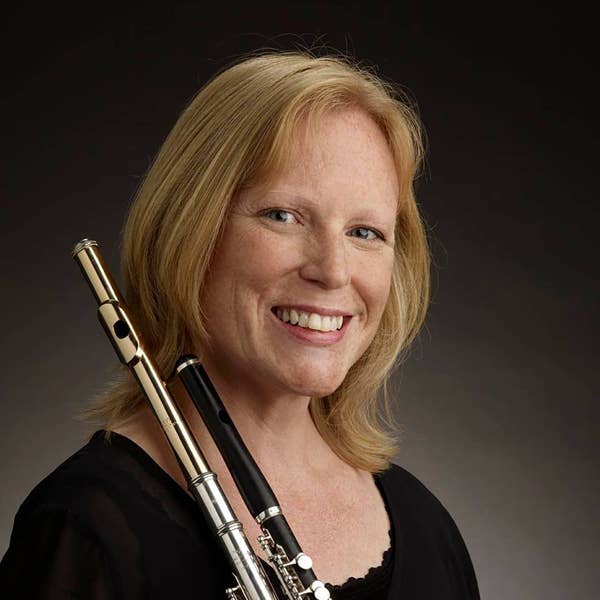
“Mary Kay is so human. She has such a wide range of expression as a person, a musician, and a player that I didn’t see anything she couldn’t do,” Zehavi says. He approached her about a concerto and Fink’s instructions were specific: a 10–15–minute composition that steered clear of common piccolo tropes (birds, marches) and an orchestral accompaniment that didn’t challenge the volume of the instrument.
“Oded beautifully avoided all of those stereotypes and really showed that the piccolo can be virtuosic and also very soulful. That’s what I was looking for,” says Fink, who heads the flute department at CIM and has actively commissioned works for piccolo, including Gabriela Lena Frank’s Will-o’-the-Wisp, a tone poem she premiered with The Cleveland Orchestra in 2014.
Zehavi’s goal from the start was to reveal the piccolo’s — and Fink’s — melodic and expressive capabilities, and he is keen to credit Fink for her contributions in what was a close collaboration. “When you hear a player who isn’t fighting the instrument but lets the vibrations happen and has soulful control, all you want to do is to give them a vehicle,” he notes. “You become an instrument in their mastery of their instrument.”
The intimate chamber orchestra scoring includes only horn for brass and several winds, along with timpani, vibraphone, wood blocks, the tubular bells, harp, and strings. (At Fink’s request, Zehavi also composed a chamber reduction for piccolo, piano, and percussion that was performed in March 2020, just as the world went into pandemic lockdown.) Together there is a tight conversation of timbres, melody, tones, and textures — grounded in melodious richness — that offer many moods and colors set against an ambient wash.
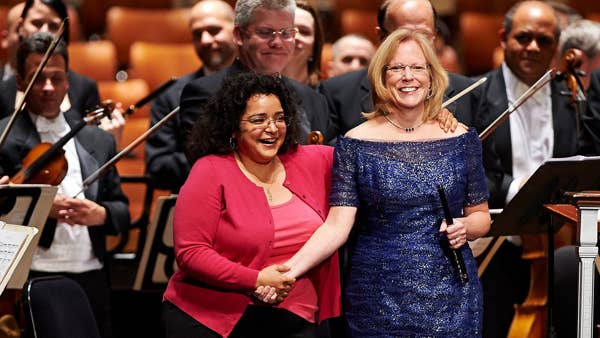
As with much of Zehavi’s music, Aurora is also tinged with a solitary, sometimes melancholic, feeling, with echoes of something both ancient and contemporary. The composer’s beautifully blended aesthetic is a testament to his own personal history. Born in Jerusalem, he describes his upbringing in a “very multicultural environment” near the Old City. “On top of all the Jewish melodies from various ethnically diverse synagogues around me,” he says, “we also heard the mosques calling and the church bells from the other side of the wall. So for me variety was the baseline, the norm.”
His studies then followed a series of teachers from international backgrounds and musical styles, including a Hungarian student of Bartók and a Russian one of Shostakovich, as well as American composers George Crumb, Sheila Silver, and Chinary Ung. Zehavi’s ease crossing genres and eras even shows in the way he mentions Sondheim’s Sweeney Todd and Mahler in the same thought stream.
If Zehavi’s melding of musical styles and cultural influences could be a mirror of the human world we live in, perhaps there is some sanctuary to be found in its cohesive and transcendent harmony. In Aurora, the clarity of the piccolo’s long, sustained melodies leads the way. And despite the specificity of its title, the work is meant to evoke a space that is not a particular thing but rather the essence of change — of something emerging out of something else. An emergence that we have some capacity to interpret, shape, and perhaps cherish.
— Luna Shyr
Luna Shyr is a freelance writer and editor. Her work has appeared in National Geographic, The Wall Street Journal, Atlas Obscura, and at Lincoln Center for the Performing Arts.
Mary Kay Fink is Principal Piccolo of The Cleveland Orchestra. She holds the Ann M. and M. Roger Clapp Chair.