Deeper than Friendship: The History of the Women’s Committee of The Cleveland Orchestra
Founded in 1921 as The Women’s Committee of The Cleveland Orchestra (WCCO), the Friends of the Cleveland Orchestra organizes fundraising events, volunteer services, and music education activities across Northeast Ohio. In 2021, the organization celebrated its centenary as an important part of the Orchestra’s support network.
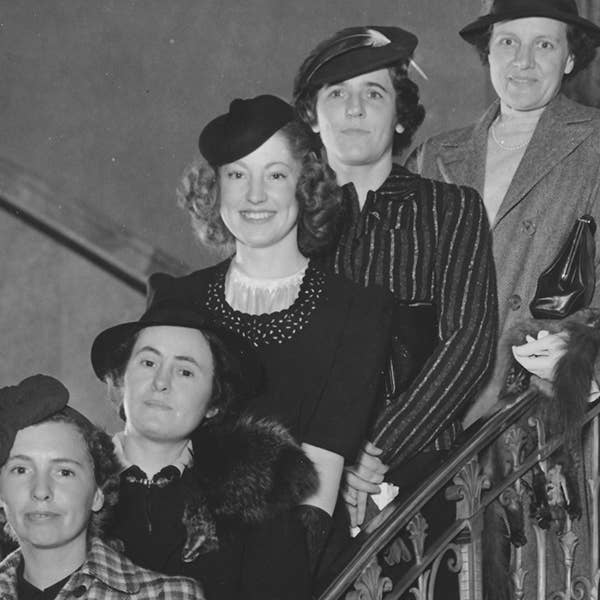
When my husband and I first moved to Cleveland a few years ago, we were welcomed with a handwritten note and a basket of Orchestra-themed goodies from the Friends of The Cleveland Orchestra (FCO). We were excited that he had won his dream orchestral job, but nervous about making a new start in an unfamiliar place. In our house full of unopened boxes, disassembled furniture, and anxious anticipation, I remember looking at the vibrant basket on our table and thinking, “Clevelanders are so nice, we’re going to be OK.” I stuck the note to our empty fridge with a TCO magnet and set to unpacking our new lives.
Beyond warmly welcoming new Orchestra members, the FCO organizes fundraising events, volunteer services, and music education activities across Northeast Ohio. In 2021, the organization celebrated its centenary as an important part of the Orchestra’s support network.
Beginnings
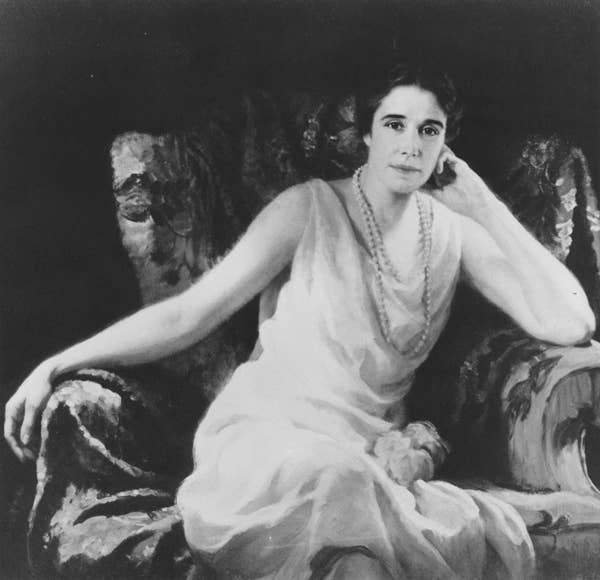
Founded in 1921 as The Women’s Committee of The Cleveland Orchestra (WCCO), the FCO’s story begins even earlier, with one particularly strong woman. Adella Prentiss Hughes was a force to be reckoned with, a pioneering woman who almost single-handedly built Cleveland’s classical music culture. Her efforts began in 1901 with the Symphony Orchestra Concert Series, followed by the founding of the Musical Arts Association (MAA) in 1915 and of The Cleveland Orchestra itself in 1918. It did not take long to recognize that this latest project was a success, and by the time the Orchestra was in its third season, Adella decided to mobilize the wives of trustees and donors into a committee to help promote the Orchestra.
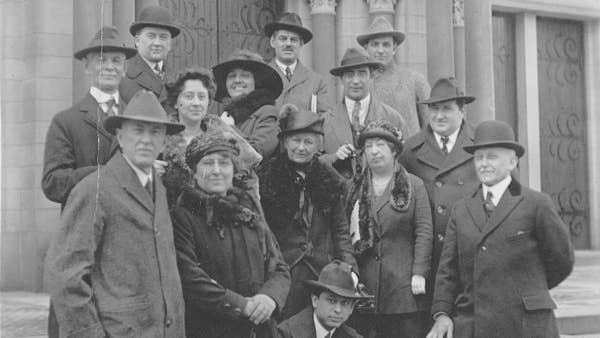
Drawing from the capable ranks of the recently dissolved War Time Canteen Workers, Adella hand-selected the first members of the WCCO in 1921. In the early years, membership was by invitation only and further restricted to season subscribers and donors to the Annual Fund. Annual dues were $5 (equivalent to about $90 in today’s currency) for the 30-member board and officers. This may seem overly selective, but social planning and fundraising were still the (unpaid) professional milieus of upper-class women in the early 20th century. These wives of Cleveland’s elite moved in the right circles to drum up significant interest and funds for the up-and-coming Orchestra and ensure its survival.
Adella chose Lillian Wick (née Schuttler), wife of steel executive Myron Arms Wick, to be the first president of the Women’s Committee. The Cleveland Plain Dealer quotes her as declaring, “We look to the women of Cleveland because women are the natural educators through whose influence the cultural and beautiful things in life are fostered” (1/29/1922). A formidable leader, Mrs. Wick quickly gathered forces and set to work, organizing events and selling tickets. Monthly meetings of the Committee were held in the Hughes and Wick homes.
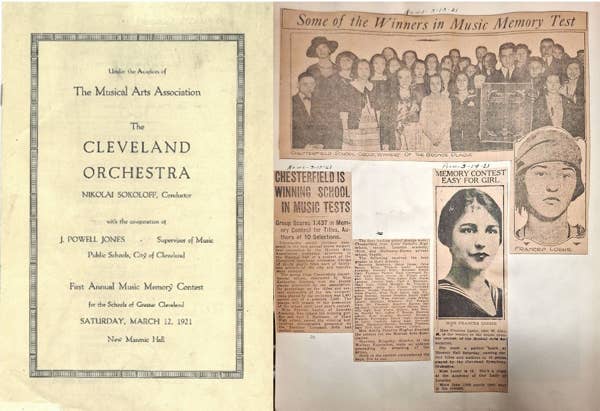
The first major event sponsored by the WCCO in 1921 was the Music Memory Contest. This competition was designed for school teams to compete against each other by recognizing details about classical music covered by their school curriculum. The contest itself featured pieces performed live by The Cleveland Orchestra. While the contest papers were graded by volunteers, the Orchestra played a short concert. It was immediately clear that parents were also interested in participating in the contest, so an adult division was created for future years, in connection with community music appreciation classes and lectures. The contest was so successful that it lasted well into the 1960s (with phonograph recordings eventually replacing live performances), and the adult music appreciation groups continued for nearly a century, until the COVID-19 pandemic.
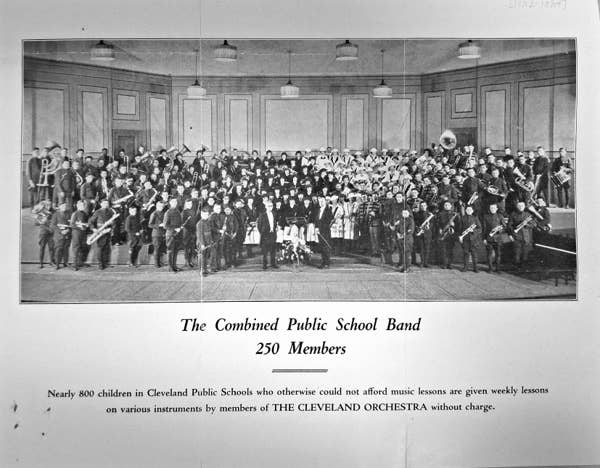
From the beginning, education was high on Adella’s list. In the 1920s, she forged a relationship with Frank Spalding, superintendent of schools, in the interest of promoting instrumental music education and worked tirelessly with Music Director Nikolai Sokoloff to build creative education programming. The Children’s Concerts Committee, an offshoot of the WCCO, took over educational programming for the orchestra in the 1921–22 season. Committee members would organize tickets by region of the city on the floor of Cornelia Root Ginn’s living room, before divvying them up to sell and deliver. Cornelia was the perfect woman to chair this effort — a mother of four, she regularly corresponded with Maria Montessori and even started Cleveland’s first Montessori school in her attic. Her husband, Frank Ginn, was a founding member of Adella’s Musical Arts Association.
In addition to outreach and ticket sales, the WCCO organized adult music appreciation classes and hosted afternoon luncheons after matinee concerts in Masonic Hall’s Mezzanine Tea-room. Members formed other subcommittees in the years that followed as the WCCO took more ambitious steps to encourage engagement and bolster concert attendances. The Extension Committee offered informative talks on the Orchestra to other local organizations, the Quartet Concerts Committee offered subscriptions to house concerts given by the Orchestra’s principal strings, and the Orchestra Schools Committee sent 30 members of the Orchestra to East and West Technical High Schools on Saturdays to offer free music instruction to approximately 800 students.
In 1925, the Women’s Auxiliary Committee was formed to involve more people in the WCCO’s efforts and vision. Mrs. Ray Hahn Joseph — wife of Joseph & Feiss Co. vice president Ralph Joseph (who was also an accomplished pianist) — stepped up to direct this new endeavor in addition to her role as chair of the Extension Committee. The membership restrictions were the same as for the original Committee, but the Auxiliary Committee met only two or three times a year, with lower annual dues of just $1. Modeled after the Women’s Committee of the Philadelphia Orchestra, this new group was tasked with filling seats at Saturday concerts.
One way they did this was through benefit bridge parties. At these stylish events, women on the Committee solicited donations from wealthy patrons to fund scholarship tickets for students, veterans, disabled people, and those living in charitable institutions. Similar fundraising events structured around card games continued into the 1940s.
In 1926, Elisabeth Severance Prentiss — sister of John Severance and wife of MAA member Dr. Francis Fleury Prentiss (no relation to Adella) — was named WCCO President. She oversaw the biggest event of the 1920s: the Court Pageant and Ball, a fundraiser celebrating the centennial of Beethoven’s death. Mrs. Florence Snider Brewster designed the evening to mimic a reception and dance at the Court of Maria Theresa, Empress of Austria. The lavish ball, held in Masonic Hall on April 23, 1927, was intended to compete with similar spectacles and celebrations happening in Berlin, Vienna, and Paris that same year.
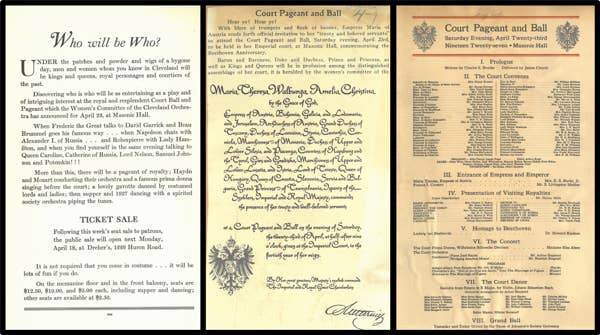
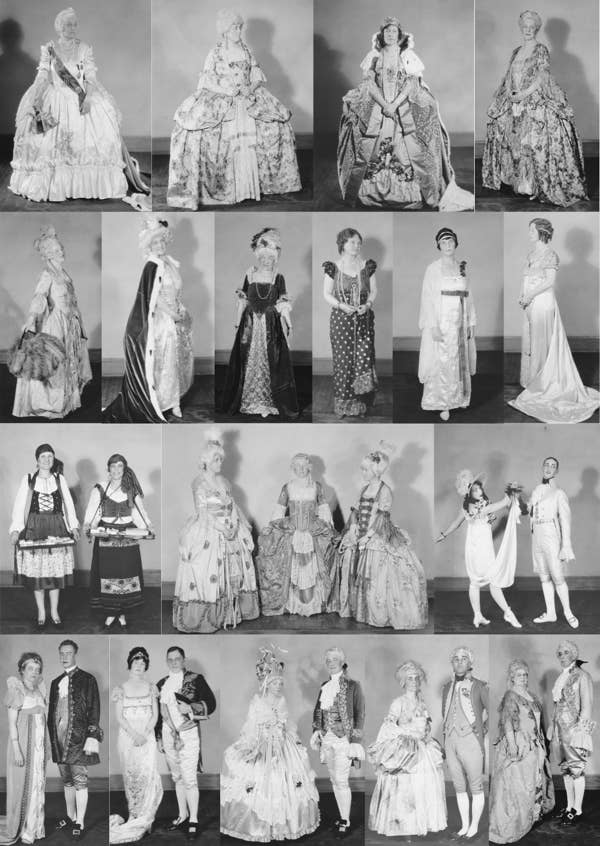
Guests, musicians, and Committee members dressed as historical figures in period costumes, many rented from New York. Some notable examples included pianist Arthur Shepherd as Haydn and Assistant Conductor Rudolf Ringwall as Mozart. Attendees paid $12.50 for tickets and were instructed to wear powdered wigs and period ribbons. The Orchestra offered a brief performance, and Music Director Nikolai Sokoloff led 20 prominent Clevelanders in a gavotte. Despite the high ticket prices and wealthy guests (not to mention the fact that the musicians donated their services), the event fell far short of its $4,000 fundraising goal. Luckily, a few generous last-minute donations wiped away the deficit and rendered the opulent event a success in the end.
On the whole, the first decade of the WCCO was marked by creativity and success. Music appreciation was firmly established in Cleveland public schools through the “Cleveland Plan,” as overseen by Lillian Baldwin, and scholarship tickets continued to be offered to needy community members. By the 1929–30 season, membership of the Auxiliary Committee had swollen to 509, and there were plans to double that within the year.
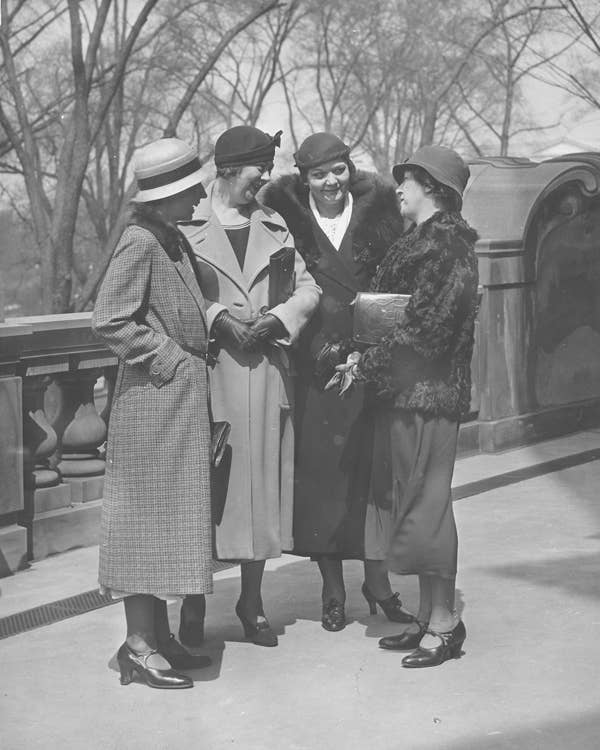
Mrs. Jane Carson Barron, who had presided over the WCCO from 1923–25, resumed her position at the helm for 1930–32. In this second term, she oversaw the establishment of bylaws and the opening of Severance Hall in 1931. Members of the Committee served as hostesses to welcome patrons into the hall for the first time, proudly showing people around the first hall in the country owned by an orchestra. It was clear that The Cleveland Orchestra and its Women’s Committee were here to stay.
The 1930s–40s: From Depression to Expansion
The Great Depression naturally cast a shadow on the excitement surrounding the opening of Severance. To keep the Orchestra afloat amidst the downturn, the WCCO split Saturday subscriptions into more affordable Series A and Series B options. Meanwhile, fundraising efforts redoubled as scholarship tickets rose in demand. The Auxiliary Committee temporarily dropped its membership requirements linked to Orchestra patronage, and Orchestra musicians agreed to receive pay based on proceeds rather than fixed salary for an added summer season.
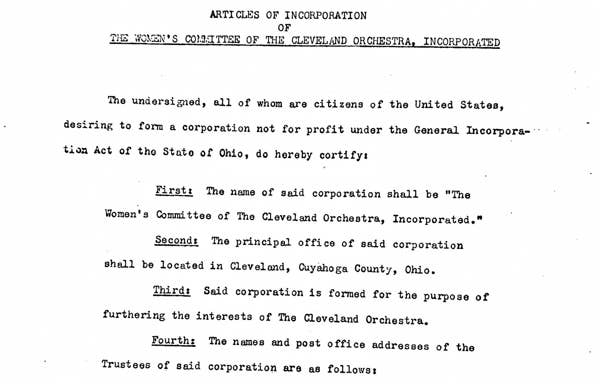
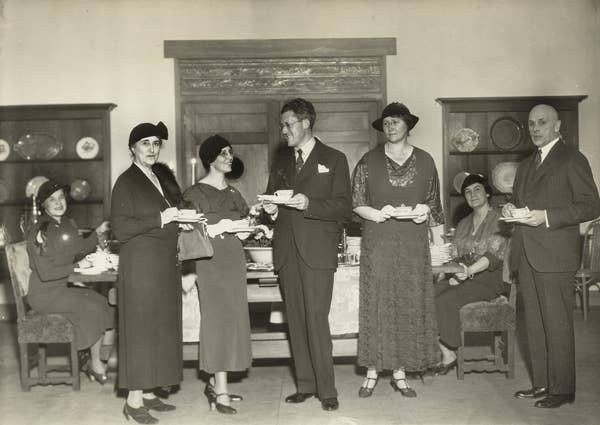
In 1930, WCCO president Jane Carson Baron corresponded with Francis Wister, president of the Women’s Committee of the Philadelphia Orchestra, to help redesign the bylaws, and in 1933, the Women’s Committee and Auxiliary Committee merged and registered as a nonprofit. Membership was opened to anyone interested and willing to pay the new $1 fixed annual fee. Change was in the air. This newest iteration of the Committee welcomed Artur Rodziński to the podium in the fall of 1933 with a special tea.
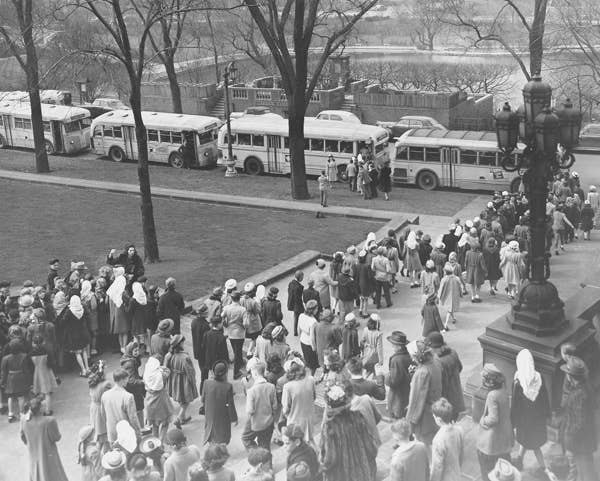
In the coming years, more subcommittees formed as outreach achieved new heights. Children’s programs grew to include subsidized bussing in 1936, and additional concerts were added for preschool students two years later. In 1937, the first Conference of Symphony Orchestra Women’s Committees convened in St. Louis. The WCCO sent several delegates to each subsequent biennial conference and even hosted the conference in1961, the WCCO’s 40th anniversary year.
A new record lending library was another successful venture to increase music engagement and membership. It was so enticing, in fact, that 31 new members signed up for this WCCO resource in 1939 — including five men! The lending library thrived from 1935–59, when it was purchased by Baldwin Wallace University.
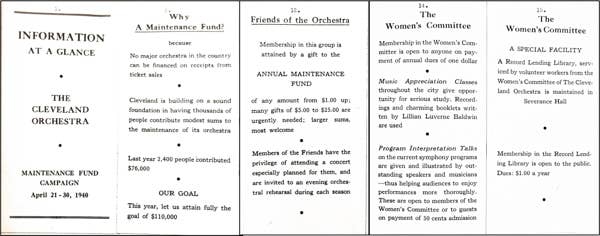
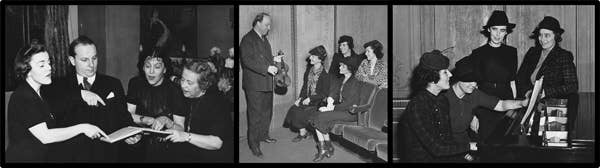
Meanwhile, the Speakers’ Committee replaced the Extension Committee, organizing dozens of Music Appreciation lectures around the region while the Program Interpretation Committee secured experts for pre-concert talks. In 1937, an additional lecture series was organized for the Halle Brothers Co. (a locally owned department store), and by 1938, the Severance pre-concert lectures were so popular that they needed to be moved from the Board Room into the Chamber Hall, where they are held to this day. With help from Halle, the Women’s Committee sponsored a special lecture by fashion designer Elsa Schiaparelli in the spring of 1941, helping set a new record for annual contributions to the Orchestra Fund. This fashion focus would become a central source of fundraising in the 1960s–80s.
During World War II, events were a bit leaner, but membership hit a new high of 1,218. Some of the music appreciation talks were now offered on Sunday radio shows. The WCCO raised $1,550 for season tickets for servicemen and their families, with an additional $1,406 raised the following year — a creative connection between arts patronage and the war effort. Additionally, a box was reserved for servicemen and servicewomen, which was used by 22 units. In 1942, the first Pension Fund concert was held to benefit musicians, and in 1945, a Hospitality Committee was formed to oversee teas and receptions.
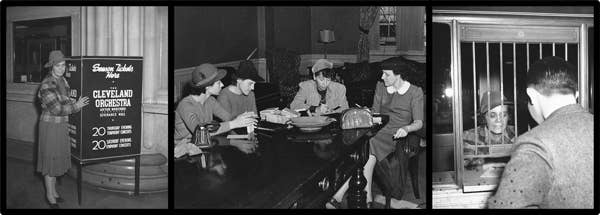
In 1946, new bylaws were ratified, introducing a $5 annual sustaining membership. Between that and 1,301 members, the Committee was able to grow its annual gift to the Orchestra Fund by 50% to $750. With growing membership and funds, Fynette Hill Kulas began employing only professional speakers for the Program Lecture series. That same year, George Szell’s first season as music director, a Radio Committee took control of a program on WGAR called “Concert Classics.” The WCCO took advantage of rising interest in recorded music in other ways, too. Otis Price, a doorman, was given a small salary to act as head librarian of the lending library, and the Music Memory Contest had officially switched from live music to phonograph.
The growing membership made increased events and fundraising possible, but what was in it for the over 1,000 women who were now contributing to the WCCO? Events and perks were included for the ballooning membership, including receptions, open rehearsals, and special music events.
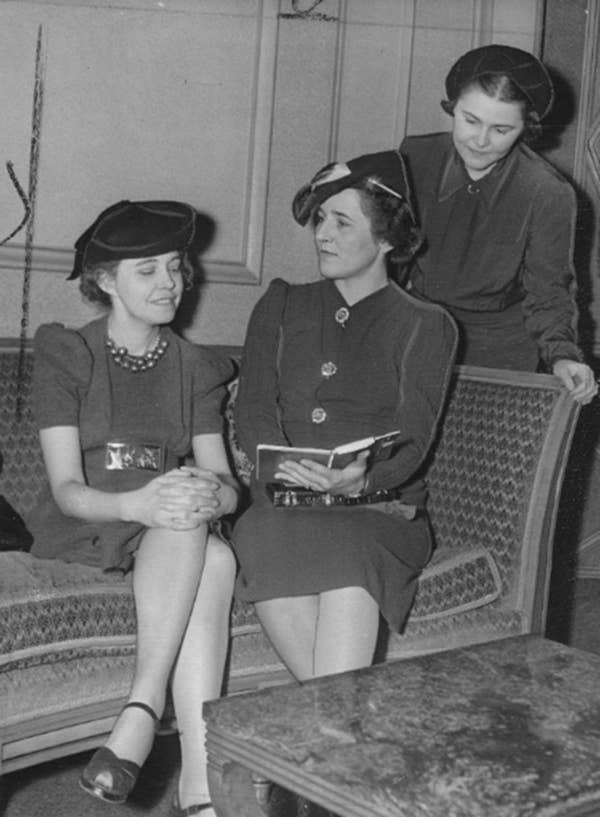
Another development for the WCCO in the 1940s was increased support for Orchestra members and their families. In 1948, the Committee threw a banquet for musicians and their spouses, which became an annual affair. In 1950, it was decided that Orchestra members who had served for 30 years would receive a special gold watch at these parties — a tradition that continues to this day (though, in 1956, it was lowered to 25 years of service).
Through the 1970s: a Four-Fold Purpose
By the 1960s, the Women’s Committee proudly espoused four key areas of engagement:
- Fundraising and ticket sales
- General educational promotion
- Socializing with musicians and music lovers
- Publicity through word-of-mouth
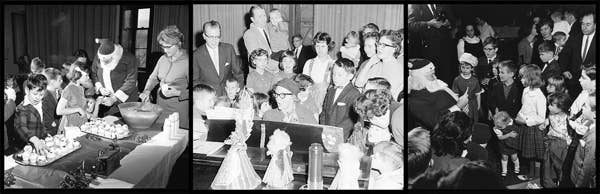
The Pension Fund Concerts, Orchestra banquets, and service awards were recent developments in the third category, and the Committee continued to seek new ways to support the Orchestra musicians. In 1957, the Women’s Committee hosted the first Christmas party for children of Orchestra members, a sweet tradition that continued for several years.
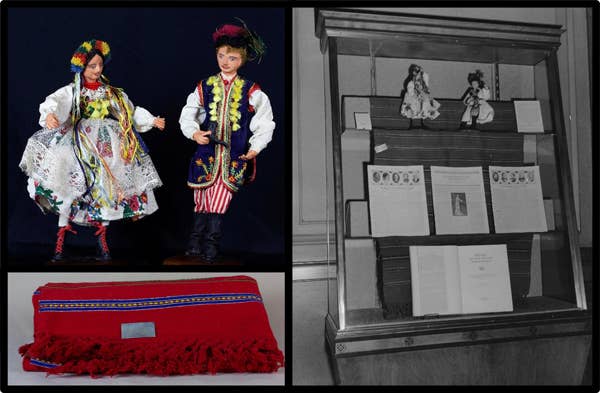
In the 1950s, the WCCO had helped musicians with a clothing drive for Polish musicians after the Orchestra experienced the devastation of World War II first-hand on a visit to Poland in 1957. Donations were collected and, in gratitude, the Katowice Philharmonic sent a blanket and dolls in traditional Polish dress as a thank-you gift.
As the Orchestra began regularly touring internationally, the Committee also started hosting going-away parties for the musicians before their departure and upon their return. The Committee organized a send-off in 1965 for the much-anticipated tour of the Soviet Union and Western Europe, and a grand party upon their return at the end of June.
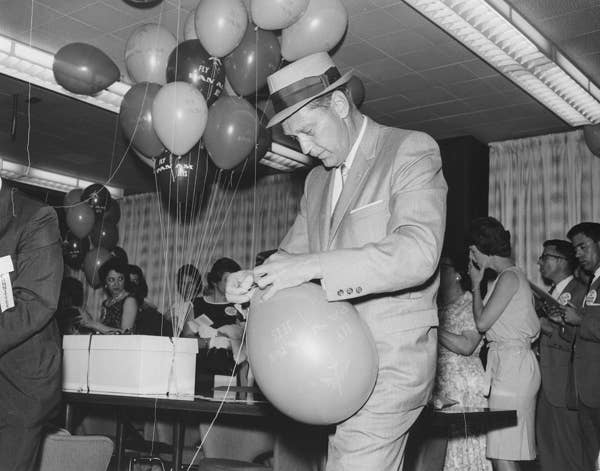
The “Sayonara Banquet” was given before the 1970 Japan tour and was echoed three years later before the next Japan tour with an even more elaborate send-off featuring festive decorations and a film on kabuki. In May 1972, the WCCO hosted a “Western Tour Send-Off Party” with a barbecue supper, country music, and square dancing for the Orchestra members before their domestic tour. In 1973, there was a “Welcome Home” party following the tour of the Pacific.
As an extension of education programming, the Alice B. Weeks Scholarship was started in 1967 to help qualified students follow careers in music. Alice was the widow of Harry Ellis Weeks, founding architect of the Walker & Weeks architectural firm that built Severance Hall. The scholarship, originally given to children of Orchestra members, is now limited to musicians of The Cleveland Orchestra Youth Orchestra (COYO). These scholarships continue to have a large impact on the lives of young instrumentalists to this day.
In addition to banquets and scholarships, the WCCO supported musicians and guests by creating comfortable spaces for them. In 1959, proceeds from the sale of the Record Lending Library were used to decorate artists’ rooms at Severance Hall. When Blossom Music Center was built in 1967, the Women’s Committee gave $10,000 to fund the piano and furnishings of the Music Director’s Dressing Room. WCCO funds also helped provide a kitchen attached to the Board Room in Severance and the foundation of the Szell Library.
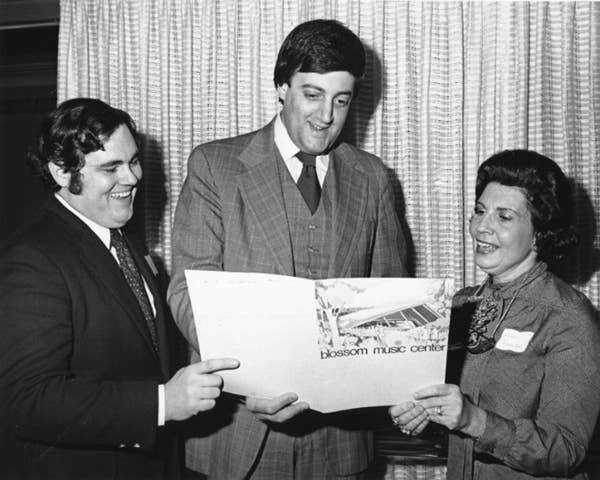
On July 19, 1968, the WCCO sponsored an opening dinner for Blossom Music Center, but the baton was soon passed to the Blossom Women’s Committee (now the Blossom Friends of The Cleveland Orchestra), founded that same year. 1968 proved to be a big year for offshoot organizations, as it also saw the founding of the Junior Committee of The Cleveland Orchestra. The added efforts of these two groups helped the WCCO support the ever-growing MAA through two musicians’ strikes, the opening of Blossom Music Center, and an unexpected music director transition following the death of George Szell.
The WCCO began their Friday Matinee concert series the 1972–73 season, at which they served brown bag lunches. There were 70 attendees in the inaugural season, but the program expanded in subsequent seasons. Throughout all of this, the WCCO continued to assist with Children’s Concerts — acting as ushers and selling tickets to schools. The Committee also sponsored 18 adult music study classes throughout the area with about 400 participants throughout the year.
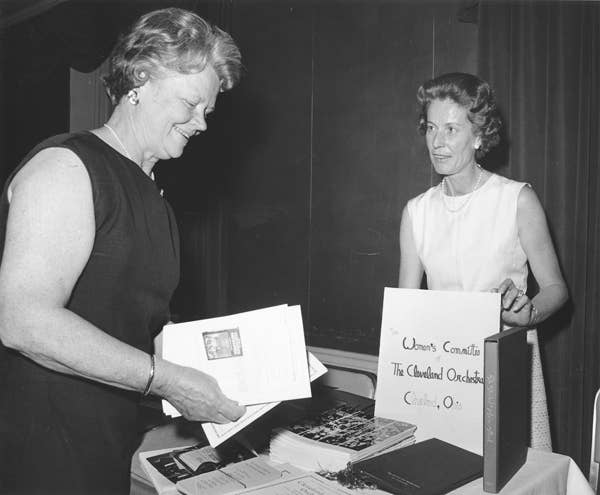
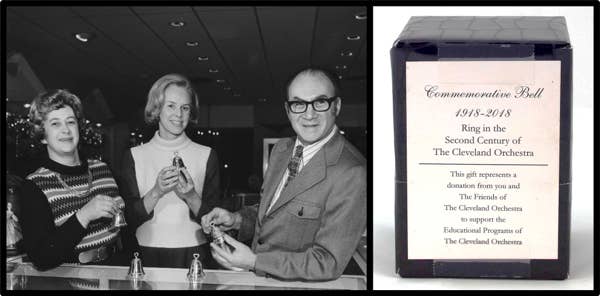
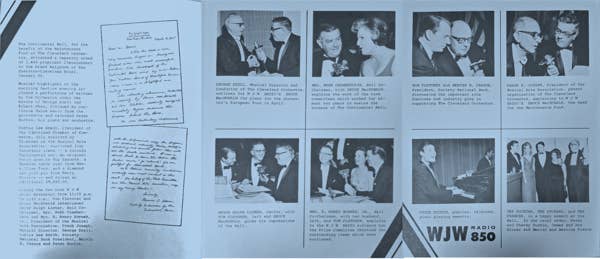
Fundraising in this era also included the sale of Orchestra merchandise and memorabilia. In 1962, the WCCO oversaw the sale of 900 records called Showpieces of the Virtuoso Orchestra as a fundraiser, and they sold 500 copies of Robert C. Marsh’s book in 1968 for the 50th anniversary of the Orchestra. In 1966, the Silver Bells fundraiser was started in collaboration with Schreibman Jewelers to raise money for educational programming.
Interlude: Having a Ball
Above all, the 1960s, 70s, and 80s were an era of spectacle for the WCCO, with elaborate fashion shows and extravagant ball fundraisers. The biennial Orchestral Ball began in 1958, and fashion shows began in 1960. These opulent events alternated every year for a decade, raising money for the Annual Fund. Most balls were held at hotels around Cleveland, with impressive guest lists and local radio coverage. Fashion shows, on the other hand, often occurred at Severance, sponsored by the Halle Brothers Co.
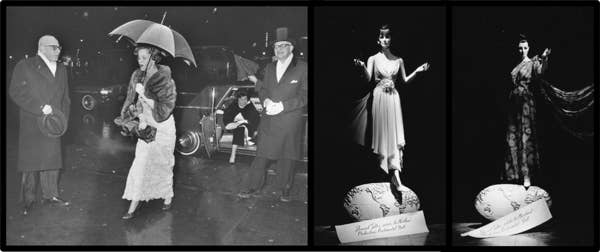
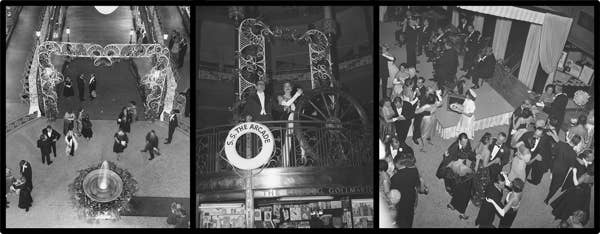
In 1970, the first Scheherazade was held — a combined fashion show and silent auction fundraiser. These proved to be a community favorite and continued biannually until the reopening of Severance in 2000. Throughout the 1970s, Scheherazade, hosted at the May Company in Cleveland Heights, alternated years with fashion shows sponsored by the Halle Brothers Co. at Severance. In that decade, balls were replaced by occasional gala fundraisers.
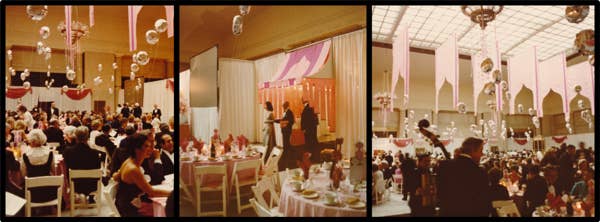
In the 1980s, an annual rhythm was reached with the Scheherazade silent auction in February, an Orchestra Ball each May, and a fashion show in September.
1980s into a New Millennium: A Growing Professionalized Organization
As economic drivers changed and more women joined the workforce in the 1980s, many of the vital roles that had for decades been filled by WCCO volunteers were increasingly overseen by new departments and paid employees of the MAA.
For example, a department of Education Activities was created in the 1980–81 season to take over the role of bringing classical music to local students. In 1994, the Music Study Groups were officially placed under the Education department and continued to meet at locations in greater Cleveland until the COVID-19 pandemic moved programming online in 2020. This, combined with the addition of box office workers and other hall staff, further narrowed the WCCO’s focus to fundraising and public engagement.
In 1978, the WCCO began fundraising through seat endowments, and in 1982, they established the Meet the Artist luncheon series. These special events for donors and members of the WCCO featured intimate performances and interviews with musicians at locations around the city and continue to this day as an offering of the FCO. In the early 2000s, the WCCO also sponsored Pondering Classics, off-site fundraising concerts that did not necessarily feature Orchestra musicians.
Scheherazade continued to generate large sums for the Annual Fund all the way through the 2000 concert season.
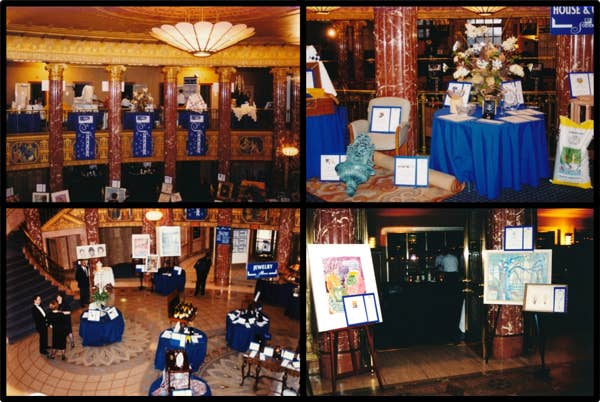
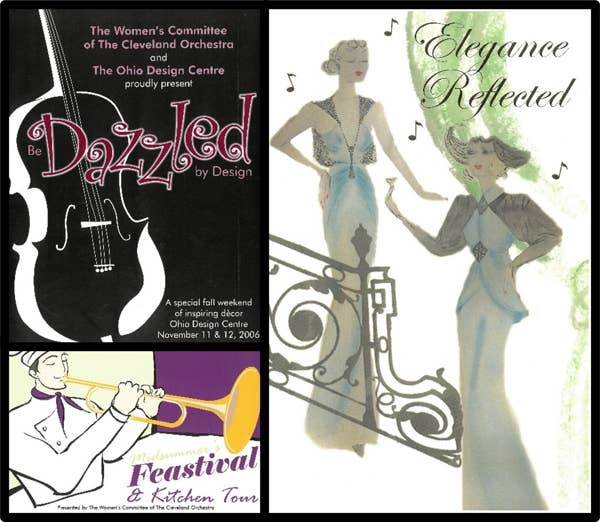
In later years, kitchen tours and design events replaced the surplus of balls and fashion shows, but the WCCO hosted one final ball in 2011 to celebrate their 90th anniversary in style.
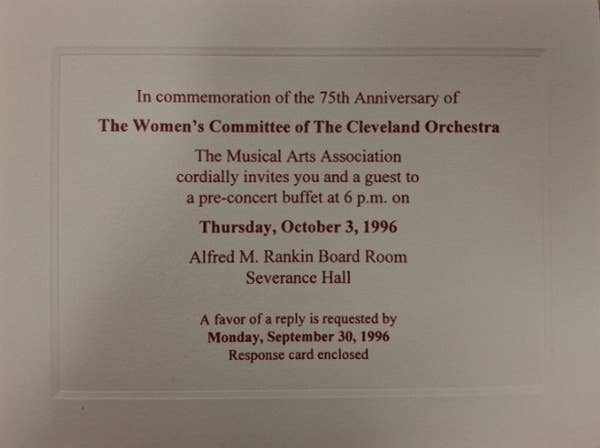
Though the breadth of the WCCO’s responsibilities had diminished, the 1990s and 2000s were an era of renewed recognition for its importance in the history of the Orchestra. In 1996, the Women’s Committee was on the receiving end of an elaborate banquet, as the MAA put on a dinner celebrating 75 years of invaluable service to the Orchestra. That same year, Dorothy Humel Hovorka, president of the Committee from 1969–71, received the first ever Cleveland Orchestra Distinguished Service Award.
Two decades later, in 2017, the Women’s Committee won a Roundtable Award by the League of American Orchestras National Conference in recognition of their continuing efforts with the Music Study Groups. Later that year, the name was officially changed to Friends of The Cleveland Orchestra to reflect the increasingly diverse membership (the organization having been officially opened in men in 2007).
And with that, we have come full circle to the group of devoted individuals who made my introduction to Cleveland so warm.
It is difficult to comprehend how much of the Orchestra’s history and legacy were made possible by the devoted and unpaid efforts of generations of WCCO/FCO members and volunteers. Through their tireless creative endeavors, The Cleveland Orchestra has remained a locally supported and treasured organization through over a century of highs and lows.
— Ellen Sauer Tanyeri was the 2024–25 season archives research fellow. The fellowship is an opportunity for graduate music students from Case Western Reserve University to work with The Cleveland Orchestra Archives.
Much of the history recounted here is thanks to the meticulous efforts of Clara Bickford, president of the Committee from 1939–41, and later historian of the Committee. In the latter role, she wrote detailed histories of the WCCO for its 40th, 50th, and 60th anniversaries.