Meet the New Class of Musicians
With school back in session across Northeast Ohio, it’s only appropriate that The Cleveland Orchestra has welcomed a new “class” of musicians into its ranks.
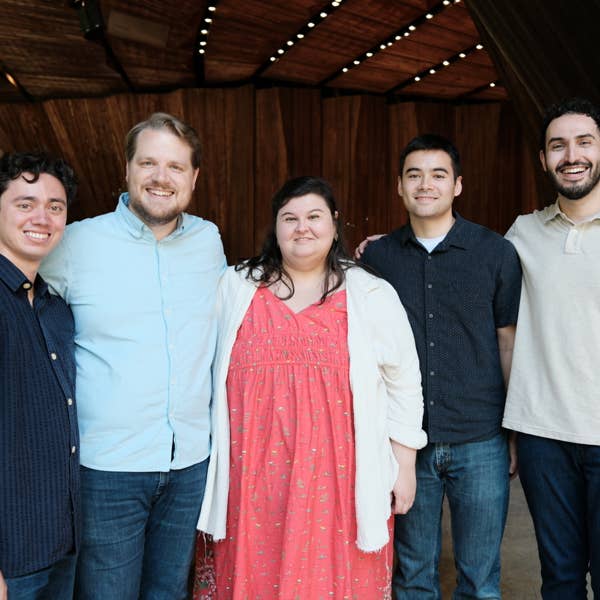
We sat down with the Orchestra’s five recent appointments — First Associate Concertmaster Elizabeth Fayette (Virginia M. Lindseth, PhD, Chair), Associate Concertmaster Philip Marten (Gretchen D. and Ward Smith Chair), second violinist Dustin Wilkes-Kim, and violists Sean Juhl and Gabriel Napoli — to get to know them and hear what they’re most excited for this season.
What was your first exposure to The Cleveland Orchestra?
Elizabeth Fayette: I come from a family of musicians, and my parents had a large library of classical music CDs. Their collection included several recordings by The Cleveland Orchestra, many of which became my first references for the standard orchestral repertoire. I particularly remember Stravinsky’s The Rite of Spring with Pierre Boulez conducting — that was incredibly impactful.
My first — and until this year, only — time hearing the Orchestra live was during a pair of concerts at Carnegie Hall in May 2012. The first night was a concert performance of Richard Strauss’s Salome; the second was a program of Brahms, Saariaho, and Shostakovich. I had student tickets in the “nosebleed” section of the hall, but the music making was so visceral and gripping that the distance did not matter one bit.
Philip Marten: During my late high school and early college years, George Szell’s recorded cycle of Beethoven symphonies with the Orchestra became my gold standard for these works. It wasn’t until very recently — as in August 2026! — that I got the opportunity to hear the modern Cleveland Orchestra perform live. I was so impressed with the cohesion and glow in the sound that sets it apart from other orchestras, including those old Szell recordings.
Dustin Wilkes-Kim: I think my first exposure to The Cleveland Orchestra was its recording of Szell conducting Brahms’s Double Concerto with soloists David Oistrakh and Mstislav Rostropovich (read more about this program here). My mother got that CD for me, along with many other recordings featuring Oistrakh. I distinctly remember not just the impression the soloists made on me but also the sound of the Orchestra.
Sean Juhl: My first exposure to The Cleveland Orchestra was from listening to a CD of viola excerpts played by the Orchestra’s former Principal Viola, Robert Vernon, who my mother studied with. Though I had heard stories about the Orchestra during my childhood, I had never listened to many of their recordings until I was in college. This CD came well before that, and I later listened to it repeatedly when I was preparing for my audition in Pittsburgh in 2018 and then here in Cleveland.
Gabriel Napoli: I’ve been listening to The Cleveland Orchestra for most of my life. Aside from concerts my parents brought me to as a child, I would also have them blast Beethoven symphony recordings on the surround-sound speakers in our living room. I consider myself lucky to have been inspired by this Orchestra from such a young age.
Why did you choose your particular instrument?
Elizabeth: As mentioned earlier, I come from a family of musicians — all string players. My mom is a Suzuki violin teacher who often taught in the house, and my older brother started playing around the time I was born. I’m sure my primary motivation in playing violin was a desire to be like my brother, rather than any understanding of what it meant to be a violinist. As I got older, the violin became so normalized in my life that it didn’t occur to me that stopping was an option. Over the years, there were a few “side quests” — including brief periods where I played oboe and trumpet — but ultimately, I stuck with the violin and have never regretted the decision.
Philip: I actually first fell in love with the viola. Its depth of sound immediately grabbed me when I first heard it at age 4, and I told my mom that I wanted to play viola when I grew up, without even really knowing what it was. However, the only string teacher within driving distance from my small town was a violinist, but she said I could always switch to viola later on. Now I happily get to play both, although violin has always been my primary instrument.
Dustin: I’m actually not sure why I chose the violin, but I think I stuck with it because of the great teachers I had when starting out. I distinctly remember the feeling of escape and curiosity that they instilled in me.
Sean: My mother was a professional violist for most of her career and at one point, she encouraged me to switch to viola from violin because, as she put it, “the world always needs more good violists.” Her stepmother back in China also played the viola (and still teaches at the Shanghai Conservatory of Music) and my cousin is a violist in the Shanghai Symphony Orchestra, so it seemed like joining the family tradition.
Gabriel: I studied violin for most of my life but dabbled in viola from time to time. Then, in college, I played string quartets in a pretty serious group and ended up falling in love with the viola. It was then that I decided to focus on it as much as I could.
What’s one thing about being a professional musician most people don’t realize?
Elizabeth: That the work never ends! The hours spent on stage — either rehearsing or performing — are only a fraction of the time it takes to prepare for a given concert or to keep fundamental artistic and technical skills in shape. Even though I have played violin for over 30 years, it takes intentional time on a regular (mostly daily) basis to be able to meaningfully contribute to a high-caliber institution like The Cleveland Orchestra.
While time away from the instrument can be healthy and restful, I try not to do this too often — not only will it take more effort to get back to peak performance, but it also could invite a greater risk of injury. But that is just the reality of musician life. Thank goodness the music we get to play is so good — for me, it is more than a fair tradeoff!
Philip: The cost of our instruments and accessories. Most professional-quality violins start at around $20,000 and easily go into the six-figure range. The bow alone can cost anywhere from four to six figures. Adding in the hundreds of dollars for cases, chin rests, shoulder rests, new strings, instrument maintenance, sheet music, and more, it is not an inexpensive career choice!
Dustin: Some people might not realize how flexible a live performance is and how different the music can sound and feel depending on the many decisions being made in real time by the performers on stage. Those outside of the industry might also not know much about the audition process. There’s a huge amount of preparation — and stress — that goes into an orchestra audition, but it’s ultimately the gateway toward winning a position in a professional group.
Sean: How much joy there is in the act of making great music together on stage! There are definitely moments where things can feel intense and serious, but I try to think about my preparation for concerts as just making room for the possibility of those “goosebump” moments where everything comes together.
Gabriel: I think people would be surprised at the amount of non-verbal communication that happens on stage as we perform. Even though audiences see music on our stands, to play at a high level requires an awareness of what is going on beyond the notes on the page. I’m always inspired by my colleagues and try to draw from the energy they bring to the stage.
What concert or piece are you most looking forward to this season?
Elizabeth: This upcoming season is full of exciting music, so it’s difficult to choose only one! I think the final month of the season, with the series of concerts celebrating the 25-year tenure of Music Director Franz Welser-Möst, will be quite special and emotional. I am also looking forward to performing Richard Strauss’s Ein Heldenleben. There is absolutely nothing like being in the middle of a great orchestra when it really gets going, and, in this piece, every section gets to show its full artistic and technical capabilities.
Philip: While it’s almost impossible to pick a single favorite from the upcoming season, the opportunity to perform Richard Strauss’s Die Frau ohne Schatten is an extraordinary one. I have always loved opera, but was somehow less familiar with Strauss’s operas until very recently. This particular work is a massive undertaking, one that only a few organizations around the world dare to attempt, so getting to be part of this production will be a very rare treat.
Dustin: I’m excited for Brahms’s Second Symphony at the start of the season. I’ve played this work before, but it will be great to perform it with this Orchestra for the first time. I’m also looking forward to having a friend of mine hear our performance of it before we leave on the Europe tour.
Sean: I’m definitely most looking forward to Mahler’s Ninth Symphony — my first with TCO or otherwise! — in late April.
Gabriel: This season is packed with incredible programs. I’m so excited for both our fall tour repertoire and to experience performing in many of the great concert halls of Europe. As far as the entire season goes, though, I would have to narrow it down to either Beethoven’s Missa solemnis — both here in Cleveland and at Carnegie Hall — or Mahler’s Ninth Symphony.