Cross-Cultural Collaborations: East Asian Composers and The Cleveland Orchestra
Several East Asian composers have forged significant cross-cultural connections with The Cleveland Orchestra. Here are their stories.
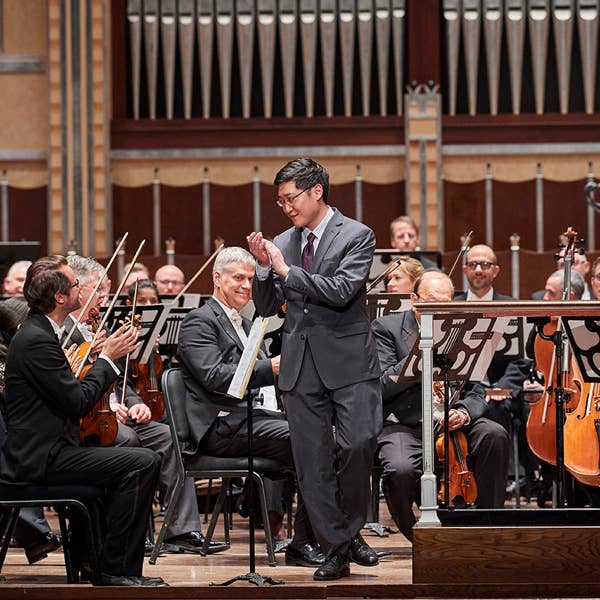
Throughout the latter half of the 20th-century, international diplomacy and rapid globalization encouraged the flow of creative ideas across geographic borders. Aspiring classical composers from Japan, China, and South Korea began adapting their native musical traditions to suit European symphonic practices. However, in more recent years, they have started to embrace compositional strategies that more truly reflect their multicultural identities. From the late 1960s onward, The Cleveland Orchestra has supported East Asian classical composers by programming their music and commissioning new works. This article highlights seven composers of East Asian heritage — Tōru Takemitsu, Bright Sheng, Chen Yi, Tan Dun, Toshio Hosokawa, Anthony Cheung, and Unsuk Chin — who have forged significant cross-cultural connections with the ensemble.
Tōru Takemitsu (1930–1996) November Steps (1967)
Japanese composer Tōru Takemitsu started listening to European classical music during the post-war occupation. Primarily self-taught, he joined the Jikken Kōbō, an interdisciplinary avant-garde community that took great interest in the experimental methods of American composer John Cage. Takemitsu’s innovative compositions soon attracted the attention of Igor Stravinsky and Aaron Copland (two composers with professional ties to The Cleveland Orchestra) who introduced the young composer’s music to an international audience.
As Takemitsu’s career developed, he began to write for the historic Japanese instruments he remembered from his youth. His music revealed an entirely new world of timbral possibilities that brought the unfamiliar sounds of Japan into the American concert hall. The premiere of one of these works, November Steps, took place in December 1967 with the New York Philharmonic under the baton of Seiji Ozawa. This performance showcased an unprecedented collaboration between a Western symphony orchestra and two traditional Japanese solo instruments: the biwa (a plucked string instrument similar to the lute) and the shakuhachi (a vertical bamboo flute).
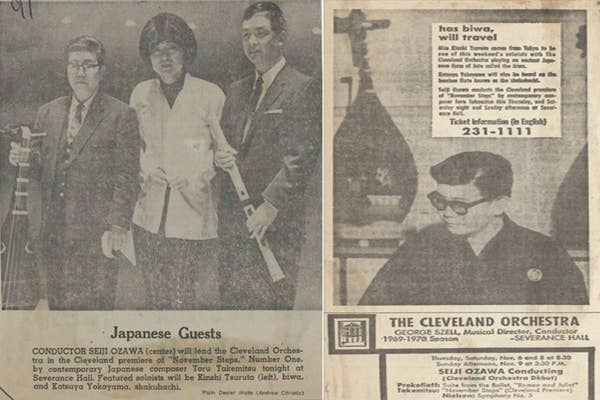
Two years later, Ozawa programmed November Steps for his guest conducting debut with The Cleveland Orchestra. The original soloists, Kinshi Tsuruta (biwa) and Katsuya Yokoyama (shakuhachi), also came to Severance for these November 1969 performances.
At age thirty-four, Ozawa was gaining notoriety as a “whiz-kid” conductor, however, his charismatic stage presence complemented his immense dedication to artistic integrity. Local music critic Alice Flaksman noted that upon receiving the November Steps score, Ozawa realized that “the music written therein … was totally incomprehensible to him who had been trained in the Western tradition. He thereupon took himself back to Japan, studied the instruments in their native setting, understood what the composer had in mind and how he was to interpret the score.”
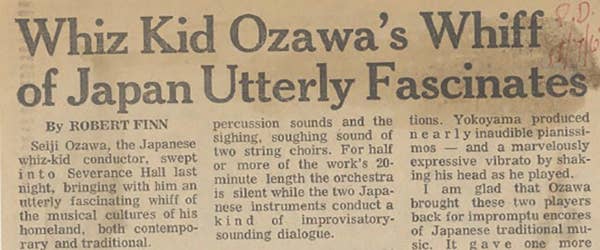
Ozawa’s efforts paid off, because the novel soundscape of November Steps was greeted with generally favorable reviews by the Cleveland press. The Sun Press praised the unfamiliar yet “far-out” sounds of the biwa and shakuhachi, while Robert Finn of The Plain Dealer observed that Ozawa brought “an utterly fascinating whiff of the musical cultures of his homeland, both contemporary and traditional.” Indeed, this program presented a special opportunity for Cleveland audiences to experience the musical atmosphere of Takemitsu’s native Japan. According to the Archive’s records, these concerts marked the first and only time that a biwa and shakuhachi have ever been heard with the Orchestra.
Bright Sheng (b. 1955) H’un: In Memoriam for Orchestra (1988)
Originally commissioned and premiered by the New York Chamber Symphony, H’un: In Memoriam for Orchestra (1988) conveys Chinese American composer Bright Sheng’s personal response to sociopolitical tragedy. H’un, as translated from the original Chinese, means “deep scars” or “wounds,” and references the enduring trauma left in the wake of the Cultural Revolution (1966–76).
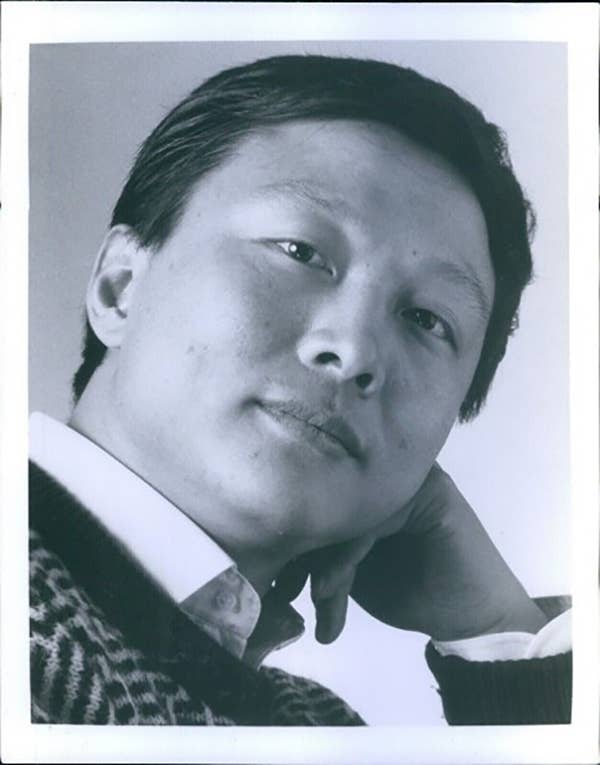
Sheng was raised in this unstable environment, and his early exposure to Chinese folk traditions was a consequence of his family’s exile from urban centers. Upon the nation’s renewed diplomacy with the West, Sheng became part of the first wave of native Chinese composers to attend graduate music programs in the United States.
Even though H’un communicates a collective Chinese experience, its dissonant and emotive orchestration transcends cultural boundaries to evoke sympathy from international audiences Several non-Western percussion instruments, such as a Chinese bass drum, Japanese woodblock, and traditional opera gong, help recreate a turbulent journey from restless cacophony to melancholy stillness.
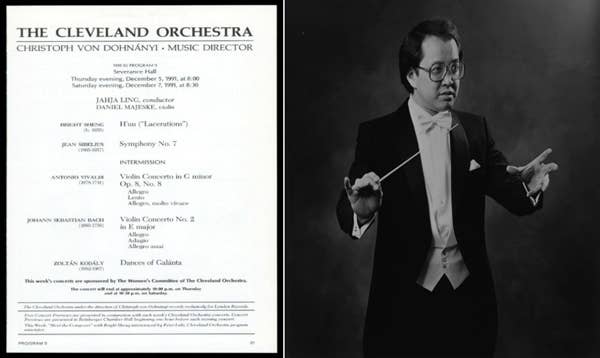
Former Resident Conductor Jahja Ling led The Cleveland Orchestra in their sole performance of H’un 15 years after the end of the Cultural Revolution. On the December 1991 program, Sheng’s somber contemporary work stood out amidst a roster of European symphonic classics, especially since the Orchestra had never performed a work by a Chinese composer until this point. Ling’s own Asian heritage made this program a meaningful gesture of kinship between musical worlds. Born to Chinese parents and raised in Indonesia, Ling was appointed Resident Conductor of The Cleveland Orchestra in 1985. He worked tirelessly to build a classical music community within Northeast Ohio, conducting in public venues ranging from North Coast Harbor to Blossom Music Center. When presented with an opportunity to amplify the experiences of a fellow Chinese musician, Ling programmed Sheng’s composition at Severance. The Orchestra has since programmed the works of other Chinese and Chinese American composers, thus ensuring these musicians have a voice in the modern concert hall.
Chen Yi (b. 1953) Si Ji (2005)
As The Cleveland Orchestra entered the 21st century, the ensemble crossed paths with Chen Yi, one of the most prolific composers of her generation. Like Sheng, Chen Yi also grew up listening to Western classical music before having her education severely impacted by the Cultural Revolution. For a time, she worked as a violinist in a provincial opera troupe where she gained experience playing Chinese folk music. The idiomatic patterns and rhythms of regional folk melodies consequently became core elements of her compositional style.
Since the late 1990s, Chen Yi has expressed her Chinese American identity through music:
Because I believe that language can be translated into music, and because I speak naturally in my mother tongue, there are Chinese blood, Chinese philosophy, and Chinese customs in my music. However, because music is a universal language, I hope to capture the essence of both Eastern and Western cultures, and to write more compositions that embody my own temperament as well as the spirit of this brave new epoch.
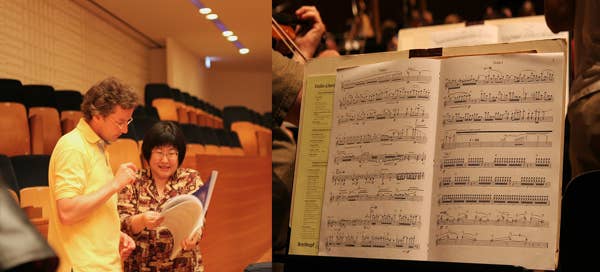
In 2004, Chen Yi was selected as the second recipient of the Roche Commissions program, an international music enterprise sponsored by the Swiss pharmaceutical company Roche and partnered with The Cleveland Orchestra. Her composition Si Ji (Four Seasons) translated the emotional intensity of four Song Dynasty-era poems — West Lake, Landscape, Mount Lu, and Thunderstorm — through rich instrumental textures and bold dynamics. Music Director Franz Welser-Möst described Chen Yi’s artistic approach as “a primordial force which I find fascinating…A wealth of ideas is unleashed in her music, going far beyond the blend of Eastern pentatonic tonalities with Western idioms and structure.”
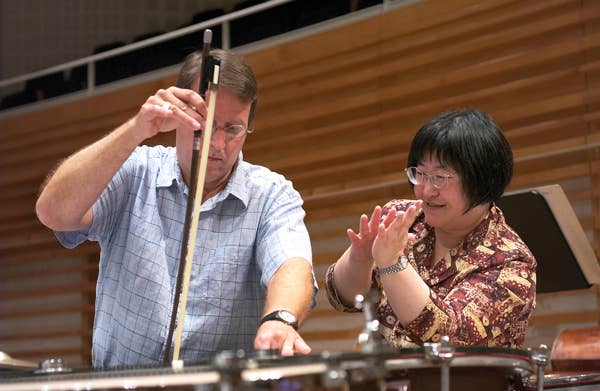
Welser-Möst and the Orchestra musicians worked alongside Chen Yi throughout their 2005 Lucerne Festival residency. This collaborative endeavor resulted in a well-received world premiere followed by culminating season performances at Severance and Carnegie Hall.
Tan Dun (b. 1957) Water Concerto (1998)
Chinese American composer Tan Dun often describes his creative philosophy with the unusual equation “1+1=1,” because he considers his music to be a harmonious synthesis of cross-cultural influences. A child of the Cultural Revolution, Tan Dun encountered regional opera and ceremonial theater before continuing his education at Columbia University. His numerous compositions for orchestra, opera, and film reflect this multicultural background by infusing Chinese instruments and performance techniques into Western concert music.
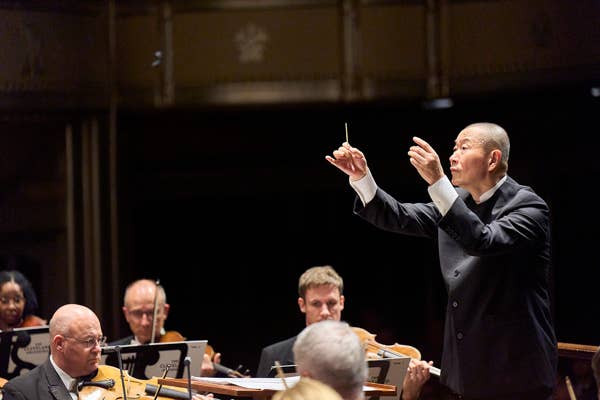
The Cleveland Orchestra welcomed Tan Dun to Severance early in the 2024–25 season. His inaugural guest conducting appearance coincided with the ensemble’s first performances of his Water Concerto (1998) and Concerto for Orchestra (from Marco Polo) (2012). Principal Percussionist Marc Damoulakis was the featured soloist on Water Concerto which employed a staggering assortment of hemispherical water basins, water drums, water gongs, water tubes, agogo bells, waterphones, mallet percussion, water shakers, slapsticks, and a sieve. Although playing with such equipment is highly unusual for Western orchestras, using organic materials is a hallmark of Tan Dun’s compositional style.
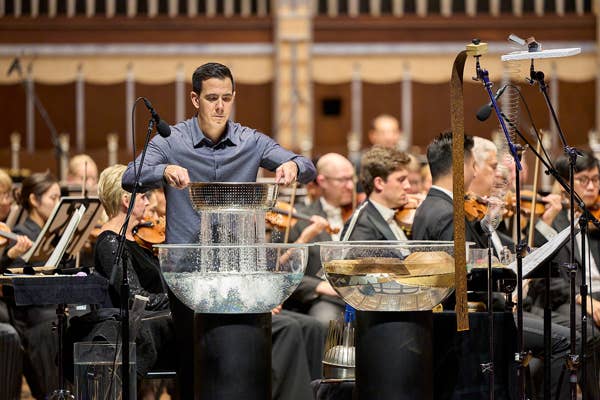
The Orchestra’s performances of Water Concerto also marked a full circle moment for both Tan Dun and Damoulakis. The composer imbued this composition with childhood memories of life in China’s Yunnan Province. His program note reminisces:
In my hometown, in ancient times and even in my childhood in the village, the people were always washing rice in the river before they cooked it, washing their clothes in the river, washing their bodies in the river. I had the experience of living with the water, playing with the water, listening to the water. It was very important to me.
For Damoulakis, playing this piece meant following in the footsteps of his teacher Christopher Lamb, who premiered the work with the New York Philharmonic in 1999. He recalled: “I heard him [Lamb] play it in Boston in 2001 while I was in the New World Symphony and was absolutely taken by it. As percussion concertos go, it’s a fascinating one and I thought it would be great to give it a shot someday.”
Toshio Hosokawa (b. 1955) Woven Dreams (2010)
During the summer of 2010, The Cleveland Orchestra premiered a composition by the fifth Roche Commission recipient, Toshio Hosokawa. Titled Woven Dreams, this symphonic work took inspiration from historic Japanese sonorities and avant-garde European orchestration. Recalling his formal education in Berlin, the composer explains how consistent exposure to contemporary concert music sparked an interest in unconventional sounds: “… so with these ears I listened once again to our ancient music. And then for the first time I understood how beautiful it is.”
According to Hosokawa, his artistic vision for The Cleveland Orchestra commission was fueled by two formative experiences:
Woven Dreams begins with a long tone of B flat. When I composed the work, I started to listen to this single tone deeply…I wanted to realize the sound heard in the womb through the means of the orchestra…In this work there are many influences from the musical language of gagaku, the ancient Japanese court music that is the womb of my music.
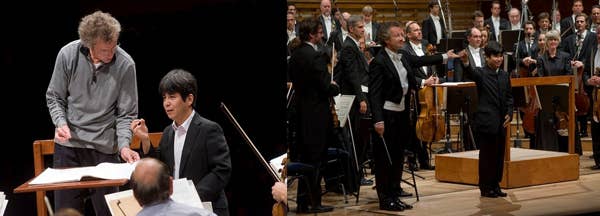
At the 2010 Lucerne Festival, the Orchestra and Welser-Möst brought the international influences behind Woven Dreams to life. The world premiere united Japanese gagaku, European orchestration, and an American ensemble into a harmonious expression of cross-cultural collaboration.
Anthony Cheung (b. 1982) Topos for Orchestra (2017)
Born in San Francisco, Anthony Cheung was the ninth composer selected for the Daniel R. Lewis Young Composer Fellow program. He served as The Cleveland Orchestra’s composer-in-residence for two seasons (2015–17), a position that enabled him to both program an existing work and write a new piece specifically for the ensemble. In May 2017, concert attendees were treated to the world premiere of Cheung’s Topos, directed by Franz Welser-Möst.
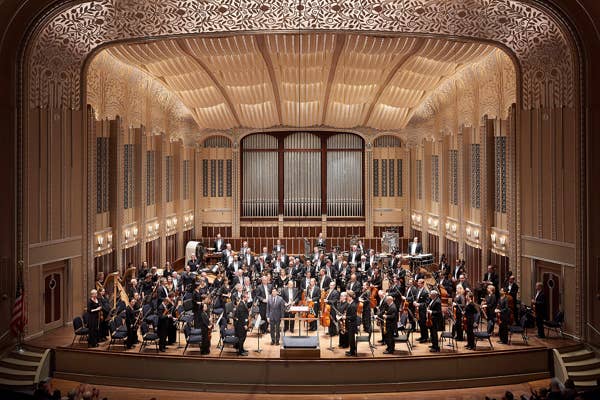
Composed for a full symphony orchestra equipped with a massive percussion section, Topos was Cheung’s largest-scale work at the time. Its four movements reference a series of recurring representational tropes or “topics” that use special musical characteristics to articulate specific ideas or moods throughout the Western classical repertoire. An avid admirer of signs and symbols, Cheung was inspired by these time-honored musical vocabularies and reinterpreted them using his own orchestration methods.
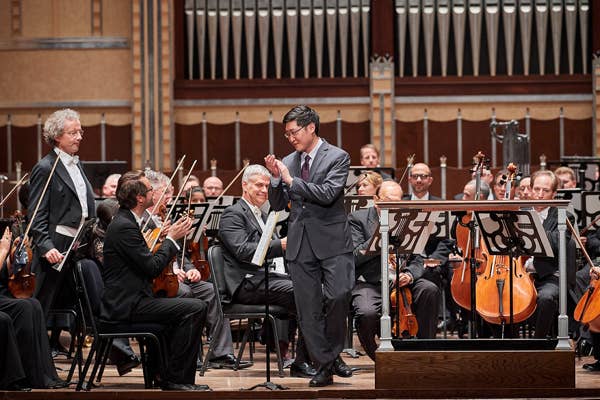
When composing for the Orchestra, Cheung intentionally picked a point of inspiration that aligned with his personal interests rather than channeling his East Asian roots. Speaking of Topos, Cheung explained: “The reason why these musical topics are relatable is because they are part of our collective historical consciousness as listeners, while also speaking to shared human conditions.” He continued, “… the fact that it’s harder to point to unified schools of thought based on nationality or region in today’s world is definitely a healthy thing.” Thus, as a multicultural musician working in a truly globalized industry, Cheung seeks to broaden the array of influences available to the modern composer.
Unsuk Chin (b. 1961) Cello Concerto (2008, rev. 2013)
A composer of outstanding intellectual breadth, Unsuk Chin has achieved critical acclaim for her innovations with instrumental timbre and performance technique. Since studying with György Ligeti in the late 1980s, Chin has established herself as part of a modern generation of South Korean–born composers writing music for an international arena.
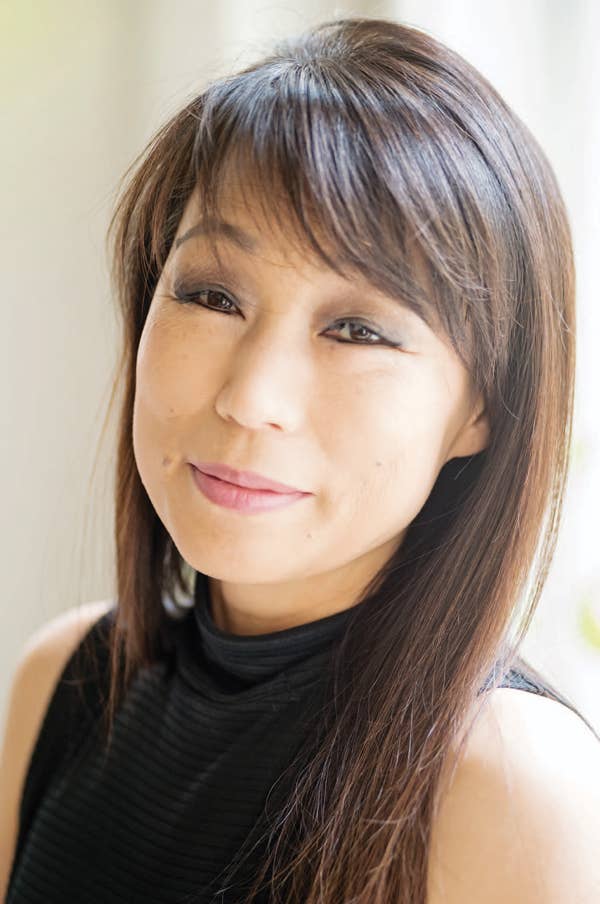
Chin’s cosmopolitan approach demonstrates her reluctance to be defined as a composer of primarily East Asian sounding music. She has stated, “I understand myself not as a Korean composer, but as a composer who is a part of international music culture and intensely imprinted with European tradition.” Consequently, her works for Western instruments and voices rely very little on traditional Korean practices, and she largely avoids “mixing things together which have completely different heritage lines.”
The Cleveland Orchestra first programmed Chin’s music during its 2021–22 season, so her works are still relatively new to Severance Hall. Nonetheless, her virtuosic style is well-suited for the talents of this world-class ensemble. The Orchestra’s February 2026 performances of Chin’s Cello Concerto (2008, rev. 2013) with soloist Alisa Weilerstein offered a rare glimpse into the sonic ambience of the composer’s native Korea. Although Chin’s compositions typically favor pure acoustics over cultural references, the concerto’s opening movement bears the subtitle “Aniri,” which is an element of the Korean theatrical storytelling genre known as pansori. As the movement progresses, it becomes clear that the unexpected lyricism of Chin’s solo cello writing is rooted within this ancient vocal soundscape.
Over the past six decades, East Asian composers have become a mainstay of classical concert culture. The Cleveland Orchestra has played an essential role in introducing their music to contemporary audiences, and it hopes to continue expanding musical horizons for generations to come.
— Ina McCormack is the 2025–26 season archives research fellow. The fellowship is an opportunity for graduate music students from Case Western Reserve University to work with The Cleveland Orchestra Archives.